
- Entertainment
- Style
- Lifestyle
- Food & Drinks
- Tech & Auto
- Culture
IN THE 18TH CENTURY, MAHARAJA SAWAI JAI SINGH II set out to make the newly built city of Jaipur a capital of culture as much as a seat of power. He invited artists and artisans from the former capital of Amber and beyond, establishing a system of 36 karkhanas, or departments, to support a range of creative pursuits, from poetry and dance to textiles, stonework and jewellery. In princely India, patronage wasn’t simply an act of preservation; it was also a means of one-upmanship, with rulers competing to draw the finest talent to their courts.
Almost three centuries later, his descendant, Sawai Padmanabh Singh, is reinterpreting that tradition through the Jaigarh Heritage Festival, which brings together heritage, craft and performance each December. “We’ve innovated to bring the experience of all of Rajasthan under one roof, at one place,” says Sawai. “But all of our experiences are rooted in heritage and authenticity. For instance, we’ve tried to bring together all of the 36 original ateliers of Jaipur into the festival and weave them into our narrative.”
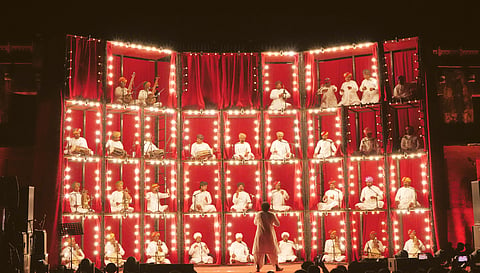
Jaigarh’s pièce de résistance was the resplendent Manganiyar Seduction—a sight to behold—hosted by playwright and director, Roysten Abel. The ambition is to make Rajasthan’s cultural inheritance relevant to a new generation. In bringing this heritage to life, it also allows Sawai, a titular figure in modern India, to build a legacy of his own.
For Sawai, the legacy lies in bringing inherited culture into the present. Abhimanyu Alsisar is taking a different approach, recreating the palace of his childhood and building a cultural platform around it. A scion of the Alsisar family, whose genealogy traces back to Thakur Kishen Singh, born into the Shekhawat Rajput lineage in 1709, has spent over a decade building Abheygarh Khetri, modelled on the palace home where he grew up.
“My grandfather donated our previous palace in the area to the Ramakrishna Mission in 1959 and then procured state and central government aid to restore it. Today, in Khetri, our old palace is fully restored as the Ajit Vivek Museum,” Abhimanyu says. The modern-day palace, which also houses a hotel, has been built on-site using stone and marble. Its layout echoes that of the original fort-palace, from the approach and main courtyard to the intricate levels visitors climb through as they explore the property.
The ambition is to make Rajasthan’s cultural inheritance relevant to a new generation, allowing Sawai to build a legacy of his own.
Royal patronage once meant attracting talent to court and sustaining the creative industries around it. Today, the impulse to nurture culture remains, but custodians must find new audiences and partners to help sustain their initiatives. Their legacy has to mean something beyond the history they inherit.
While Sawai is bringing inherited culture into the present, Abhimanyu Alsisar is taking a different approach. A scion of the Alsisar family, whose lineage traces back to Thakur Kishen Singh of the Shekhawat Rajput clan, born in 1709, Alsisar has spent over a decade building Abheygarh Khetri, modelled on the palace home where he grew up. The modern-day palace, which also houses a hotel, has been built on-site using stone and marble and its layout echoes that of the original fort-palace.

“Khetri is very close to my family and its history. It is here that my great-great-great grandfather [Maharaja Ajit Singh of Khetri] met Swami Vivekananda and gave him his title. I’m known as the Kashi of Shekhawati, as we have over 150 temples here. All of it contributes to the rich history of the place, and my family’s role has been integral to it,” he says.
Alsisar launched Magnetic Fields, a cultural and music festival held at Alsisar Mahal; a decade after its launch, he has rebranded it as Nomads and brought it to Abheygarh in 2026. The move reflects a desire to create a more intimate, music-led experience as Magnetic Fields outgrew its original venue and the festival landscape grew more crowded.
A month earlier, he had hosted the second edition of Durbar, a luxury cultural retreat focused on wildlife conservation, craft and music. The retreat featured a light-and-sound show exploring the region’s heritage, talks and art showcases by conservationists, and a musical ensemble that brought together veteran percussionist Trilok Gurtu and fusion folk troupe Nimaad.
At the core of our discussions has always been authenticity—a quality today’s audiences actively seek,” he says. While a conventional music festival offers a standard setup of stages, bars and food courts, his approach is deliberately intimate. “By tailoring the event for a smaller audience, we safeguard our core values and weave authenticity directly into the attendee experience, right down to the narrative behind the food and the music,” he adds.
At The City Palace, Sawai has partnered with restaurateur and hotelier Abhishek Honawar to launch The Sarvato, a modern-day fine dining experience, earlier this year; he’s also founded the Jaipur Centre for Art with contemporary arts specialist Noelle Kadar. “More than anything, my intention was really to start and spark conversations around culture and heritage, because right now, very few young people are interested in culture,” Sawai adds.
Royal patronage has evolved with the times, and to bring a cultural festival to life today involves a partnership between the royal custodian, an experienced event organiser and a network of commercial sponsors. For Durbar, Alsisar has a partnership with Warren de Sylva, cofounder of event management firm SponCo, while Sawai has teamed up with Sanjoy Roy’s Teamwork Arts.
Roy, who has been the driving force behind the Jaipur Literature Festival’s success, says part of the task is to make these spaces inviting for younger audiences. “When we came in, one section of the fort-palace where we host the Jaigarh Heritage Festival was unused and unattended. Our team saw an opportunity to turn it into a wonderful open-air lounge, where delegates could savour the natural beauty of the place and enjoy a sundowner, with a bar and music in the background,” he says, adding that plans are afoot to create an open-air sleep-out under the stars.
Brand partnerships are another part of this equation. Durbar, for instance, onboarded the spirits brand Godawan, while Jaigarh had Vedanta as their title sponsor. The partnership works both ways— while festivals gain access to commercial support and expertise, brands get to associate themselves with the heritage and a one-ofa-kind setting.
Warren de Sylva explains the thinking behind Durbar. “The idea was to go regional and explore the folk music traditions of India, but present them in a way that it is fit for a world stage, rather than in their typical setting where a folk artist is really relegated to a background music piece. The brand really bought into that vision,” he says. The second part of the puzzle was bringing in a person who aligns with and lives this ethos. “I thought, who better than Abhimanyu for Durbar.”
For these royal custodians, keeping traditions alive also means sustaining the communities behind them.
In Odisha, Mrinalika Bhanj Deo of the Bhanja family of Mayurbhanj hosted a three-day festival celebrating Chhau at Belgadia Palace, her family’s restored, 18th-century-old Victorian palace. The Great Eastern Epics Festival seeks to raise awareness of the dance form and bring Odisha’s cultural heritage to new audiences.
The festival dates back to a tradition established nearly 140 years ago, when Maharaja Krushna Chandra Bhanja Deo introduced Chhau at the popular Chaitra Parva festival hosted within the palace grounds. Bhanj-Deo revived the tradition in 2025, in partnership with RARE India and Aadi Naad, showcasing all three regional styles of Chhau.
For Bhanj Deo, conservation goes far beyond “static inheritance.” “Heritage resides not just in textiles or objects, but in ways of thinking, making and belonging. Growing up in Mayurbhanj, these traditions were not curated experiences—they were part of daily life,” she says. “When we began restoring Belgadia Palace, for instance, it wasn’t about recreating a museum version of the past, but about allowing the space to continue its original purpose: as a place of gathering, dialogue and cultural exchange,” she says. Her work with artisan villages and cultural walks, she adds, reinforces the idea that progress can be rooted in mindful creation, community and continuity.
For Gauravi Kumari, the titular princess of Jaipur, conservation also means ensuring that traditional skills find new practitioners and audiences: “I don’t see nostalgia as something to resist—it’s something to channel. The goal is to reinterpret, not replicate. By bringing traditional forms and techniques into conversation with contemporary perspectives, we ensure that our heritage remains relevant. This way, younger and global audiences can engage with it as something alive and forward-looking, not just something to admire from afar.”
Her work at the Princess Diya Kumari Foundation reflects this belief. “One of our largest initiatives trains women from low-income backgrounds in heritage crafts, giving them the skills to create sustainable livelihoods. We don’t want to just keep these crafts alive but empower the artisans themselves to take ownership of their futures,” she explains.