- Entertainment
- Style
- Lifestyle
- Food & Drinks
- Tech & Auto
- Culture

Here’s a fun fact for you.
In August 1945, just after Japan’s surrender in World War II, two junior U.S. Army officers—Dean Rusk and Charles Bonesteel—were tasked with drawing a line to divide Korea into Soviet and American zones of occupation. Working hastily with a National Geographic map and little knowledge of the region, they chose the 38th parallel almost at random, using a pencil.
And so, North Korea and South Korea were born into existence. Even though this was supposed to be a temporary solution, the pencil line stuck. What began as a rushed military decision ended up shaping one of the most enduring divisions of the modern world.
I bet you wouldn’t know that just by looking at a map, right?
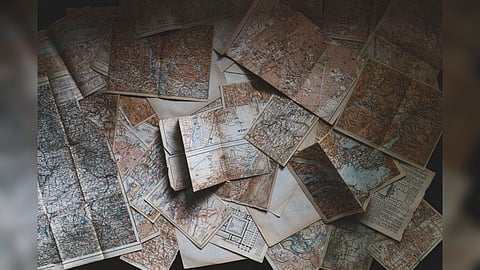
Maps are gossip. They sit there in the neat little boxes, colour-coded and scaled to perfection, giving us the illusion that they’re just facts on paper. But spend enough time with them, and you’ll realise that they’re nothing else but little fictions dressed up in latitude and legend.
Every border is a story someone got to tell. Every blank space, a decision. They’ve been used to start wars, sell colonies, redraw histories, and occasionally—just occasionally—help you find a decent café in a new city.
So it makes sense that the best books about maps aren’t just about paper and place. They’re about power. About who gets to draw the lines, and who gets erased. They’re about pandemics, pipelines, and the poetry of remote islands.
So, if you’re cartographically curious, here’s a reading list.
From geopolitical thrillers disguised as nonfiction to atlases of islands you’ll never set foot on, these are nine books for people who love maps.
You don’t have to be a policy wonk to be riveted by Marshall’s thesis: the borders we inherit from rivers, mountains, and coastlines have more to do with war and peace than any ideology ever could. From Russia’s obsession with warm-water ports to the fractal chaos of the Middle East, Prisoners of Geography is an accessible, region-by-region unpacking of how natural features shape global politics. It’s part history, part journalism, part TED Talk. The tone is urgent, the scope global, and the takeaway unavoidable: you can’t drone-strike your way out of bad topography.
This one’s pure carto-joy. Wright offers up 100 maps that are part infographic, part existential musing. Want to know which countries don’t have rivers? Where McDonald’s still hasn’t penetrated? Which nations have had female leaders? Brilliant Maps is basically a visual encyclopedia of the weird, wonderful, and occasionally worrisome realities of modern geography. Flip through it on a Sunday and you’ll find yourself questioning everything from the way power is distributed to why we still drive on the left side in India.
Elborough’s book reads like a love letter to lost worlds. Cities swallowed by desert, towns submerged by dams, entire coastlines redrawn by time and tide. It’s beautifully written and melancholic in the best way—a reminder that places, like people, are temporary. Accompanied by arresting photographs and archival maps, Atlas of Vanishing Places doesn’t just show you what was. It forces you to reckon with what’s slipping away right now.
Before John Snow was a Game of Thrones heartthrob, he was a British physician who figured out—using a hand-drawn map—that cholera was being spread by a single water pump in Soho. The Ghost Map is a gripping piece of science history that unfolds like a detective novel, complete with unlikely heroes, bureaucratic villains, and a killer you can’t see. Johnson’s storytelling is brisk and brainy, and the map at the heart of the story? A literal life-saver.
Brotton’s magisterial book isn’t just about maps—it’s about the ideologies baked into them. From the Hereford Mappa Mundi to Google Earth, he shows how cartographers have never just been measuring coastlines—they’ve been drawing worldviews. Faith, empire, science, nationhood: each map in this book is a portal into a different way of seeing. Come for the historical deep cuts, stay for the crisp prose and killer insight into how much of our current reality is shaped by old illusions.
Originally published in 1991 and updated for the age of Google Maps, this book is equal parts entertaining and disturbing. Monmonier reveals just how manipulable maps really are—and how much of what we think we know about space and place is, well, totally subjective. From redistricting to misleading weather charts, How to Lie With Maps is a reminder that every “objective” map is just someone’s version of the truth.
This one’s for the nerds, and Isay that lovingly. Rowińska takes you on a brainy tour through the math behind maps—why coastlines are fractal, how logistics networks operate, and what it takes to optimise a UPS delivery route. But what makes Mapmatics sing is her elegant, often witty prose and her ability to connect the dots between abstract equations and real-world consequences.
Schalansky’s cult-favourite book is equal parts art object and literary mood-board. Each of the 50 islands in this atlas is lovingly mapped and accompanied by a short, often haunting piece of writing. Some read like historical vignettes; others verge on fiction. What unites them is the sense of solitude, distance, and the strange poetry of isolation. A book to be savoured slowly, preferably alone, ideally on a rainy afternoon.
This one flips the idea of maps on its head. Instead of land and sea, Atlas of the Invisible charts the things we can’t usually see: economic inequality, global internet infrastructure, climate change footprints. The result is a data-driven atlas that feels anything but cold. Cheshire and Uberti’s graphics are lush and surprisingly moving, and their prose is just nerdy enough to be delightful. If Edward Tufte and David Attenborough had a lovechild, it would look something like this.