
- Entertainment
- Style
- Lifestyle
- Food & Drinks
- Tech & Auto
- Culture

It was our own fin-de-siecle. AR Rahman had arrived. Newspapers were flush with terms like “bold scenes” and “metrosexual”. Even fashion seemed to lose its patience for subtlety—sheen, skin and silhouette colluding to announce rather than suggest. Celebrities were still at the mercy of gossip and scandal. MTV and remixes were all set to rock our world. A whole cultural permission for excess and texture.
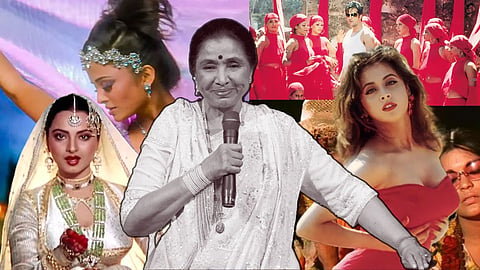
And suddenly, there was this hunger for something that felt like mended dreams and rebellion. And what if I said that all of it came in the form of a sonic shift? Even though I was a little boy, the widespread hankering for something edgier, something more textured and something less pristine, pierced through my little boy consciousness. Somewhere, Urmila Matondkar in a swimsuit, strutting to Tanha Tanha, still conveyed to my mind that this was something new.
We were witnessing the heady bloom of a true rockstar—Bollywood’s first true baddie, if you will. She was us millennials’ first link to the golden age of film music that we grow evermore nostalgic with each passing day now. For our generation, before there was the melancholically wise ode to the Present in Aage Bhi Jane Na Tu, there was the lush, glamorous romance, a sparkly thing of the Past, of Raat Shabnami. Bhosle, ever the performer giving the actors her voice was played on a run for their money, epitomised an experienced older lover confident in her passion for us, the fortunate loved subject she was serenading with a rich orchestra in the backdrop. We felt desired, we felt involved.
The unapologetic forwardness of an Asha Bhosle song, with the grainy vocals she made entirely her own, made it nearly impossible to imagine in another’s voice. She had whispered desire into the imagination with Piya Tu Ab Toh Aaja—but in her voice, its seduction gained control and rose to a dictating-terms level. Of course, she injected Aao Huzoor Tumko with a sensory intoxication but in her style, its singing received a consciousness of performance. In Yeh Mera Dil Yaar Ka Diwana, she played with a winking, vaudeville sensibility. Who knew intimacy could ache until they heard In Aankhon Ki Masti and its singer’s characteristic lingering over each word of the lyrics? To this day, the part in Sharara listeners most wait for is “shola… hai yeh tann mera, arrey dekho tum paas na aana” (my body is burning embers—watch out, do not come closer), where Bhosle’s voice performs provocation with an ironic coyness.
In short, Bhosle brought playback to the foreground with her choice of the way she sang a song. To the millennial mind, which would eventually be so accosted with deliberateness and emotions like guilt and shame, which come rushing only because they were taught to participate in them with a vengeance, being sung to felt like visibility. With her, our music involved us, our music reciprocated us. A 67-year-old telling us
Kambakht ishq hai jo, saara jahaan hai woh (this damned love)
Kab aata hai, Kab jaata hai (can’t say when it arrives and then leaves)
Par rehta hai jab tak yeh kambakht, jannat dikhaata hai (but while it exists, it raises you to heaven)
felt liberating in a way that even indie pop and Alisha Chinai hadn’t. Loud and layered in a way many Bollywood songs from the era weren’t, Kambakht Ishq’s inherent aggression gave a sound to our own angst. The explosive vocalisation of “kambakht ishq” flowed into a mellow build-up and settled into the knowing detachment of “jannat dikhaata hai”, complemented superbly by her famous soulful low notes.
In 1999, longing received a been-there, done-that passion in Kahin Aag Lage Lag Jaaye, the intense, high-energy dance number in Taal. In the song, which talks about disillusionment with love after heartbreak, Bhosle brought the authority of someone who had actually lived it, using rude awakenings to carve a new definition of a triumphant sort of female torment. Because it had to come from a singer who once vocalised vulnerable love with a sunshine youthfulness, in songs such as Puchho Na Yaar Kya Hua, Yeh Vaada Raha and Dillagi Ne Di Hawa.
Some research can tell you that Bhosle’s voice would sit in a zone called the mezzo-soprano. It was a distinction that made her especially suited to voice complicated, worldly or even villainous emotions. How else would Dum Maaro Dum gain its anthemic hum? How else would the Arabic refrains of Khatouba—which, as entertainment outlets will confirm, was improvised at the last minute—become unmistakable for decades to come? Oh, how would Mujhe Naulakha Manga De Re rise above simple female want, to become arch and unproblematically transactional?
We millennials were the first outsiders to become acquainted with the offbeat zaniness of these songs that the generation prior to us grew up loving. And it was all thanks to Asha Bhosle, the undisputed enchantress of Bollywood film music for our porous, bleeding generation. Today, when the world is without her lilting, comforting voice reminding some that love is worthwhile despite the heartbreak, and others, that no other calamity is quite as painful as heartbreak—we can proudly know that we were the first to truly vibe with her. She was born earlier, but she grew up with us.