
- Entertainment
- Style
- Lifestyle
- Food & Drinks
- Tech & Auto
- Culture
TWO YEARS AGO IN CHENNAI, I WAS WORKING AS the sound engineer for Zakir [Hussain] bhai’s performance. After sound check, he surprised me backstage with an impromptu cake of carrot halwa and biscuits, and sang “Happy Birthday” to me.
This took me back decades, to my eighth birthday in 1999. My parents, both in the film industry—my father a guitarist and my mother a veena player—raised me in a world of rhythm and sound. They had planned a birthday party for me, but I had other ideas. I had started learning the tabla at six, and when I heard about Zakir bhai’s concert at IIT Madras, I was adamant about not missing it, even if it meant skipping my own party.

My parents, God bless them, reached out to one of the musicians performing with him, explaining the quandary I had put them in by refusing to attend my own birthday party. Somehow, they managed to move the celebration to the concert venue, where Zakir bhai allowed us wide-eyed kids to run around the auditorium. It was perfect. I got my birthday party and I got to hear Zakir Hussain live. It’s a memory that has stayed with me ever since.
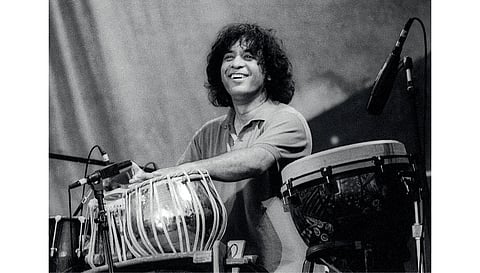
It is difficult to describe what Zakir bhai was to Indian music. At once classical, contemporary, exploratory and collaborative, he was the glue that held it all together, taking India’s musical presence onto the global stage. Everything he did was intentional; his vision, shaped by close engagement with generations of tradition, extended far into the future.
He internalised not just ideas from music across the world, but an entire global culture, absorbing it into his being and translating it through the tabla. The magic he created on stage is the stuff of legend.
By the time I was twelve, I was always hanging around at the Music Academy in Chennai, often skipping school to lend a hand to the sound technicians. There was one Zakir Hussain cassette, “Energy”, that I would listen to on loop. Over time, Zakir bhai got to know me, and when I asked him where I could take my tabla training forward, he suggested I come to the Dadar [Mumbai] classes of Abbaji [Ustad Allah Rakha], which were then being run by his brother. I enrolled, and that is where I met my guru, Yogesh Samsi-ji. But I eventually became a sound engineer because Mujib, Zakir bhai’s sound engineer for forty years, began mentoring me in sound and that’s how my professional association with the maestro began.
Recording and doing the pre-mix for the Shakti album “This Moment”—which won a Grammy in 2024—was a life-changing
experience for me, not least because of the precious time I got to spend with the members of Shakti. No Grammy compares to watching the magic of these masters coming together. Zakir bhai was, of course, extremely happy and pleased, even though this isn’t his first Grammy—and hopefully not his last. He has contributed to music that hasn’t yet been released, so who knows?
Every meeting with Ustadji brought me so much joy—even those that were virtual. I recall a recording for a Zoom concert
during the pandemic: Zakir bhai was in California and I was in Chennai. The large files were taking time to upload, and during the wait, he began playing, exploring an idea. I didn’t interrupt even after the files were done, and when he finished, he said to me, “Have you memorised the qaida [composition]?” He never missed a beat!
He was naturally, supremely gifted—whatever he thought came out in his hands. The hard work behind those incredible tabla performances was a lesson for me; there was no recording for which he was not a hundred percent prepared. He often knew the music better than the artist. You were always learning with him, but never in an obvious way. I remember one such moment when he came to my house in Chennai and we drove out together. My one-year-old son was with us and
Zakir bhai began playing the tabla on a surface in the car. My son was completely captivated.
We were set to perform across Australia, Southeast Asia and India in January–February, but those dates never came to pass. By October 2025, his health had begun to decline and he passed away in December. The last time I saw him play was at Masters of Percussion tour on August 15, 2024, at the Esplanade Theatres in Singapore. He was a magnetic, electrifying presence—someone who elevated everything around him. You didn’t just watch it; you wanted to be a part of that elevation.
My association with him is deeply personal. I never felt the need to capture those moments on camera; the few photographs I have with him were all taken by others. He would come to my studio and I never once asked for a picture. Once, he even asked me, “Don’t you want a photo with me in your studio?” I didn’t. These were moments and memories I wanted to cherish, not share.
Zakir Hussain was a tsunami. I have perhaps drunk a cup of his teachings; I aspire to reach a bucket. He was the north star of my life. For everyone who knew and loved him, he was the highest standard as a musician and as a person that you could aspire to. He left too soon.
The writer curated The Way Forward, a tribute to the late Zakir Hussain on his 75th birthday (March 9), for the Kiran Nadar Museum of Art. As told to SHASHI SUNNY
To read more such stories from Esquire India's April 2026 issue, pick up a copy of the magazine from your nearest newspaper stand or bookstore. Or click here to subscribe to the magazine.