
- Entertainment
- Style
- Lifestyle
- Food & Drinks
- Tech & Auto
- Culture
Gurjeet Singh’s love for textiles goes all the way back to his childhood in Algon Kothi, where his mother and four elder sisters stitched and sewed fabrics at home. As he helped them with everyday tailoring tasks, he picked up the techniques of embroidery, patchwork, knitting and more. These early experiences hold deep emotional and creative resonance for the artist, as he remembers them as the starting point of his love affair with art.
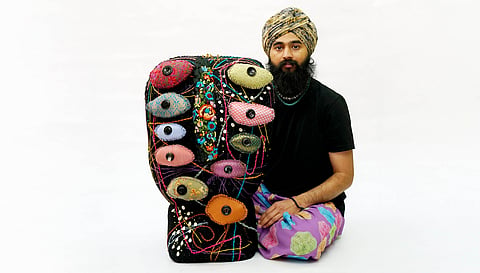
“I would often sit at the sewing machine, trying to replicate the intricate patterns on salwar bottoms. That’s how I learnt the craft,” he recalls. Singh has now brought this intimate history into a bold new collaboration with Jaipur Rugs: Dreamers, which turns traditional hand-knotting into an act of storytelling, spanning themes of gender, caste, queerness and generational trauma.
Singh brings this intimate history into a bold new collaboration with Jaipur Rugs. Dreamers, their joint collection, turns traditional hand-knotting into a powerful act of storytelling, exploring themes of gender, caste, queerness, and generational trauma.
The collaboration was a long time coming. Jaipur Rugs first encountered Singh’s work in 2023 and had hoped to work with him ever since. “What made this special was that it felt like a conversation between me and their weavers and artisans,” says Singh. “So while the works explore themes close to my heart—freedom of choice, the fragility of human imperfection—I was able to blend my emotions with the personal stories of the artisans.”
The title Dreamers is also a pointed, ironic rejoinder to the Supreme Court’s 2023 ruling against the legalisation of same-sex marriage. “It’s our way of saying we will continue to push back against discrimination while refusing to let go of our dream for a better world.”
Singh has always used his medium to send a message. Last year, his show To Kill a Bully With Kindness at Chemould CoLab featured delicate drawings on thick wasli paper and sculptural textiles—both a bold statement against the queerphobia Singh witnessed while growing up in rural Punjab, and a joyous celebration of his personal journey. There was a palpable sense of coming-of-age in this exhibition, with moments of künstlerroman peeking out at you from the very core of Singh's burlesque creatures. Their fallen eyeballs, exaggerated facial features and infectious loneliness belie the story of a 30-year-old artist who was constantly bullied in school and college for being “too soft.” (In a cheeky twist, his Instagram username today—'softgurjeet'—sounds like a sweet revenge on his former tormentors.)

Born into a middle-class Sikh family in the border hamlet of Algon Kothi in Punjab, Singh’s whole life has pivoted around challenging the ideals of masculinity in a community that prides itself on its ‘martial race’ reputation. Art has always been his “beacon of hope,” a powerful tool of self-expression guiding him through life’s highs and lows. “We all face challenges as children—self-doubt, vulnerability and pain. We are often targeted, stigmatised and picked on, but when we are young, we don't know how to cope with it. When these emotions started seeping into my work as an artist, I did not stop them because we may believe that we have fully healed, yet that's often not true,” remarks Singh, whose art delves into themes of gender discrimination, sexuality, his queer identity and sustainability.
Despite training as a painter from the Government College of Art in Chandigarh, Singh is rapidly gaining recognition for his “soft sculptures,” which evoke diverse reactions among viewers. “While some people see them as comforting and cuddly toys, there's something real and raw about them which can be unsettling to others. To me, they are expressive, intuitive and unpretentious,” explains Atyaan Jungalwala, founder of Chemould CoLab gallery, where To Kill a Bully With Kindness was on view.
While the Dreamers collection features sculptural portrait heads crafted from fire-damaged rugs once destined for disposal, Singh extends this ethos of reuse in his own practice. He repurposes discarded fabrics—shirt buttons become eyes, scraps from local tailors are stitched into form, and waste materials from designer friends find new life in his sculptures.
“In 2022, I was in a residency in Mumbai and carried 50 kilos of discarded fabrics back to Chandigarh,” he chuckles, adding that a sustainable approach is the need of the hour for artists today.
Parts of To Kill a Bully With Kindness also drew from Singh’s appreciation for the Japanese Kintsugi technique, which honours breakage and imperfection. Other works feature pierced needles—symbols of the power words carry, and how unpleasant comments and lived experiences can “stab like needles,” leaving behind wounds that fester.
His art reminds us that fabric has no gender. “It is the most utilitarian material and we are always surrounded by it,” says the artist, who was often teased as a child for showing an unnatural affinity towards textile. Yet, he has always felt a sense of pride and dignity in the craft. “There was nothing to be ashamed or guilty about what I was doing,” insists Singh, adding that his family was always supportive towards him and never once made him feel that he was “any different from the other boys.”
Most young children who are confused about their sexual orientation or identity don’t find acceptance at home because heteronormative parents are unprepared for the consequences. But in Singh’s case, his family was protective of him. Instead, he was traumatised by peer pressure, so much so “that I even contemplated suicide.” Boys in his school would call him names and some tried to forcefully kiss him. Last year, when he read a news item about a 16-year-old boy from Ujjain driven to suicide due to bullying, memories of his own childhood flashed before him. “I never had the courage — ki marr sakte hain (that one can die),” he reflects, dolefully. One particularly striking sculpture in To Kill a Bully With Kindness was born from a pristine white fabric, perhaps intended for a woman's tunic. Ironically titled Maila (Dirty), Singh has used it to challenge society’s perceptions of purity and beauty. “We are obsessed with materialism. You will notice that people take such good care of their immaculate white clothes and are so invested in trying to protect its so-called purity and innocence. But why don’t they accord the same respect to humans and our inherent virtues?” he asks.
In recent years, there have been subtle shifts in social and cultural attitudes towards LGBTQ+ and queer art. In the increasingly gender-fluid era we live in, Singh is not surprised that galleries and institutions are finally embracing diverse narratives and offering representation to the LGBTQ+ community. When asked whether his voice has helped bring queer perspectives into the mainstream, he says blithely, “The cultural conversation has already begun and this is a positive step.” A demure smile follows, before he quickly adds, “Abhi toh bohot door tak jaana hai. (There's still a long way to go.)”
It’s a journey he continues to honour in both his work and his daily life. When asked how he plans to celebrate Pride Month, Singh breaks into an enigmatic smile. “For me, every month is Pride Month. I try to make each day memorable—whether it’s sharing a meal with friends over long conversations, working in my studio, being with family, or simply imagining a more equal world... there’s so much to do, isn’t there?”