
- Entertainment
- Style
- Lifestyle
- Food & Drinks
- Tech & Auto
- Culture

AI generated summary, newsroom reviewed
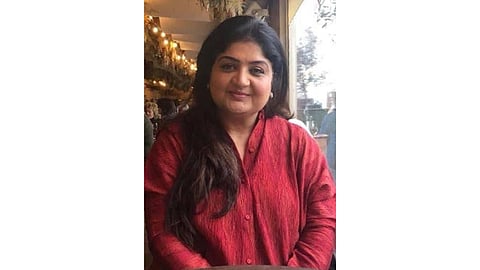
Dipti Goenka was not yet a florist the first time Sonal Shah's Bageecha stopped her. The shop sat on Nepean Sea Road in 1990s Bombay, one of the city's rare spaces that understood the power of a good floral arrangement. "Back then, dedicated floral design studios were rare, and I would eagerly wait for an occasion that justified ordering one," she remembers. She went anyway, more than once, drawn by something she would only be able to name much later: the awe of seeing flowers being turned into something more than just a pretty bouquet. That sensation became her life's work. It just took a while to arrive.
Before BudLuv had a name or an address, Goenka was a commercial pilot. Then, for a significant stretch, a homemaker raising her daughter. The flowers threaded through all of it, a consistent preoccupation that she indulged through visits to florists, learning about and sourcing unusual blooms, and curating gifts in vessels that said something more than the flowers alone could. What she was developing, without framing it as such, was a sensibility, a taste that comes with hours and hours of practising and perfecting a craft.
It was this perfection which her husband saw when he coined the term florisculptor for her, a title she prefers to go by even today. "He felt my creations looked less like traditional floral arrangements and more like sculptures—organic, expressive, and intentionally asymmetrical," Goenka says. "I see them as a medium for creating form, movement, and emotion, much like a sculptor would with clay or stone." Where a conventional arrangement reaches for symmetry and abundance, her work tends toward tension, movement and asymmetry.
The clientele this approach has drawn includes India's cultural and industrial creme de la creme: Karan Johar, the Piramals, Mariwala S, and several other luxury hotel chains and the Bollywood elite. Each commission begins with what she describes as a reading of the client: their aesthetic register, their living habits, their private concerns, Vastu and Feng Shui considerations... all shape her colour decisions. Pets in the home determine which species are permissible. The mood of each room informs what the florals are asked to do within it. "I ensure the florals complement and enhance the character of every room rather than simply decorating it," she says.
Her work leads Goenka to design arrangements that would simply be considered too fragile, or too difficult anywhere else. These include floral mannequins, the kind that demands both engineering precision and artistic control. But the most difficult, she says, are floral chandeliers, which put an additional weight of consequence on an already daring engineering venture. Something that hangs from a venue's ceiling must be secure, after all. It must come down without taking anything with it. "Creating something visually dramatic while ensuring it is secure, long-lasting, and installed without causing any damage to the venue's interiors requires a great deal of planning and problem-solving," she says, using the matter-of-fact tone of someone who has solved the problem multiple times without making a fuss about it.
But floristry is also a race against time. Freshness, in her business, is the bare minimum, yet equally hard to maintain. So how does one manage to pull off a floral sculpture in time? "We work with a network of trusted suppliers who can provide flowers as close to the event date as possible," she explains. "We also grow some varieties on our own farm in Madhya Pradesh, which gives us greater control over quality and availability. Careful planning, air conditioning, and timing ensure that the flowers look their absolute best when guests experience them."
More than once, the conversation turns to the emotional stakes of the work. Clients have wept. Not once, not in some isolated incident, but enough times that it became a recognisable experience. The first few times it happened, she was alarmed. Then they explained themselves. "They were simply overwhelmed by the beauty of it and deeply moved by the experience." She has not forgotten those moments. They function, for her, as a reminder of what she is actually trafficking in: not peonies and proteas, but the particular feeling that surfaces when a person encounters something more beautiful than they were prepared for.
This is, in her framing, what flowers do that language cannot. They arrive ahead of the words. Or in place of them entirely.
She gets excited when we shift the subject to Indian weddings. The tradition of welcoming guests with flower garlands: she loves it. "It's timeless, warm, and uniquely Indian," she says. "It creates an immediate sense of celebration and hospitality." What would she be happy to never see again? Artificially dyed flowers. "Nature already offers an incredible palette," she says, and the implied critique of the dyed variety is that it mistakes novelty for beauty. Nature's palette is the point. Working around it is a kind of aesthetic defeat dressed as creativity.
I ask her the question of men and their equation with flowers. The received cultural wisdom in India is that men receive flowers awkwardly and almost never buy for themselves. But Goenka’s experience contradicts this. "Men are often far more expressive with flowers than they're given credit for," she says. Whether sending or receiving, they engage with the process; they ask questions; they mean it. "Women sometimes approach flowers more mechanically," she offers, "but men often engage with genuine curiosity and emotion."
As for the most common mistake men make when buying flowers? Goenka delivers the answer with the warmth of someone who has heard too many stories from florists over too many years. And been through it with her clients, too: a wrong delivery address. Drama that no arrangement, however considered, can really undo.
The arc from Bageecha in the 1990s to a Madhya Pradesh farm and commissions for India's most prominent households is not a straight line. It runs through cockpit hours and school pickups and a long private education in what beauty is capable of doing to a room. What it produced is a studio that treats flowers the way serious artists treat any medium: as something with its own logic, its own demands, and its own capacity to say things that resist every other form of expression.
Goenka still, one suspects, occasionally walks into a florist's shop just because the space makes her feel good.