- Entertainment
- Style
- Lifestyle
- Food & Drinks
- Tech & Auto
- Culture

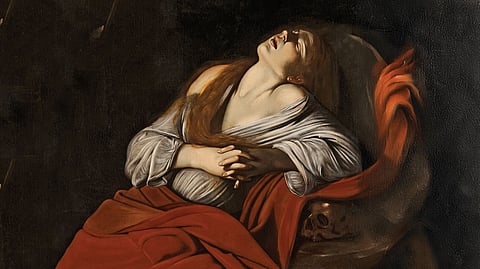
Caravaggio's Mary Magdalene in Ecstasy isn't the textbook piety painting. It is heavy on the sensual undertones—her head thrown back, her lips parted, body seemingly tranquil. We see her in private vulnerability, her neck fully elongated, her hair tumbling down her bare shoulders, her fingers entwined loosely resembling the prayer position but not quite that.
In one painting you get the duality of release and restraint, of light and deep shadows. Unlike the typical spiritual allegory of the sacred femininity tied to Mary Magdalen, Italian baroque master Michelangelo Merisi da Caravaggio’s portrayal is subversion.
It is a piece of art that’s visually provocative. But that’s not what has the art circles divided! The rare painting that’s made its premiere in India this week in Delhi, surfaced in a private European collection for the first time and was hailed as the discovery of the original Mary Magdalene in Ecstasy when in 2014, leading Caravaggio scholar Mina Gregori authenticated it.
But then a second painting resurfaced, “Klein Magdalena,” discovered after Second World War and authenticated as Caravaggio painting by critic Roberto Longhi and backed by art historian Maurizio Marini. Currently on display in Rome.
You May Also Like: Esquire Recommends: 10 Art Exhibitions You Need to See This Month
Confusing enough? Wait till you actually catch the glimpse of the two paintings together. And before you dip your paintbrush into the debate puddle yourself, know that authorship in the world of art isn’t only about who is the artist behind the painting or a piece of work.
It is also about the narrative; the price that helps critics canonize it. Collectors want their name beside the painting. Especially Caravaggio, the baroque baddie.
With Mary Magdalene in Ecstasy, the argument moves beyond the academics, its also a race about attribution. From analysisng the technical sample, the pigments to the study of brushstrokes, all of this holds tension as much as identifying the genius artist.
While one camp believes that Klein Magdalene is not the original one as the face features feel more modernist, the other believes it is original. Whatever camp of critics you’d like to side, one thing is clear: a painting that disappeared has reappeared and has all the enthusiasts of classical European art intrigued.
You May Also Like: Tyeb Mehta’s Trussed Bull Makes History
After killing a man in Rome, the artist has fled the city, leaving behind half finished commissioned works with patrons not knowing what will happen next. It is believed that during this time—estimated to be sometime around 1606—in Napels or Malta in Italy, Caravaggio painted the Mary Magdalene.
For a painting that for many years was only speculated is now here with its carnal mysticism and emotive realism is nothing short of groundbreaking moment. Mary Magdalene in Ecstasy, is a poignant depiction of spiritual transcendence, exemplifying his signature chiaroscuro.
You May Also Like: The Art Of Talking About Art: A Beginner's Guide
This technique heightened the emotional and physical presence of his subjects and redefined the portrayal of the human form, lending it an unprecedented sensorial depth. His radical approach profoundly shaped the trajectory of European art in ways that continue to resonate today.
The painting will be open to the public in Delhi’s Kiran Nadar Museum Art in Saket until 18th May this year and is accompanying the visit of Italian Deputy Prime Minister Antonio Tajani and Minister for University and Research Anna Maria Bernini in India.