
- Entertainment
- Style
- Lifestyle
- Food & Drinks
- Tech & Auto
- Culture

At what point do we welcome change and when do we push back? LEGO’s latest drop has put that question squarely on the table, and the internet, predictably, is split down the middle.
Unveiled at this year’s Consumer Electronics Show (CES), the Danish toy giant introduced its first-ever Smart Brick that has got everyone talking. For a company whose humble plastic blocks have remained largely untouched for nearly a century, the idea of LEGO going “smart” has struck a nerve with builders young, old, and very online.
To put it simply, it’s LEGO with a pulse. Built as part of what the company is calling its Smart Play System, the brick introduces sound, light, and motion-based reactions into traditional LEGO sets. The goal, according to LEGO, is simple: enhance play by layering digital interaction onto physical creativity without sending people back to a screen. Still, not everyone is convinced.
Online reactions have ranged from curiosity to outright mockery. One Reddit user quipped, “If this is a Smart Brick, does that mean all the other bricks are stupid bricks?” Others were more pragmatic, noting that since their LEGO creations are built strictly for display, the new tech-heavy additions hold little appeal beyond maybe buying one out of sheer curiosity. Nevertheless, cost is another sticking point, with many worrying that electronic components could push LEGO sets into even pricier territory.
Concerns extend beyond comment sections. A BBC News report covering the CES announcement noted a sense of “unease” among play experts, particularly around the introduction of chips inside bricks and Minifigures. Josh Golin, executive director of children’s wellbeing group Fairplay, warned that Smart Bricks could “undermine what was once great about Lego,” potentially limiting the imaginative freedom that has defined LEGO play for generations.
LEGO, however, is firm in its stance: this isn’t a replacement, it’s an expansion.
“This is an addition, a complementary evolution,” said LEGO executive Begher in an interview with IGN. “We will still very much nurture and innovate and keep doing our core experience.”
He likened the Smart Brick’s rollout to the introduction of the Minifigure decades ago. Initially small and limited, the Minifigure eventually became central to LEGO’s identity. “Wherever there’s opportunity for this type of dimensional play, we will probably explore it,” Begher explained.
“It’s not to say that it replaces anything. It’s an added layer that’s here to stay.”
Importantly, LEGO insists the Smart Play System is designed to increase interaction without requiring a screen and a crucial distinction at a time when parents are increasingly wary of digital overload. The emphasis remains on creativity, experimentation, and learning through play.
The Smart Play System is built around three core components: Smart Bricks, which house the tech and respond with lights, sounds, and movement-based reactions, Smart Tags, flat LEGO pieces that instruct Smart Bricks on how to behave and Smart Minifigures, which trigger unique sounds and reactions when interacting with Smart Bricks. Together, they bring LEGO playsets to life while remaining fully compatible with traditional bricks.
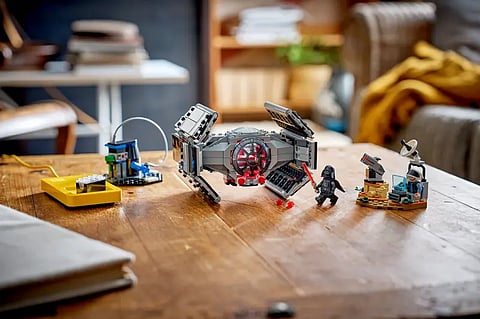
To kick things off, LEGO is launching the Smart Play System in three Star Wars sets:
Darth Vader’s TIE Fighter (473 pieces), featuring a smart Darth Vader Minifigure, one Smart Brick, and one Smart Tag
Luke’s Red Five X-Wing (584 pieces), including two Smart Minifigures, one Smart Brick, and five Smart Tags
Throne Room Duel & A-wing (962 pieces), with three Smart Minifigures, two Smart Bricks, and five Smart Tags.
All three sets will be available for preorder beginning January 9, with an official release slated for March 1.