
- Entertainment
- Style
- Lifestyle
- Food & Drinks
- Tech & Auto
- Culture
There's a certain pleasure in the scratch of a pen against paper, the way ideas gather on a blank page. The tactile and immersive experience of writing adds some depth, aids memory and augments emotional resonance.
But a paper notebook is an analogue charm in an increasingly digital world—where your notes are needed across all the surfaces you work on, and better still, are searchable and shareable. In the same digital world, we are caught in a perpetual cycle of multitasking, where deep, concentrated work has become an elusive luxury.
The powerful laptop, the sleek tablet, or the indispensable smartphone—the very tools designed to enhance productivity are now its greatest saboteurs. They bring with them a relentless barrage of distractions, with each interruption shattering focus and imposing a significant cognitive load.
Almost as a counter movement in response to this digital overload, there’s a new category of devices that champion not the addition of more features, but the deliberate subtraction of distraction.
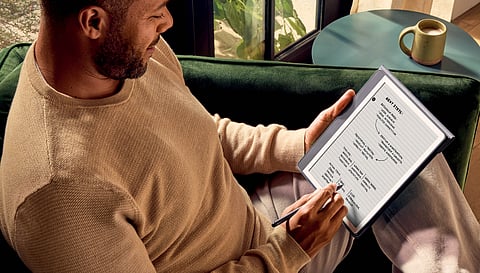
Paper tablets (or E-Ink tablets or e-notebooks, as different brands call them) promise the tactile calm of a Moleskine notebook with enough digital muscle to justify keeping your other gadgets aside. Like a Kindle, but for writing. If you’ve ever experienced a Kindle, you’d be familiar with an E-Ink screen that mimics paper. It doesn’t glow like LCDs or OLEDs and hence is easy on the eyes. Additionally, the matte, paper-like screen is inherently anti-glare, making it great for reading in bright sunlight.
Plus, the act of writing on a paper tablet is remarkably similar to using a pencil on a high-quality paper notebook. The screen surface is textured to provide a subtle but distinct friction that offers a certain resistance to the stylus nib, creating a sense of control and feedback that is absent on the slick glass of a conventional tablet.
This display has an ancillary benefit—an almost fanatical battery life allowing these devices to run for days or weeks on a single charge.
Beyond the visual and cognitive benefits, paper tablets offer a uniquely satisfying tactile experience that bridges the gap between the digital and the analogue. Plus, while their primary pitch is of an e-notebook, they are fantastic e-readers as well for everyday documents and PDFs as well as eBooks that you’ve sourced from elsewhere.
This deliberate choice to embrace a technologically simpler and single-purpose device carries implications beyond mere productivity. As the narrative shifts towards digital wellness and minimalism, the act of choosing a “dumber,” more focused tool is ironically, a more productive choice.
Paper tablets are not a replacement for your laptop or tablet, mind you. It’s where you draft, ideate and annotate—the slow, attentive work that benefits from fewer distractions. Use it for journalling, meeting notes, document revisions or visualising concepts.
And because these tablets are geared toward single‑tasking, they force you into a discipline many of us want but rarely achieve on a multi‑app touchscreen device. The deliberate paring down of functionality directly combats the addictive nature of modern smart devices. There’s no notification informing you of a new email, no ping from your social media universe, or no other app vying for your attention when you are jogging your brain. It’s a doomscrolling-free device.
Our daily lives are saturated with multi-purpose devices that fragment our attention. In that sense, paper tablets offer a sanctuary for focus. It is a deliberate and strategic retreat from the digital noise, enabling the deep, uninterrupted concentration required for creative ideation, critical analysis and meaningful productivity. Essentially, the limitations of paper tablets are their most powerful features.
If you want your thoughts to land and stay, this is the tool worth carrying. But none of these come cheap, and except reMarkable, all of these need to be imported to India (so no aftersales support). But if you want to take a conscious decision to reclaim control over your cognitive landscape, maybe give it a spin.

Comes with a host of smart features that make it ideal for users that prefer focused note-taking, writing and annotating presentations, e-books and documents. Has an intuitive search function with handwriting recognition.
Their Android-powered versatility greatly enhances what these devices can do, yet it also risks bringing back the very distractions they were meant to eliminate.
Best for writers who want the closest feel to writing on paper and a clean, distraction‑first interface—intentionally limited, with no apps on board, but needs a subscription to unlock its full potential.
The ultimate e-reader, supercharged with (basic) writing capabilities. It’s a great choice for users with an existing library of Kindle books.
Packs in comprehensive note organisation and a stylus that sports a hard ceramic nib that is virtually indestructible. Plus, there’s no need for subscription.