
- Entertainment
- Style
- Lifestyle
- Food & Drinks
- Tech & Auto
- Culture

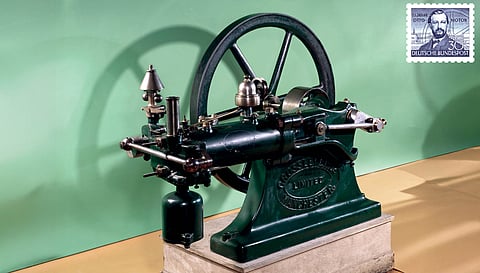
The German designer Nicolaus Otto invents a four-stroke engine that serves as a viable alternative to the steam engine. The internal combustion engine uses a four-stroke mechanism that draws in a mixture of gas and air to create an internal explosion. Now known as the Otto Cycle, more than 30,000 engines were made over the next 10 years thanks to their reliability and efficiency.
In 1885, Karl Benz made the world’s first practical automobile – three wheeled – to be powered by a gas engine. Known as the Benz Patent Motorwagen, Benz received a patent for it in 1886. In the same year, Gottlieb Daimler modified a stagecoach to design the world’s first four-wheeled automobile. The Daimler Motor Carriage was the first four-wheeled vehicle powered by a high-speed combustion engine.
Sold for around $825 (approximately R71,000 today), the Ford Model T was introduced to the world as the universal car. The revolutionary vehicle saw many firsts apart from having the steering wheel on the left: an engine block and crankcase cast as a single unit, a removable cylinder head for easy access, and extensive use of the lightweight but strong alloy known as vanadium steel.
Perhaps the most famous Rolls Royce, the Phantom was the perfect mix of engineering excellence, fine material and skilled craftsmanship. Known as the New Phantom, Rolls Royce offered the vehicle in a long-wheelbase form and a shorter wheelbase too. At one point, names like The Dreadnought, The Cookie, Yellow Bird and The Elusive Pimpernel were also in consideration. But even 100 years after its conception, it remains at the pinnacle of luxury cars.
One of the most recognisable cars ever was actually introduced by Adolf Hitler, who wanted Ferdinand Porsche to design a car to withstand the German “autobahn” speeds. The “People’s Car” went into production in 1938 and debuted at the 1939 Berlin motor show. The Beetle retained its distinctive shape for almost six decades. By the time Volkswagen pulled the plug on it in 2003, it had sold more than 21.5 million units worldwide.
Jeep Wrangler is a descendant of a first World War icon. In 1940, the US Army invited automakers to bid to produce a light reconnaissance vehicle to replace the Army’s motorcycle and modified Ford Model-T vehicles. Three names were in the running: Willys-Overland, American Bantam Car Manufacturing Company and Ford. Willys came up with the Willys Quad, later known as the Willys MA, renowned for its rugged performance. Willys would go on to trademark the “Jeep” name and introduce it as a civilian vehicle.
The first car to wear the Ferrari badge, the Ferrari 125 S was quintessentially red. Fitted with a V12 engine, it debuted at the Piacenza circuit in May 1947. In the words of Enzo Ferrari himself, the car’s performance was “a promising failure.” While the V12 engine served Ferrari cars well for more than 40 years, eventually, only two units of the 125 S were made.
Citroën wasn’t afraid to dial the design of their cars up a few notches. The DS 19 is testament to that. It caught eyeballs at the 1955 Paris Motor Show. Futuristic in its looks—the aerodynamic body, avant garde lines, the low hood, or frameless doors—the car featured technology ahead of its time, like the hydropneumatic suspension or hydraulic assistance for steering.
First imagined—and drawn—on a restaurant tablecloth by Sir Alec Issigonis, the Mini became a cultural icon of the 60s.The whole vehicle was little more than 10 feet by 4 feet by 4 feet, with other space saving elements like the tiny 10-inch wheels. Its versatility made it a crowd favourite. Turns out, small cars aren’t all that bad. Between 1955 and 1960, tailfins—like the ones on the Cadillac Eldorado—also defined a new generation of design inspired by jet aircraft.
Undoubtedly a British cultural icon, the DB5 has stuck to the collective consciousness of automotive fans globally. Admired for its powerful engine and timeless design, be it the saloons or the convertibles, the car proved to be a great successor to the DB4. The DB5 has had many famous owners down the years—from Paul McCartney to Mick Jagger—but none more popular than a certain James Bond.
Originally known as the Porsche 901, the car was renamed a year later, the Porsche 911 remains an automotive icon. The flowy curves, low silhouette and sporty angles, coupled with a six-cylinder rear-mounted engine, made it a delight to drive. It could go from 0-100km/h in 9.1 seconds, with a top speed of 210km/h—impressive numbers for a sportscar in the 60s. Between, 1963 and 2023, over 1.2 million 911 sportscars were made.
Now considered a contemporary and historical model, the Miura was the original supercar with a design that packed a punch: the slanted headlamps, transverse engine (placed sideways) and a fascinating chassis. The V12 engine generated 370 HP worth of power and a max speed of 285 km/h, making it the fastest standard production car in the world at the time. It was also a popular choice among film directors. As many as 43 movies were made with the Miura, including The Italian Job (1969).
The wedge-shaped body, scissor doors, low ground clearance, diagonal lines on the front hood —there was much to love about the Countach, which became a defining part of the Lamborghini legacy in the ’70s. These defining features that make it recognisable even from a distance have remained unchanged.
Two words: carbon fibre. The MP4/1 was the first racing car—and first car of any kind—to feature a carbon chassis. While the MP4/1 would win just a single race in F1, it made the sport more innovative and safer. Carbon composite cars were able to boast a much higher stiffness-to-weight ratio, making them not just lighter and faster but safer.
A product of iconic designer Gordon Murray’s mind, the McLaren F1 was a two-seater speedster with aerodynamics at its core. It had no spoilers, no wings on struts and was incredibly stable at high speeds. The dihedral doors not only added to the car’s look but made it easy to access the central driving position. It was the world’s fastest production car at the time of its launch.
While Andreas Flocken’s Elektrovagen is widely regarded as the first-ever electric car (back in 1888), the GM EV-1 was the first modern, mass-produced electric vehicle from a major automaker. The EV-1 was quick and reliable but full of shortcomings. It was expensive to build and a victim of the limited battery technology at the time.
The Veyron changed the automotive world in 2005. A technological marvel, the hyper sports car could go from 0 to 100 in less than three seconds, with speeds of over 400 km/h. Envisioned by Ferdinand Karl Piëch, the long-time CEO and chairman of Volkswagen, the Veyron set many speed records and inspired many variants.
Nissan’s flagship GT-R was both a Grand Tourer and a sports car. The car’s design, right from the front to the back, screamed speed and performance – be it the double-bulge hood with ducts, the visible brake rotors or the quad-tip exhaust system. The muscular look and sharp lines completed the GT-R’s overall silhouette. Nissan described it as an ultimate supercar for anyone, anywhere, at anytime.
The fact that the Tesla Model S was the top-selling plug-in electric car worldwide in 2015 and 2016 says a lot about its impact on the electric vehicle industry. The introduction of autopilot and over-the-air software updates proved to be a gamechanger. The chrome accents, front trunk and refined aerodynamics added to the overall package.
To read more such stories from Esquire India's July 2025 issue, pick up a copy of the magazine from your nearest newspaper stand or bookstore. Or click here to subscribe to the magazine.