
- Entertainment
- Style
- Lifestyle
- Food & Drinks
- Tech & Auto
- Culture
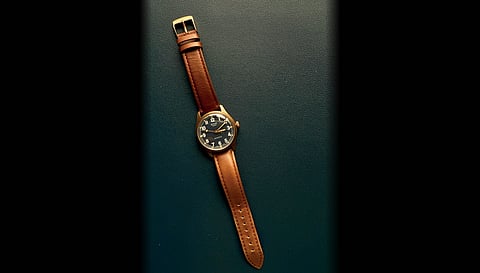
JAPANESE WATCHES HAVE ALWAYS HELD A QUIET fascination for me. There’s something very intentional about the way they design their dials: minimalist and meticulous, with attention to detail. For me, the dial is where the soul of the watch is. This KUOE Old Smith, in particular, has a deep blue, fine-grained textured dial, that evokes the porous roughness of beachside rocks, if they were dark blue. But from a distance, one can say that it mimics a night sky, softly dusted with stars. Sometimes, I use a watchmaker’s loupe over my eye, just to admire the texture on the dial up close.
I’ve always wanted a watch with a bronze outer shell (which houses the dial). There is something about the way the patina slowly ages it, giving it a timeless (no pun intended), classic feel. I picked the KUOE Old Smith, with its 38mm dial, last year in Kyoto, Japan, and since then, the bronze has mellowed beautifully (thank you, Mumbai weather). The original sheen has ebbed, replaced by a vintage look that makes it feel like a piece from history. Even the leather strap has softened nicely.

I’ve always appreciated antique watches, which explains why I gravitated towards a microbrand like KUOE. Their timepieces pay homage to the hand-wound British military watches from the 1940s to the ’70s, an era that I find deeply fascinating. That sense of utility etched in design, resonates with me. While I do appreciate and own modern watches, there’s a beauty to old-world timepieces—those built solely with a utilitarian purpose. An aviation watch, for instance, wasn’t about style but function: oversized dials for legibility that was made for pilots navigating the skies. There’s an honesty to this kind of design.
More often than not, the watches in my collection are pieces that carry layers of history or storytelling. That’s what pulled me toward the KUOE.
What makes it special was the experience from its store-cumworkshop in Kyoto. The workshop is tucked away in a nondescript building. You step into the elevator, get off on the second floor and walk through a grey corridor. You ring the bell. The door opens. Suddenly, you are in a working studio with specialists quietly sitting in cubicles, tinkering with tiny components. You’re offered a seat and a representative brings out a tray with different watch faces, hands and straps. You’re invited to mix and match, and build your own timepiece, part by part. It’s like stepping into a watchmaker’s
lab.
I must have spent at least an hour there. My daughter Leia, who was seven at the time, watched as I explored everything with childlike curiosity. Seeing me so engaged may have instilled in her a curiosity of her own, a sense that it’s okay to be interested in something, no matter how niche or esoteric.
The store experience felt intimate. It was the sort of DIY process of assembling a watch that added a layer of meaning. It also reflects something personal. Kyoto and London are my favourite cities. This watch, made in Kyoto and inspired by British design, feels like a symbolic bridge between the two. I’ve worn the KUOE watch on dates with my wife Pooja, and sometimes, during quieter moments too. Like, when I am at home, sitting in my armchair late at night, with a book in hand and a nice glass of mezcal by my side, I’ll strap the timepiece on for fun. There’s no reasoning behind this night-time ritual of mine. It just feels right.
As told to RADHIKA IYENGAR
To read more stories from Esquire India's November 2025 issue, pick up a copy of the magazine from your nearest newspaper stand or bookstore. Or click here to subscribe to the magazine.