
- Entertainment
- Style
- Lifestyle
- Food & Drinks
- Tech & Auto
- Culture

Louis Vuitton’s strange, beautiful, quietly mythologised timepiece from 1988, the Monterey, has finally resurrected after nearly four decades in hibernation.
The Monterey wasn’t supposed to be legendary. It was Vuitton’s first wristwatch, long before the Tambour defined the maison’s horological identity. It didn’t even have an official name — American clients misheard montre (French for “watch”) and started calling it “Monterey.” The moniker stuck, and so did its cult status. Designed by Italian architect Gae Aulenti — the visionary who turned the Gare d’Orsay into the Musée d’Orsay — it looked like nothing else on the market. Smooth, lugless, with a crown sitting defiantly at 12 o’clock, it felt more sculpture. It was audacious, architectural, and deeply uncommercial.
Fast-forward to 2025, and Vuitton has brought it back. Only this time, it’s not a nostalgic throwback. Aulenti’s radical form has returned sharper, sleeker, and finally mechanical, built entirely in-house at La Fabrique du Temps in Geneva.
If you trace Louis Vuitton’s watch story, most would point to 2002’s Tambour as ground zero. Fair. But the Monterey came first — decades earlier, when Vuitton partnered with IWC under Günter Blümlein’s leadership to experiment with its first foray into horology. Aulenti’s designs were uncompromising: the LV I (a 40mm yellow or white gold world-timer with moon phase, retrograde date, and alarm) and the LV II (a 37mm ceramic model with a simpler display). They were powered by quartz — advanced for the time, but a mismatch with the watch’s ambition.
Collectors didn’t quite get it back then. The Monterey was expensive, eccentric, and too futuristic for the late ’80s. But as taste evolved — and as Vuitton’s credibility in fine watchmaking grew — those same traits turned it into a cult object. Tyler, the Creator wore one in 2023; Nicolas Ghesquière sent vintage pieces down the A/W 2025 runway. Suddenly, what once looked experimental started looking prophetic.
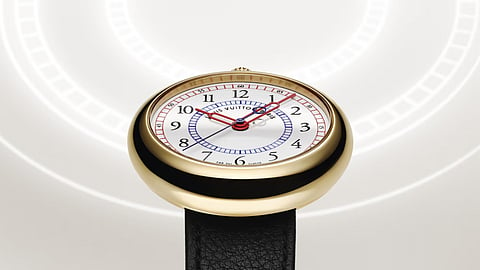
Now officially crowned the Monterey, the modern version is Vuitton’s most thoughtful revival yet. Its 39mm yellow-gold case stays true to Aulenti’s original lugless form, but with a new sense of precision — mirror-polished like molten metal, with that iconic 12 o’clock crown now textured with Clous de Paris engraving. The strap attaches invisibly beneath the case via a quick-release system etched “1 of 188.” Because yes, only 188 will ever exist.
The white Grand Feu enamel dial is a masterclass. It takes roughly 20 hours of work and ten kiln firings between 800°C and 900°C to achieve its opaline sheen. Red and blue railway tracks mark the hours and minutes — a nod to the original — while white-gold syringe hands and a blued seconds hand cut cleanly across the gloss surface.
Under the hood, the quartz of old is replaced by Vuitton’s in-house LFT MA01.02 calibre, complete with a rose-gold rotor, circular-grained plates, and a 45-hour power reserve. The finishing is all done at La Fabrique du Temps, down to the last bevel.
Matthieu Hegi, Artistic Director of the manufacture, calls it “a symbiosis between old and new,” which is exactly what it feels like — vintage lines with modern muscle.
What sets the Monterey apart is intent. As Jean Arnault, Vuitton’s Director of Watches, put it, the goal was to “do it the way La Fabrique du Temps would have done it today — enamel dial, automatic movement, everything in-house.”
The Monterey isn’t here to start a product line or chase commercial glory. It’s here to remind everyone that Vuitton’s story in watchmaking didn’t begin with the Tambour — it began with an architect’s wild experiment in 1988. Now, that experiment has finally matured.
At €56,000, delivered in a Louis Vuitton trunk, the Monterey is more than a collector’s piece for sure.