
- Entertainment
- Style
- Lifestyle
- Food & Drinks
- Tech & Auto
- Culture

Everyone wears them, but if there's one piece of clothing that truly captures the male experience—it’s a shirt. A casual giveaway of how seriously (or not—no judging) you float in the world. Paul Newman in his button-down Oxfords. Prince, the rocker, of course, and his ruffled shirts. Mick Jagger in his open silk affairs. Consider the collar, tugging at which in pride is a universally understood signage. Or, how high up you prefer to roll your sleeves, à la Obama—conveying how self-assured you’re feeling in a moment. If you tuck it in or like to leave it untucked. Layering it inside or over. And we haven’t even yet arrived at the smaller subject of patterns and material.
Rajan Jain is a man who knows his shirts. A sprightly gentleman in charge of a 165-year-old spinning and yarn trading family business, he sits, smiling, at the table in a crisp chambray half-sleeve. His shirts speak wordlessly of how deliberately he’s moved in the world. Across from the table, are the next generation of his family—sons Akshat and Ankit, and daughter-in-law Varvara Maslova. Scions of a new-age fashion house cut out of a textile legacy.
The Dutch brand 100Hands—founded in Amsterdam in 2014 and retailing at luxury boutiques across the Netherlands, the UK, Sweden and Japan—crafts some of the world’s finest handmade shirts at its sprawling factory-atelier on the outskirts of Amritsar, in village Majitha, where a textile legacy continues amid golden fields. Paul McCartney wears their shirts, as does Farhan Akhtar. Ralph Fiennes sported one on the red carpet recently. Sachin Tendulkar is a returning customer. Over dinner, Ankit, who studied Finance in Edinburgh and returned to be part of this sartorial revolution in the place of his birth, will rattle off a long list of business leaders that 100Hands dresses up.
Whenever someone mentions 100Hands, it’s usually all about the numbers—a couple of shirts will typically set you back by a lakh in rupees. Their stitch-count per square inch is twenty-five (12-15 is the industry standard). One shirt from their Gold Line collection takes 35 hours to create in an age when another could take just 18 minutes. These babies pass through hundreds of hands in these 35 hours—the original ‘hundred’ in the brand’s name multiplying with the atelier’s expansion.
How do you stand out in a market dominated typically by regional giants (Italy, France and the UK alone dominate about 80% of the market)? “To be able to do that, we overloaded this shirt. When it goes into the market, it’s so loaded with value that it becomes very hard for competitors to replicate,” says Akshat, who worked as an investment banker in Amsterdam—where he still lives with wife Varvara and their son—before shifting his focus to 100Hands.
The ‘value’ he is referring to is the proverbial devil of the details. Esquire India is here to witness the metronomic gestation that every shirt of theirs undergoes before it is released into the world.
"When we started off, the question was —what do we want to make? The whole world sees you (India) as a mass-production industry,” Akshat tells me as he sits us down in his office adjoining the factory-atelier’s beating heart—its humming cutting floor. “Then we said, ‘Okay, if we are going to do this, it has to be the best-possible job’. There’s Volkswagen, there’s BMW—but only one Rolls-Royce—in the industry.”
For instance, Akshat and Varvara set great stock by collars—something that is emblematic of the entire aesthetic prestige of their craftsmanship. “Our collars don’t droop even after five thousand washes,” he says. It means that they’re sewn to the main body entirely by hand, preventing flattening and ensuring the collar roll—a feature that’s gotten increasingly rarefied in upper-body clothing.
Indeed, collars give to and borrow from so many things in culture—from the category of one’s occupation to their propensity for rebellion or conformity. As the duo expounds on the aesthetics of the collar roll, my eye wanders to Akshat’s collar, which rests lightly just above his clavicle. It’s a cutaway collar whose outward edges nicely frame his face and chin. In some shirts, Varvara tells me, snap buttons concealed underneath keep them from flopping over.
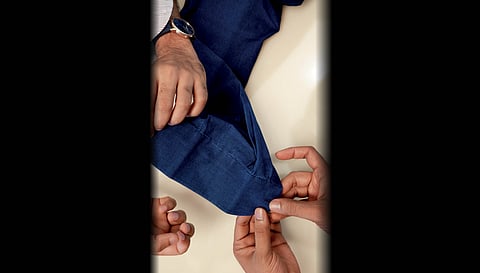
“The front panels, too, are sewn by hand, and very meticulously,” he continues, “Very few Italian brands do this, but a big difference is that where we do six stitches, they do one. So, the number of steps taken for the manufacture is the same, but for somebody, it could be a six-minute step and for somebody else, it may be 14 minutes.” For the purpose of this demonstration, denim is chosen for ease of viewing. And indeed, it’s a fabric they excel at, too, owing to the house denim washing facility that Varvara swears by. It’s supposed to be one of the best in the world.
Speaking with Akshat, you cannot help but notice the debonair flair. Unfolded sleeves, unfastened cuffs, soft voice, a Flemish-influenced articulation when he talks. Wearing a well-tailored shirt, to him, has to do with a certain deliberateness in how to approach dressing as a man. “It has to do with individuality, not with following… In India, there’s still a large gap in knowledge [as regards fashion]. Everything that we know still comes from Bollywood. There’s no sense of concept and nobody really is leading the way. But for people who are willing to look outwards, things are changing fast,” he says.
Akshat enjoys handling shirts. He fishes them out of crisp parchment paper, lays them out with a gentle flourish. Unbuttoning them and running his slender fingers along the smooth hand-rolled hems, he hardly seems like the same guy who developed a tracking software for the manufacture of his shirts. On one August afternoon, he unravels an exquisite Japanese indigo number and flips it inside out, like a mentalist building up to the Prestige.
“Except for the labels, you can practically wear it inside out,” he says referring to the seams. “There are no threads anywhere. None. And it’s not chance—it’s done with intention. Everything is done on the edge, on a zero level of sewing parameter,” he says, caressing the neat sleeve placket free of any stray threads. “Nobody in the industry can spend 10% in team allocation in cleaning this stuff up.”
Attaching sleeves by hand—a practice usually followed for jackets—instead of mechanically, delivers structured silhouettes. “Architecture,” I say a touch grandiosely. “A nicer fit,” says Varvara, smiling, for whom these marvels of luxury tailoring are an everyday affair now. Born in the Soviet Union, the former finance professional was the one who made the push for the operation to go from high-end manufacturer for shirtmakers on Savile Row and across Europe—to its own brand. The name 100Hands, too, came from her.
“Fixing sleeves to smaller armholes offers greater articulation of the arm, and a sharper shoulder line,” Akshat explains, sliding his fingers down the lustrous lushness of the fabric. “You make the body, then you attach the sleeve in a rotated format. The fit is two- to four-fold improved. A few Italian brands do it; we don’t claim any kind of exclusivity,” he adds.
The kind of exclusivity they do claim is doing all this at price points the others don’t. “Making by hand isn’t really the art. Making it with such precision and finesse is. For us, it has to do with obsession, being crazy. The cut is shown through the fit. When someone wears our shirt, the sleeves, body attachments and collars stand out on their own,” he says.
And, of course, there’s the years of generational knowhow and eye for yarn quality that the Jains boast that has gone into the selection of their fabrics—Irish linens, cool summer wools and Loro Piana cashmeres, Japanese denims among them—from little-known mills around Europe and Japan.
In our little explorations around the atelier, we discover the minute details that each 100Hands shirt is studded with—smooth, hand-rolled hems even on the thickest fabrics available, hand-sewn gussets done with painstaking finesse, cuffs and plackets featuring stitching right at the very edge. “We handroll the piping entirely. Even on very thick-feeling fabric, you will notice that it stays consistent. I’m not sure how many would see this sort of value addition as value addition, but it’s the core of why we do this,” Akshat says. Speaking about the immaculate pattern-matching on a check shirt in fine wool, he tells me, “It’s a large check. The lines—both vertical and horizontal—running across the shirt will always match around the front and back panels.”
He stresses on the tailoring’s intimate focus on even things you don’t easily notice—like the small shadow area under the arms. “If you’re careful, it’s not impossible to achieve, but with mass production, or when you need to layer fabrics during cutting, it’s an extremely tough ask,” says Akshat.
Indeed, it’s the cutting floor where, he says, “much of the magic happens”. Under rows and rows of overhead fluorescent lamps, fine hands bring their wares to the exacting demands of this endeavour. An earnest young patternmaker marks out patterns on tan drafting paper. Cutters slice apart shapes on large swathes of fabric along marked lines. Apprentices iron fresh hems, cuffs, plackets and collars—before they can be sewed on to the main body of the garment. And finally, inspection checkpoints ensure that manufacturing can stick to the lowest waste margins.
“Anything that is off the mark must go back and start over in the first half of the cycle, because this stage is where we can fix it before sewing begins,” Akshat tells me over the steady din of voices. “That is why we often rework shirts at a rate that’s way higher than the industry standard—because we feel they must go out when they’ve fulfilled our parameters.”
Time is slipping away, of my own accord, as I pore over a buttonhole being sewn. The scrawny fingers of the embroiderer move deftly over and under the tiny seam securing the slit through which the button will pass on this shirt. “We sew everything right at the very edge, leaving next to no margins. Which also means the needle can easily slip out during the course of the work. But such has been the rigour that we follow that the team now doesn’t remember there’s any other way,” says Akshat.
Some say that embroidering buttonholes offer higher durability, but even if they just serve an aesthetic purpose, it seems worth the time taken to do each one. For it signals devotion that exists just for the sake of it. Art for art’s sake.
“The buttonhole is one of our signature techniques,” Akshat explains, his thumbs extending outward to expose the ornate covering of thread around a buttonhole. “It’s basically an Indian technique where we embroider around the slit instead of sewing.” It helps that the staff comes from a culture where hand embroidery—for instance, cross-stitching—is part of life growing up.
Internationally, high-end shirtmakers hand-embroider buttonholes at a significant addition in cost. At 100Hands, this indulgence is built into the positioning of the brand as a luxury maison that can compete with the elite names. “We’re doing something that’s very hard to sustain as a business for even the best. To make this repeatedly is burning your own hand, you see,” Akshat says.
The couple recounts a rather amusing incident from a few years ago, when they were visiting a store in the Netherlands. “The guy showed me a shirt from Kiton—which was quite messy, evidently in the hand-embroidered way. And he said, ‘Why should I give you more money if yours doesn’t look done by hand?’ Later, I told him in all seriousness, ‘Listen, I can get it made by our training staff if you would like them done in a certain way,” Akshat recalls in his own amused manner. The storeowner immediately backtracked.
Admittedly, this is craft at its unapologetic finest. But craft’s also a frayed notion these days, a throwaway misnomer applied to anything, a frivolous shorthand. And thankfully, Varvara and Akshat don’t seem to reach for it at the drop of a hat. Having worked with a whole clutch of prestigious Savile Row shirtmakers and French menswear maisons, decked the racks at the Harrods and the Bergdorf Goodmans—they now know, that armed with a full-scale creative lab firing on all cylinders, they want to join the frontend.
The writing’s on the wall: the Jains want to be seen in the same breath as international luxury brands and not pigeonholed as the underdog ambling along on the crutches of heritage. They’re among the rare Indian names invited to showcase at Pitti Uomo. They’ve earned blurbs to covet from final word authorities, including a standing ovation from the Japanese house Isetan. They’re excited about their association with Galeries Lafayette, the luxury department store soon opening in Mumbai. “We want to have our brand at the end of that product line—especially since we, unlike a lot of the famous ones, have our own atelier to do so.”
It’s a resolve as sexy as their shirts.
To read more stories from Esquire India's September 2025 issue, pick up a copy of the magazine from your nearest newspaper stand or bookstore. Or click here to subscribe to the magazine.