
- Entertainment
- Style
- Lifestyle
- Food & Drinks
- Tech & Auto
- Culture

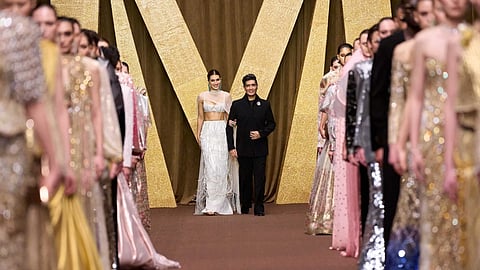
For the second time in a row, Indian couturier Manish Malhotra closed the Autumn-Winter season of Dubai Fashion Week with a show packed to the rafters (far larger than other international designers on the calendar) in a city where almost half the population consists of South Asians but a far larger percentage thirsts for Indian fashion and luxury. His proximity to Bollywood certainly is the hook—phones go up immediately when Kriti Sanon appears on the ramp. Still, in international markets, the versatility of his designs is the sure-shot sinker.
Last year, Malhotra’s DFW showing celebrated not only his 35-year legacy in fashion but also his landmark international debut. His AW 25/26 finale featured international supermodel Adriana Lima and boasted an equally star-studded front row comprising Karan Johar, Urmila Matondkar, Lakshya and Adar Poonawalla. Building on that debut, this year’s showcase highlighted not only the region’s demand for Malhotra and Indian couture in general, but also how important the region is for Indian designers, given the sherwani-inspired jackets and chikankari-embroidered abayas on display. Models carried clutches and Gladstone bags crafted by Indian artisans from materials sourced around the world. Black, ivory and midnight green dominated the colour palette. These were ensembles that could be worn as easily at a cocktail in Udaipur as at a red carpet in Dubai.
Malhotra’s approach for his DFW outings is clear. “While the craftsmanship remains Indian at its heart, the styling and silhouette sometimes reflect regional confidence and sophistication,” he says. This is why, in Dubai, he leans into more fluid drapes, sculpted silhouettes, rich textures and stronger embellishment. “There is a love for refinement, but also for spectacle done beautifully,” he adds.
This works wonderfully for Dubai, where Indian expats form around 35 per cent of the UAE population. Their influence was evident in the guests attending DFW. A woman in a ruffled ecru gown with a maangtika hugged another in a floral saree. Taha Shah posed for pictures dressed in a textured black sherwani-style jacket. Pearl-encrusted capes. Choli-style blouses. Embroidered blazers, jackets with tiger motifs, beaded evil-eye bracelets. It was a match made in heaven—India’s love for embroidery, maximalism and colour aligning with Dubai’s appetite for luxury.
“The audience (at DFW) is diverse—buyers, private clients, media and global tastemakers all come together in one place. Dubai understands luxury at a very intuitive level. Clients are not just coming in for occasion wear, but they’re curious about the craft, the embroidery, the story behind each piece. There’s more appreciation for bespoke couture and more meaningful conversations around design,” Malhotra shares.
24 hours earlier, Kresha Bajaj had echoed a similar sentiment after her show at DFW. “I think both cultures are very emotional dressers. We love dressing with memories attached to it, being creative, but we also have our roots in craftsmanship. Dubai, being a hub for so many cultures and people from all over the world, has a really interesting mix of fashion. That’s why, for me, Dubai is an amazing space,” Bajaj told us after her show. Like Malhotra, Bajaj’s collection also highlighted embroidery and embellishment, but with an edge.
Backstage, after Malhotra’s show (where 60 models walked and 20 menswear looks were showcased), we are in a cramped room thick with congratulatory guests and media. Kriti Sanon, as statuesque as ever, in a show-stopping pearl-encrusted ensemble, talks about being late to Malhotra’s fittings a long time ago. “I remember being so scared,” she laughs, jaw-dropping emeralds dangling from her ears. The couturier looks as dapper as ever, only his strained voice betraying the stress of presenting at an international fashion week. Outside the room, somebody mentions how the show started late. His friend says they didn’t mind, especially once a rendition of Chura Liye Hai Tumne filled the venue. A photographer requests a model in an ornate lehenga—the world’s slinkiest dupatta draped around her neck—to lift her shoulders just so. A flash and a click. Another, in a structured black velvet jacket with sequinned shoulders, lounges by the door.
In December 2023, Malhotra opened a 5,000 sq ft flagship at the Dubai Mall. Designed by Gauri Khan, it was the first such venture by an Indian designer in the city’s competitive Fashion Avenue. Two years of Dubai Fashion Week showcases later, the aim is not to claim a market—he’s already done that. It is to strengthen the emotional connection he’s built in the region, which will, most certainly, translate into a loyal clientele in one of the world’s most prosperous cities.