
- Entertainment
- Style
- Lifestyle
- Food & Drinks
- Tech & Auto
- Culture
RAGHAVENDRA RATHORE IS USUALLY THE BEST dressed man in the room. The last time he felt otherwise, he was in his mid-twenties, taking tea at The Carlyle with Jacqueline Kennedy Onassis and Rajmata Gayatri Devi, who wanted all the gossip from Oscar de la Renta’s offices at 550 Seventh Avenue, then home to the studios of America’s leading designers. Rathore worked at the Oscar de la Renta studio, wearing the three-piece suit that was the house uniform. Beside two women whose style had shaped generations, the suit was just a uniform.
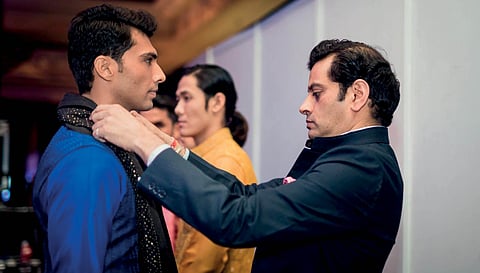
It was a rare lapse for a man who grew up in Jodhpur’s former royal family, among men who took clothes seriously. His first lessons came from his father, Swaroop Singh, an MLA whose wardrobe ran to bandhgalas, achkans and breeches. As a boy, Rathore spent a season watching a pair of breeches being made and learning what each detail was for. At festivities, he helped his father dress, minding the colour and shape of the turban, the sword scarf and even the scent.
After studying at Parsons School of Design in New York and working at Donna Karan and de la Renta, Rathore came home and launched his label in 1994. The bandhgala which he had watched his father wear would become his signature. The Indian man he dresses today has a much larger wardrobe, both literal and cultural. He slips between a kurta and a tuxedo in the same week.

International luxury houses now make sherwanis, while sneakers and Louboutins find their way beneath them. When Diljit Dosanjh became the first Indian artist to perform on The Tonight Show Starring Jimmy Fallon in June 2024, he wore a Rathore half-sleeve kurta and tehmat (lungi), paired with his trademark holster vest and Nike Air Force 1s. Rathore sees Indian men falling into two camps: those who value subtlety and those who need bling and applause.
At 59, Rathore makes most of his clothes to order. He wears his own bandhgalas with interchangeable buttons. Away from the atelier, he is more plugged in than all that heritage might suggest. “I am particularly interested in how AI can support design and help us make better decisions,” he says. Lately, he’s been hooked on War, Sienna Miller and Dominic West’s divorce drama on JioHotstar and listening to Lifafa, Suryakant Sawhney’s electronica project. His idea of rest is anywhere his phone can’t follow.
In conversation with Esquire India, Rathore explains what international labels miss when they attempt Indian wear and why proportion says more about a garment’s identity than embroidery.
Take away the embroidery, the zardozi and the safa. What makes a garment Indian today?
Its proportions, its relationship with the body, the way it responds to our climate and our way of living, our traditions and our festivals. A plain bandhgala can be unmistakably Indian without a stitch of embroidery. Indian identity also lives in the relationship between the wearer and the person making his clothes.
Does Indian fashion still need defining?
It needs a point of view, but the wearer needs freedom. Someone can move comfortably between a kurta and a tuxedo without either choice becoming a statement about his identity. Our role is to help those choices sit together in a considered wardrobe. When the advice is right, he can enjoy what he owns for longer, instead of continually buy-ing another version of himself.
The world can picture a Japanese or a British aesthetic. What does an Indian one look like?
India is too varied to fit into one picture. Jodhpur offers one vocabulary, Bengal another, and the South many more. A national aesthetic cannot be manufactured anew at every fashion week.
How is Indian luxury seen abroad?
The conversation has broadened, although India is still too often associated with embellishment and occasion wear. I would like equal attention paid to our tailoring, design intelligence and ability to build lasting client relationships.
Meanwhile, international houses now make sherwanis and bandhgalas. What do they miss?
The best bring discipline in construction, fabric development and presentation. What can be missed is the context: most international brands customise these collections locally for the festive season, and the garments may not feature in their global lines. Making a convincing silhouette is one achievement; earning the trust to dress someone repeatedly is another.
Zegna and Reliance Brands invested in your label in 2018. Is an Indian silhouette cut in Italian cloth still Indian, and what did the investment mean for you?
The origin of the cloth does not decide the identity of the garment. Its design, construction and cultural understanding do. The investment was a significant milestone: we were the first homegrown luxury brand to bring in institutional capital, and many others have since followed. Zegna remained a partner until it went public, after which Reliance Brands initiated the purchase of its stake.
The bandhgala is so closely tied to your name. How has it evolved?
The evolution is often in things you feel before you notice: balance, weight, movement and the precision of the fit. I see its future in a wider everyday wardrobe, travelling beyond the ceremonial occasions with which it is often associated.
How differently does a 25-year-old wear a bandhgala from his father?
A younger man is more likely to question the conventions around it: what goes underneath, what trousers to wear, whether it needs a formal occasion at all. His father may approach it through familiarity and established codes.
And the next generation of designers? You founded Gurukul School of Design in Jaipur. What did you want them to learn?
A designer today needs to be an all-rounder, with an understanding of finance, marketing and public relations alongside design. That is the thinking behind our Design 360 course. Indian identity should give a student the confidence to investigate, rather than a formula to repeat. We closed the Jaipur school during COVID and are now in final discussions with like-minded institutions across India to take the programme into new locations.
Your own education began at home. What did you inherit from your father’s way of dressing, and what did you leave behind?
My father was my first style hero. He taught me that elegance could belong equally to people from every walk of life. What I would leave behind is the idea that inherited clothing must remain fixed in its original form. Refining it for contemporary life is how you keep it in use. I often accompanied him to the villages. Without my realising it then, those visits nurtured my appreciation for design through the clothes, colours, craftsmanship and ways of living around me.
What does being from Jodhpur’s royal family open for you, and what does it get in the way of?
It gives me an intimate understanding of a particular cultural history, but it can also encourage people to see the background before the work. A family name may introduce you, but the business survives through the quality of the clothes, the consistency of the service and the trust you earn.
How would you describe your own style?
Classic, familiar and relatively uncomplicated. A bandhgala with interchangeable buttons is a good expression of how I think about dressing: a small adjustment can change its character without replacing the garment.
What does Indian luxury mean to you?
Being understood. A garment made with knowledge of your proportions, your preferences and the life you lead. It also means recognising the skill and time of the people making it.
Is there a bandhgala you would never make?
One in which the person disappears behind the garment. Embellishment can be beautiful, but it needs a reason and the right wearer.
To read more stories from Esquire India's November 2026 issue, pick up a copy of the magazine from your nearest newspaper stand or bookstore. Or click here to subscribe to the magazine.