
- Entertainment
- Style
- Lifestyle
- Food & Drinks
- Tech & Auto
- Culture

Innovation has always been a hallmark at Christian Louboutin.
While we’ll have to wait until next year to see what Jaden Smith, the Maison’s newly appointed Men’s Creative Director, brings to the brand, we can experience a striking limited-edition capsule by Louboutin right now.
La Vie en Inde pays homage to India’s cultural richness, refined craftsmanship, and enduring spirit of celebration. At the heart of this capsule lies the essence of Navratna (nine gems), yet it’s about so much more. “La Vie en Inde is about how India makes me feel: radiant, grounded, connected,” says the designer, a frequent traveller to India.
In an Esquire India interview, the designer shares his inspirations, India’s influence and how the smallest spark can ignite boundless creativity.
We know you’re a big sketcher—lots of lines, curves and improvisation before it comes alive in 3D. Do you remember your first sketch? What was it, how did you feel drawing it—and do you still have it tucked away somewhere?
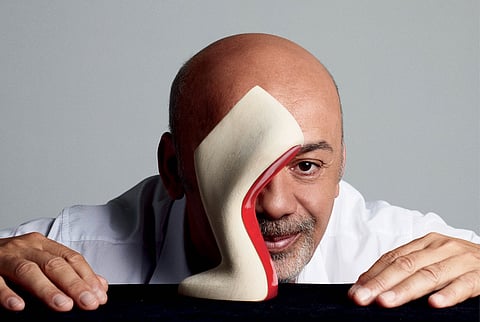
I was around 10 or 11 years old when I visited the Palais de la Porte Dorée in Paris. There was a sign with a high-heeled shoe,crossed out with a red line, it was meant to protect the floors, but it completely captivated me. I started sketching that stiletto heel. That was my first real sketch.
From that point on, I kept sketching shoes, sometimes the same silhouette over and over, just changing a small detail. I didn’t even know designing shoes could be a career; I did it simply because I loved it.
My mother actually kept one of those early drawings, and it’s still with me. It reminds me how creativity often starts from something small, something you're curious about.
Tell us about your design process. Is it more instinctual and sporadic, or is it based on trend analysis and market research?
My design process is entirely instinctual and deeply personal. I start sketching with a pen. I isolate myself for at least two weeks and draw. If it’s summer, I go to a warm country, if it’s winter, I go to a cold one. Once you are in that zone, it all becomes easy. Sometimes my drawings depend on the things I have seen and heard, things I forgot I had even noticed. There are words, noises, colours, faces, songs, they float in my mind and eventually they come together on paper. It’s never really about following trends or market strategies. As I see it, you either approach design in an industrial way or you stay true to your vision and create what you believe in and hope people like it.
You don’t just visit India, you return to it like one might to a memory or a muse. What is it about the country that keeps pulling you back? How does ‘La Vie en Inde’ interpret that connection in a way that feels different from the previous times?
India isn’t a place I visit, it’s a place I return to, again and again, because I always come back different. Each time I go, I discover something I didn’t expect; a craft, a region, a belief or even just a moment. There are few places in the world that offer so much depth, so much contrast, and so much generosity of culture. It teaches you to listen, to observe, to be present.
La Vie en Inde is about how India makes me feel: radiant, grounded, connected. It’s more about the rhythm of the country, the spirit that infuses everyday life. It’s more personal, more emotional like a memory you carry with you, even after you leave but it’s not about a specific element only.
How do you strike the right balance between cultural inspiration and personal interpretation? Especially when it comes to something that’s as symbolic as the Navratna.
For me, it’s not about blending cultures or reinterpreting traditional designs, it’s about celebrating them through my own lens. With La Vie en Inde, I was inspired by the Navratna not just for its symbolism, but for the beauty and emotion behind each stone. It’s a way of paying homage to India’s cultural richness and refined craftsmanship.
In a country like India, gems are more than just ornaments and colour is more than just hues. They carry emotions, culture and legacy. How did these elements reshape your creative process?
That’s exactly what struck me most in India that jewels and colours are never just decorative. They carry memory, belief, identity. In Europe, a gemstone is often seen as a luxury item, a status symbol. But in India, it’s something you wear for protection, for clarity, for balance. It’s emotional. So instead of thinking, “What would this look like?” I started asking, “What would this feel like to wear?” I wanted each piece to radiate. This collection is more about the essence of the stones than something literal.
This capsule flirts with French finesse but embraces Indian colour. What was it like merging these two visual languages?
French finesse and Indian colour may look very different on the surface, but at heart, both cultures have a deep love for style, ritual and storytelling through design. The most unexpected similarity? I think it’s the belief that beauty is not just about looking good, it’s about expressing something. So when creating La Vie en Inde, I didn’t try to make a fusion. I simply let the two voices speak to each other, naturally.
We know you’re an avid collector—do you see fashion as art, or is there a difference between design and art?
The border between art and fashion is very blurred to me, it’s really about perception. There could be a part of art that could be considered fashion, definitely, if you look at some of the designs of John Galliano, they’re pure art. But I wouldn’t say that about every designer. Some designers are artists, some designers are designers.
When Mika asked you to make him a pair, the menswear shoe design process started for you, right? He could’ve called anyone. Why do you think he called you, a women’s shoe designer? Did he see something that you hadn’t laid claim on till then?
Yes, that’s right—my journey into designing men’s shoes really began when Mika, the French-Lebanese pop singer, approached me about 15 years ago. He was preparing for his second album tour and asked if I’d design shoes for him. We
had a great conversation, and I remember asking him directly, Why me? I design for women—what made you come to me for men’s shoes? His answer was simple but powerful. He said, I have three sisters, and every time one of them puts on a pair of your shoes, something changes. They light up. Their energy completely shifts. I want that same feeling when I’m on stage. People can see that I truly love what I do—it’s something that naturally comes through in my designs. Maybe Mika saw that energy and wanted to bring it into his world, into performance. And that was the beginning of it all.
Musical comedy, dance, the circus, cinema’s leading ladies, pop stars—you’ve always been drawn to performance. What about it inspires you?
Dance has always been a source of inspiration for me… more than dancers, I like performers in general for the consciousness they have of their bodies and the way they move. When I started, I wanted to design shoes for showgirls after an internship at the Folies Bergère. I have always been drawn to theatricality. That’s why I love cinema, especially Indian cinema. There is this incredible richness of colour, movement, music and emotion.
A Louboutin conversation is incomplete without talk of the sole that’s rendered red. What was the starting point of your connection to red?
Red has always spoken to me. It’s powerful, emotional and full of life. It’s the colour of love, passion, danger… and celebration. I often say, even people who say they don’t like colour, usually like red. In 1992, I was looking at one of my early prototypes, the Pensée shoe, and something felt off. The sketch had so much energy, but the final shoe looked a bit flat. My assistant happened to be painting her nails red nearby, and I spontaneously took the bottle and painted the sole. Suddenly, the shoe came to life. That moment changed everything!
To read more stories from Esquire India's October 2025 issue, pick up a copy of the magazine from your nearest newspaper stand or bookstore. Or click here to subscribe to the magazine.