- Entertainment
- Style
- Lifestyle
- Food & Drinks
- Tech & Auto
- Culture

At the Louis Vuitton Men’s Spring/Summer 2026 show in Paris, India’s soft power wasn’t just referenced – it was centre stage. By the time the last note of A.R. Rahman’s “Yaara Punjabi” echoed across the Centre Pompidou, Paris was no longer Paris. For ten glorious, disorienting minutes, it was already somewhere between Ludhiana and Ladakh.
Pharrell Williams’ Spring/Summer 2026 menswear show for Louis Vuitton was only what can be described as a seismic cultural moment. It was immersive, intentional, and deeply evocative and probably one of the most confident and cinematic culturally layered collections we’ve seen in years.
Let’s be clear, however: this wasn’t the usual “inspired by India” fluff in that vague, ornamental way that fashion loves to do. This was personal. Immersive. Pharrell and his team had done the work—taking research trips across New Delhi, Mumbai, and Jodhpur, mining Indian style codes for their lived-in elegance, their tactile richness, and their heatproof cool. This was a full-blown sartorial homage to India’s many moods.
Staged in front of the Centre Pompidou, the show began with a visual jolt. A sprawling, hand-painted, wooden gameboard formed the runway—a life-sized rendering of Snakes and Ladders, the ancient Indian game of fate and philosophy, reinterpreted here by renowned architect Bijoy Jain. The symbolism wasn’t lost: fashion, after all, is its own kind of game. And this set—playful yet profound—framed the collection in a way that felt both cinematic and spiritual.
From the snakes and ladders to Indian male models dominating the runway to the print revival of The Darjeeling Limited trunks, the collection wasn’t a love letter to India—it was a whole damn novel.
Pharrell’s vision for Louis Vuitton has always leaned into the unexpected, but this season, he found his richest material in the contrasts of Indian style. The clothes drew directly from the silhouettes and substance of the Indian wardrobe: languid tailoring, mismatched layering.
Silk and cashmere were treated to resemble handwoven khadi. Stripes and checks—staples of both the dandy and the Delhi tailor—were reimagined in boucle, chenille, and even metal yarn. The colour palette leaned earthy and sun-washed. Flame-like oranges, aged whites, washed-out burgundies, and dusty denim evoked the tones of Indian streets, deserts, temples, and tea stalls. There was turmeric. There was cinnamon. There was also ‘coffee indigo denim’. A rich indigo-purple—somewhere between midnight and jamun—stood in for black.
Despite the abundance of craftsmanship, a laid-back attitude permeated everything from tailoring to sportswear, with influences that ranged from madras checks to hiking gear. Waistcoats worn under sports jackets, shirts thrown over shorts, jackets in featherlight fabrics. Nothing was stiff and everything breathed.
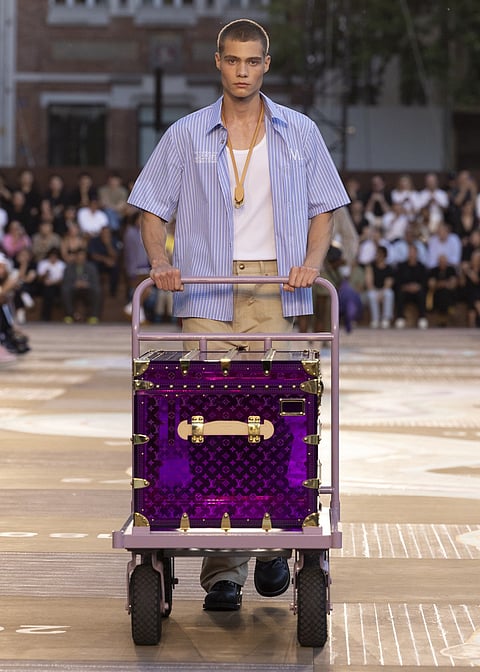
The legacy of Louis Vuitton as a travel house found a worthy echo in this collection’s reverence for journey—physical and spiritual. A revival of the Darjeeling Limited luggage, first seen in Wes Anderson’s cult film, emerged as a defining motif. Originally created for the movie in 2007, the semi-tan leather trunks embroidered with elephants, cheetahs, gazelles and palm trees now reappeared on everything from cashmere coats to canvas bags and even denim Speedys.
If one idea coursed through every piece in the collection, it was softness—not just in touch, but in philosophy. Buttery leathers formed the base of the new Malletier line of bags, their smooth surfaces dyed in sun-faded hues and finished with aged-gold trims. The house’s signature Speedy P9 reappeared in crocodile, ostrich, denim and scarf-printed versions, often adorned with beading or hand-embroidery. Some bags looked as if they’d been unearthed from an ancient Rajasthani haveli and others like they were plucked from the future—complete with transparent purple acrylics and gemstone closures.
There was a clever interplay between mountaineering and luxury: fleece-like blousons and hiking boots rendered in heritage weaves and rich suede, backpacks crafted in crocodile and deep-dye denim, and glamping-coded outerwear that nodded to the Himalayas as much as to Himalayan streetwear.
Even the shoes seemed weather-worn and loved. The LV Jazz loafers—designed with no left or right—came in soft pastels, suede, ostrich, and crocodile. There were skate shoes with gem-studded soles, and Yeti boots in Kashmiri-toned suede. Pharrell has always leaned into tactile storytelling, but here it reached a new high.
The accessories were animated with the season motifs – beanies appeared in ripped trace-of-time Monograms, while the caps were sun-bleached. Cable socks were encrusted with crystals, while even the silk squares were rendered in motifs of snakes and ladders and Damier chess boards. Even the striped neckties paid homage to those of crickets. Bangles and ankle bracelets with pendants appeared in aged-gold metal. Meanwhile, the bracelets were set with semi-precious stones including black onyx, howlite, amethyst or tiger's eye.
The show’s soundtrack, too, was soaked in cross-continental influence. Pharrell collaborated with Indian music legend A.R. Rahman on a track titled “Yaara Punjabi,” which played alongside Clipse, Voices of Fire, and Doechii. The blend of gospel, hip-hop, and Indian melody the entire show a spiritual cadence. It felt lived-in. Layered. Familiar to the Indian ear, but resonant to all. The show closed with “Get Right,” a rousing track co-produced with Tyler, the Creator.
What makes this collection so significant is not just that it pays homage to India, but that it reframes the country’s aesthetic vocabulary as aspirational—and central—to global luxury. From tailoring to textiles, silhouettes to soundscapes, every element was steeped in specificity but polished for the world stage. It wasn’t costume, it was culture.
Pharrell’s India isn’t the India of postcards or platitudes. It’s the India of contradictions—gritty and opulent, spiritual and irreverent, ancient and neon-lit. And that, perhaps, is the real triumph of this show: it didn’t just show off India’s influence on fashion. It showed how fashion, when done with depth and clarity, can become a mirror to something far more profound.