
- Entertainment
- Style
- Lifestyle
- Food & Drinks
- Tech & Auto
- Culture

The whole world came to a standstill last week thanks to Microsoft Outlook’s outage. Memes were galore, with people celebrating a rare day off (of sorts!) from meetings, mails and mayhem. Did you feel the same elation? I certainly did, though for us writers and editors, it was business as usual. I must admit that the reprieve from the relentless flow of emails was quite a relief!
Speaking of memes, the internet has been having a field day ever since Robert Pattinson was announced as the new James Bond. Do read Raja Sen’s passionate argument for why James Bond needs Pattinson more than Pattinson needs James Bond. In other news, Kiara Advani is our new digital cover star, and the first woman to grace an Esquire India digital cover. Read her chat with Akshay Sawai about the many moves she's been making of late.
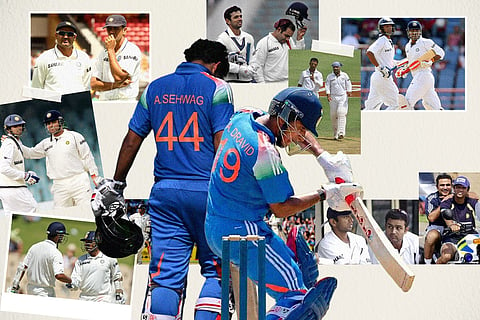
For this week’s newsletter exclusive, following India’s U-19 triumph at the Asia Cup last week, Prannay Pathak (our in-house cricket enthusiast and unofficial commentator) writes about the new-age Sehwag and Dravid (IYKYK!) and why this might just be the start of something special!
Until next week.
Saurav Bhanot
Digital Editor, Esquire India
Two of India’s most iconic cricketing surnames are back in business. Those who lived through their time know how special this fleeting moment is
By Prannay Pathak
Anvay Dravid and Aaryavir Sehwag, who represented India at the recent U-19 Asia Cup, are throwing it back to Indian cricket’s fondest era.
About two decades ago, when T20 cricket was still in its early infancy, Virender Sehwag was known for toying with bowling attacks with gum and filmi songs in his mouth. Arisen from slumber like a modern-day Kumbhkarna, the Delhi batter has led some of the most breathtaking assaults ever seen in Indian batting. “See ball, hit ball” was his famous and much-quoted mantra.
In contrast, Rahul Dravid, by then an all-weather stalwart of Indian cricket and the owner of a rock-solid defence, was the bulwark of commanding totals in Tests and the anchor of tricky 50-over chases. But, most memorably, Dravid would go on to star in some of the most thrilling and memorable partnerships.
Exactly twenty years ago, in a Test versus Pakistan, he opened the batting with Virender Sehwag against Pakistan in the first game of the series. With their backs against the wall, having conceded 679 in the first innings, the Indian captain couldn’t have thought that nobody else would get a bat in the rest of the game.
The duo put on a mammoth 410 for the opening stand, with Sehwag scoring a bulk of the runs (254). At the other end, captain Dravid remained watchful as ever, ensuring that the bowlers didn’t mistake his partner’s cavalier-seeming strokeplay for a weakness in their partnership.
Their sons, Anvay and Aaryavir, however, are both modern-day batters with an attacking game. They might not even go on to represent the country in the same way as their illustrious fathers, or even get to the senior side, but if they do get to a stage where they routinely bat together, the prospect is a delicious one for fans. There’s a bit of Virender in Aaryavir dancing down the track to loft the bowler over his head for six. There’s a bit of Rahul in Anvay, also a wicketkeeping-batter, lunging forward and cover-driving the bowler for four. We’re definitely not dreaming all this up.
How much would cultural memory weigh on the boys’ minds? Would they—do they—remember the ways in which their illustrious fathers frustrated and captivated cricket fans watching the game on their 21-inch colour televisions? They surely remember that their fathers played with bats sponsored by the same FMCG brand?
‘Dravid’ and ‘Sehwag’. Do these boys, brought up in a surely more connected world fast losing its sense of awe, know the distinctive flavour of reassurance that their names once brought to
fans’ minds? Dravid, with its anglophone attributes suggesting a specific titanic temperament marked by stillness and a secure game. Sehwag, with its lilting swagger, brought to mind someone—or something—named to deliver whacks after whacks of punishment. You rarely heard broadcasters or fans refer to them as ‘Virender’ or ‘Rahul’. They were Dravid and Sehwag.
There’s something charmingly old-world about watching athletes who are chalk and cheese in their approach to the game, partner up to flatten opponents. You’ve seen it with Rishabh Pant and Cheteshwar Pujara, Virat Kohli and Ajinkya Rahane, and Ravichandran Ashwin and Ravindra Jadeja. One partner lands a hundred cuts on the opponent’s body and the other drains its blood, drop by drop.
Despite the contrast in their batting approaches, Dravid and Sehwag were united in their determination to come out on top no matter the game situation. Sehwag was bombastic and expressive in his showmanship, while Dravid asserted himself with an icy competitive spirit. During India’s 2003-04 tour of Pakistan, each produced a mammoth Test innings,. Dravid compiled a sublime 270 at Rawalpindi (Sehwag was dismissed off the first ball of the innings) and Sehwag steamrolled the Pakistani attack for an iconic 309 (Dravid lasted 10 balls here). Before that, in the final of the 2003 ICC World Cup, Sehwag (the highest scorer with 82) and Dravid (the second-highest scorer with 47) combined briefly to give this writer, then 10 years old, a faint flicker of hope, with an 88-run stand in a chase of 360.
The duo played for India when our bowling was nowhere near the feared unit of late that former captain Virat Kohli and bowling coach Bharat Arun cultivated. Before we could hope for absolute Test dominance anywhere in the world, they ensured batting alone could prevent losses. While Dravid could occupy time, Sehwag could launch game-changing salvos during time windows when the opposition was probably looking forward to dinner later that evening. In 2008, during the famous Chennai Test versus England, the opener delivered an explosive start late on the fourth day, as India rocketed past 100 in no time. The following day, after he was dismissed for 83, India went on to successfully chase 387.
In the aughts, these two names came to mean something unique to fans of Indian cricket. They were as united in the perceived weaknesses of their playing style—Dravid to detractors could seem painfully stagnant and Sehwag’s stubborn proclivity for ridiculous run-rates would expose him to footwork purists’ wrath—as they were divided in the styles themselves.
And yet, those who really understood the role of providence in any sport knew that the distillate of their respective dimensions—the severest attack and the staunchest defence—would prove the difference between winning and losing. Not for nothing was Sehwag often the difference between India and their opponents in Tests, and Dravid brought his mastery of innings-building to 50-over cricket. Those who know their cricket will recall that Dravid still holds the record of the joint-second-fastest ODI fifty (22 balls) for India.
Perhaps we remember those years as a better time to be alive, too. Not that the world was any less troubled, or that India was free of its familiar anxieties. But the future hadn’t yet acquired quite so many of the things that now make it difficult to look forward to. There was no AI threatening to make one’s professional life obsolete, no daily accounting of climate catastrophes, no sense that every passing week brought another reason to be apprehensive about the country.
Or, perhaps, I was just a teenager watching day five of the Chennai Test versus England without a care for my biology pre-board the following day.
As their extraordinary opening partnership in Lahore in 2006 reached 410, Sehwag and Dravid stood on the cusp of making a ridiculous bit of history in Lahore: the highest opening partnership in Tests. With the record four runs away, the Nawab of Najafgarh, as usual oblivious of trivial statistics, tried to upper-cut a short ball. He missed and the ball sailed into Kamran Akmal’s gloves. The next ball, the same result. For ball three, Rana Naved-ul-Hasan ran in and pitched it around the same length, rolling his fingers to take the pace off. Sehwag swiped at it again and this time the bat managed a scrape against the ball, which Akmal promptly collected and erupted in relief more than joy.
I have long wondered: what would have it cost him to just duck and wait for another ordinary delivery to go past Pankaj Roy and Vinoo Mankad? The answer is: it would have cost him the dear price of not being the kind of detached, unpredictable, fragile thing we knew him as.
On that nippy morning, as Sehwag walked back having nicked one to the wicket-keeper after a random 400-run opening stand out of nowhere, somewhere Dravid must have thought something similar. After India conceded 679 in the first innings, putting up four hundred for the first wicket must have been hardly on anyone’s expectation list. Dravid, who had contributed a characteristically measured 128 to this improbable stand, had little reason to complain.
Generations change, but fans remain the same. Online, the grumbling has already begun. Our nepo radars have been active about Aaryavir and Anvay failing to perform against Pakistan in a low-scoring league game (because how dare anybody fail to perform against Pakistan?). One comment even derided the two as “star kids” who didn’t deserve their spots on the team—even though sport really is one arena you cannot bluff your way through without talent. Not to mention that they did earn selection with strong domestic performances in their age categories.
No matter how long Aaryavir and Anvay play for an India side, may they forge their own paths. May one of them always promise something extraordinary any moment and the other, to hold the line against anything. And may fans and broadcasters always call them Sehwag and Dravid. It’ll be sheer magic. Is it too much to ask?
Liked this story? Click here to subscribe to the Esquire India Weekly newsletter