
- Entertainment
- Style
- Lifestyle
- Food & Drinks
- Tech & Auto
- Culture

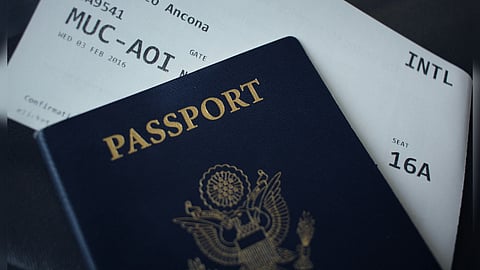
For a brief, shimmering moment this week, it looked like the Indian passport had entered its golden age. News tickers flashed headlines: India jumps eight places on global passport ranking.
But of course, headlines do what headlines are supposed to do before the details creep up.
Eight places on the ranking? That’s a tidy leap. Progress, even.
But for any Indian who has spent an afternoon digging through old tax returns to prove they won’t illegally immigrate to Belgium, the real question isn’t ranking — it’s access.
What exactly does moving from 85th to 77th actually get us? A stamp-free welcome to Paris? The ability to book a spontaneous flight to Lisbon? Not quite.
What we’ve gained, in concrete terms, is visa-free access to two new countries: the Philippines and Sri Lanka. That’s right — two neighbours that most of us have already visited, often while navigating labyrinthine e-visa systems. The bureaucratic bar was low, and we finally limboed under it.
So if you were hoping this meant borderless globetrotting through the world’s cultural capitals — you may want to keep your Schengen folder intact (sorry sweetie).
The Henley Passport Index, for the uninitiated, is a quarterly ranking of the world’s most “powerful” passports — determined by the number of destinations a passport-holder can enter without a prior visa. The data comes from the International Air Transport Association, and while the index makes for good diplomatic PR, it also functions as a subtle map of global privilege.
At the top of the heap is Singapore, whose citizens can glide into 193 of 227 countries without the need for consular labyrinths. Japan and South Korea trail closely at 190. A block of European passports — Germany, France, Spain, the usual suspects — sits comfortably in third. Meanwhile, the U.S. passport now grants visa-free entry to 182 countries.
India, ranked 77th, shares its slot with Burkina Faso, Côte d’Ivoire, and Senegal. It’s a curious club — bound less by economic heft and more by the slow churn of diplomacy, trade negotiations, and shifting global alliances.
India’s improvement on the Index is a statistical win — but a practical one? Less so. The total number of destinations Indian passport holders can visit without a visa or with a visa on arrival is now 59. That’s two more than last year. And, frankly, it still excludes most places Indians actually want to go. Europe? Still a paperwork maze. The U.S.? A biometric odyssey. Australia? Please queue here, and bring your financial history and birth chart.
This is not to say the destinations on the list aren’t worthwhile — Mauritius, Indonesia, Seychelles, and now the Philippines are all remarkable in their own right. But they are, let’s be honest, familiar. Well-worn. A short-haul holiday roster for the upwardly mobile South Asian traveller. There is no dramatic expansion in cultural or professional opportunity here. The Henley climb is more about diplomatic optics than the spontaneous joy of being able to board a flight to Amsterdam next weekend.
Still, it would be cynical to dismiss the shift entirely. For a country whose passport ranking has long lingered in the lower-middle tier, upward movement signals something more systemic. It suggests slow, iterative improvements in how Indian travellers are perceived — less as migration risks, more as legitimate participants in global exchange. Visa-free access isn’t just a convenience; it’s a signal of trust, privilege, and geopolitical leverage. And right now, India’s passport is gaining — however modestly — in credibility.
Here’s the short list: 19 African nations, 18 Asian ones, 10 in the Caribbean and Central America, another 10 scattered across Oceania, and Guyana in South America. If you’re looking to escape bureaucracy entirely, your options are tropical, affordable, and generally eastward.
So yes, we’ve moved up. But still wait. The world is slowly opening up. Just not all at once.