
- Entertainment
- Style
- Lifestyle
- Food & Drinks
- Tech & Auto
- Culture
Kazakhstan doesn't get talked about enough in terms of vacation travel destinations. It's the ninth largest country on the planet, sitting across two continents, and most people can't place it on a map beyond a vague memory of a Borat joke.
That's a shame, because the country's interior looks like someone took five different planets and stitched them together. Chalk cliffs. Sunken forests. Canyons the colour of rust. Stone spheres scattered across the steppe like they fell out of the sky. That being said, here are six places that reveal the country in all its colours:
People love asking whether you're a mountain person or a beach person, as though the two are mutually exclusive.
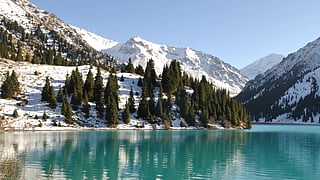
Big Almaty Lake is a good argument against the question. Tucked high in the Ile-Alatau National Park, just over an hour from Almaty, the alpine lake sits beneath snow-capped peaks, its colour shifting from milky blue in spring to an almost unreal shade of turquoise by early autumn.
At more than 2,500 metres above sea level, the lake is the city's main water reservoir, so swimming and boating are off limits. Instead, visitors come for the drive through the mountains, the viewpoints overlooking the water, and the hiking trails that wind through the surrounding national park. On a clear day, the stillness of the lake against the rugged mountain backdrop makes it one of Kazakhstan's most striking landscapes.

Start in the southwest, on the Ustyurt Plateau, about 300 kilometres from Aktau. Millions of years ago, this landscape lay beneath the ancient Tethys Ocean. When the water receded, it left behind white limestone cliffs, sharp ridges and towering rock formations that have been shaped by wind and time into one of Kazakhstan's most extraordinary landscapes. By late afternoon, the limestone shifts from white to gold and pale pink as the light changes. The viewpoints capture the scale, but it's only on the valley floor that the cliffs begin to feel truly immense.
Beyond Zhanaozen, the road dissolves into rough desert tracks, which is why most visitors arrive by 4WD. A short detour leads to the Karynzharyk Depression, 75 metres below sea level, where the Kenderli salt flat turns into a mirror after rain.
The first thing you'll notice is the trees. Bleached spruce trunks rise out of turquoise water, still standing where they grew before an earthquake in 1911 flooded the valley. More than a century later, the submerged forest remains remarkably well-preserved beneath the surface, making Kaindy one of Kazakhstan's most recognisable natural landmarks.
Set within Kolsai Lakes National Park in the Zhetysu region, a few hours from Almaty, the lake is usually paired with the nearby Kolsai Lakes on a day trip or overnight stay. Walk the shoreline for changing views of the drowned forest, hike one of the surrounding trails through the pine-covered hills, or take in the stillness from the water's edge. In winter, when the lake freezes over, the trunks appear to rise through solid ice, giving the landscape an entirely different character.
Two hundred kilometres east of Almaty, Charyn Canyon is twelve million years old. Its most photographed stretch, the Valley of Castles, is where wind and water have carved red sandstone into shapes that genuinely resemble fortress walls and towers. It's accessible by regular car, which makes it one of the easier entries on this list.
You can hike in, drive to the main viewpoints, or come by public transport and walk the rest. Give it more than a few hours if you can. Most people do it as a rushed day trip from Almaty. Two or three days lets you get past the entrance and into the canyon proper.
Scattered across the Mangystau steppe, around 100 kilometres inland from the Caspian coast, are hundreds of near-perfect stone spheres. Some are no larger than a football, while others stand several metres across, as though they had been placed there rather than formed by nature.
Scientists believe they're concretions, created over millions of years as minerals gradually accumulated around a central core. Local folklore speaks of it instead, with legends attributing the stones to ancient battles or long-forgotten giants.
Many of the larger spheres have cracked open over time, revealing intricate patterns inside. Torysh is usually visited as part of a wider journey through Mangystau, often alongside Bozzhyra Valley and the Karynzharyk Depression. There are no marked paths or viewing platforms, just open steppe and an uncanny landscape that calls for a spirit to wander and find out.
Altyn-Emel is Kazakhstan's largest national park, home to landscapes that feel worlds apart. The Aktau Mountains appear chalk white from a distance, but inside the canyons the cliffs reveal bands of red, yellow and deep ochre, exposed over millions of years. Nearby, Katutau offers a striking contrast, its volcanic rock twisted into dramatic, sculptural forms.
The Singing Dune rises 150 metres above the surrounding steppe and stretches for about three kilometres. On hot, dry days, the shifting sand produces a low, resonant hum, a phenomenon generally attributed to friction between the grains. Climb to the top for sweeping views across the Ili Valley. There is no public transport into this part of the park, so most visitors arrive by private vehicle or organised tour, with camping available near the Mynbulak ranger station.