
- Entertainment
- Style
- Lifestyle
- Food & Drinks
- Tech & Auto
- Culture

WHERE DO YOU THINK YOU CAN really smell a barbecue? I can bet it’s on the deck of a ship, with the marauding wind scattering its most precious commodity—the smoke—in all directions. Getting a place to sit shouldn’t be all that hard since the 50-somethings are dancing to What Is Love by Haddaway and the 20-somethings, crowded around a table, have found that moment on a trip when the passage of time has cooked the adolescent shyness out of you. And yet, if you don’t quickly find a table and coat your palate with the remaining cold heat of your cheeseburger soon enough, you will soon be brought back to the sorrowful realisation that it’s your last evening in Antarctica. Most people don’t go to Antarctica a second time. Even more people don’t go to Antarctica at all.
You will cast one dramatic, forlorn look around you at the summering silence of the white continent.
But Antarctica isn’t anything you’ve made it out to be. Least of all silent. If you listen closely. Listen to its penguins clamouring like welcome parties on pebbly beaches. Their comically short forewings sitting just above their oil-shined feathery bellies. Arr-aawraaw they go.
It’s not just their calls that are loud. Their guano leaps at your zodiac— a small inflatable dinghy—from half a kilometre away. The streaks their poo leaves could colour entire islands. Once you’re used to making the sensory association between these streaks and how their vast catchments violate your nostrils, you begin smelling their nitric rawness from the veranda outside your cabin.
And then there is the phenomenon you’ll witness called the catastrophic moult. You may find it amusing, with your human intelligence and knowledge of the quirks and mock-serious dramatic occurrences of the animal kingdom. But, standing stationary and absolutely miserable, these statuette-like young adults covered in rough brown feathers all over are undergoing what’s probably the existential crisis of their lives. Marooned in stinky colonies and gazing longingly at the others waddling, falling, slipping, diving in and emerging out of the ocean. Savouring to the fullest and the naïvest, these young adults are in their roaring twenties, a whole life full of uncertainties ahead of them.
One of the fates these new graduates could bravely meet is being gobbled up by a leopard seal. Near Bancroft Bay, your zodiac gamely pursued the killing of a fresh gentoo penguin. Seals can be the most innocently cruel beings ever—you wondered as your zoom lens framed the goofy face of the marine leonine. It looked stupid and adorable, frozen in that one moment you would fish out of your gallery over and over. It tossed around and bashed about its young avian compatriot like a rag doll, probably saving it for later, coming up for air occasionally, probably sick of the zodiac intruding on its private theatre. Or maybe it was putting on a show?
MUCH LIKE THE REST OF ANTARCTICA, THE leopard seal, with an elongated head, gnarly teeth and slinky undulations, feels like a prehistoric remnant of our ancient planet. And it might be all because of the Drake Passage.
You can fly to Antarctica these days, but for anyone who wants to earn it, the Drake Passage is an essential cordon in anyone’s pursuit of this land. Said to be the roughest sea crossing, it is what separates the rest of the planet from the great white sheet of ice at its bottom. The barrier it puts in between is not just physical but also temporal—48 hours of chaotic seas, powerful winds and gigantic swells. On the third day, out on the sprawling viewing deck, scanning the horizon for the first iceberg spotted on this journey, you realise you’ve come a long, long way from the existence you knew.
You are on the Ocean Explorer, Quark Expeditions’ compact expedition vessel with all possible means to keep you protected and adequately plied in Antarctica’s unpredictable great outdoors. Your temperature-controlled cabin leads you to the elevator via which the other decks can be accessed. The buffets are grand, and the bar is impressively stocked. It’s probably the most comfortable place to be on earth right now.
But—and compliments to the staff and the excursion programming—it is a cocoon you want to burst out of at every available opportunity. By the time the announcements begin, outlining the day’s order of excursions, you’re sweating from anticipation. Parka on the chair, both pairs of socks pulled up all the way, chapka strap around the neck loosened. A lightweight hunting cap with a fur lining, the thing keeps you protected from the sleet and the frigid winds outside. Are your waterproof pants keeping you mobile enough? Gloves? Oh, you’ve decided you don’t need them in this torrid love affair with this windy, windy land where summer temperatures hover around 8ºC.
Then, the static crackles. Hi, Ocean Explorers, we would now like to invite those of you in the green gr…
But you’re already in the hallway, lumbering towards the ready room and towards the locker for your suite. … green group to the ready room. Green group, please make your way to the ready room. Sneakers off in a second, you slip into the muck boots in a fluid trance. Then you feel your fingers moving behind your back and under your groin as the life vest’s straps click into place.
As you learn on the first round of zodiac cruises around Barrientos Island on the third day of the expedition, life on the zodiacs, driven by a crew of diversely decked out, carabiner compass-wearing guides who have kill switches wound around ring fingers, can be addictive. The sputtering, diesel fume-belching engines carve trails on dense water as you hold on for dear life to the ropes slung along the pontoon. Then you realise it’s going to be okay even if you don’t. Each trip out coats you more in the rhythm of Antarctica, on to its scheming birds’ plans and anointed by the sprays of its farting mammals.
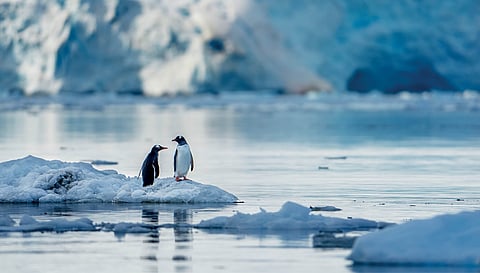
Named by a Chilean Antarctic expedition in 1949, Barrientos, the first stop in the South Shetlands region, immediately earns your concern about the speeding snow loss in Antarctica. In the past two decades, the mile-thick sea ice layer that forms Antarctica’s mainland has lost considerable chunks due to melting or breakoffs (estimated at 1.85 trillion tonnes). It’s only later that you learn that this rugged island ringing with avian cacophony is an ice-free former sealer base. On the fourth day, Antarctica’s perceived otherworld meets ours near Astrolabe and Duroch Islands, where gentoos and Weddell seals perch on floating bergs, living life in serene precarity.
On the fifth day of the expedition—the ship rolls towards a momentous destination on this trip, making its first continental landing at Portal Point. Something about making contact with the mainland of Antarctica renders each detail a little more vivid in this otherworldly place known as the Reclus Peninsula. The rocks on the beach are sliced bread-like, their edges making them seem like unborn plaques on a land so distant that it might as well be the past. In the distance, antlike humans trudge their way up swaddled in yellow parkas. An icy meadow stretches from one end to the other, outdone by the shrill blue of the glaciers in the background. Over a great many years, the accumulation of snow squeezes the air trapped in ice out. Every other colour in the spectrum is absorbed and blue scatters across the icy shoulders, bellies and hips of the glacier. Beneath your feet, guano bits, with their hints of mauve, cheer up icy canvases.
Later in the day, as you cruise in Bancroft Bay, where the water is dense and just a couple of shades away from milky white, humpbacks breach and bow-ride around the zodiacs. Despite considerable snow loss in the continent in the past decade or so, this is a landscape drenched in icy monotones. And the mind again goes back to how the odd occurrence of colour brings about a delightful discombobulation. But what will really challenge how you think about reality is the next day.
You’re headed for Paradise Harbour. The shadow-like hutments of the Chilean González Videla Base come into view as you chat about poetry and snow loss with your hosts, the Soins—Mandip and Anita—from Ibex Expeditions, the Indian boutique travel company that has filled up half of the slots on the Ocean Explorer. As the dining hall empties out in the closing comments of the conversation, you wrap up and walk up to the top deck. On the port side, the headless back of a Sphinxlike mountain passes us by like the opening riff of “Shine On, You Crazy Diamond”, the water still as glass and the solitary, looming speck in the void occurring a second time in its perfect immensity. The name—Paradise—immediately gains proof.
The zodiacs are lined up and a glacier rumbles in the distance. There’s no wind or ‘precipitation’, just misty clouds in whose churning rolls the peaks disappear. Cruising begins as a glacier rumbles in the distance. You watch cormorant colonies watching you from their perches on rocky cliffs. The weather’s peachy and the whales are busy figure-skating in the icy rink as a glacier rumbles in the distance.
And then, it calves. Just falls apart.
The frieze, held up by two shapeless columns is gone, as are its unique fracture lines and striations. The muted, icy explosion a few hundred metres away sends ocean tremors strong enough for the venturesome zodiac to return to the cormorant colony.
Sure, it’s a little chip off the glacier wall. It happens all the time, doesn’t it? Somebody asks Adrian Boyle, expedition ornithologist, with half an expectation of correction.
Boyle, endowed with a tasselled crochet beanie and stoic expressionlessness, eases in with the affrmative before delivering the response that’s been expected of him all along, telling the group that incidence of calving has gone up in recent years and a lot of it has to do with warming temperatures.
So far, worrying news about Antarctica, the climate stabiliser and carbon sink of the rest of the planet, has been water off your back in your indifferent home in one of the world’s hottest cities. You remember reading about the new Endangered status for emperor penguins with a numb discomfort. Activists and anti-Antarctic tourism voices routinely discourage travellers who can afford the costs of the journey from going to this untrammelled wilderness.
But what if you were told—that the bigger worries still were something going on elsewhere on the planet?
IF YOU REMEMBER PORTAL POINT, THE pigment responsible for the mauve tinge in that batch of penguin poop is astaxanthin. The name of the compound comes from a marine crustacean called krill. In the Antarctic summer, its abundance means the penguins will mostly crap in that colour. Tiny, with incandescent transparent bodies, large, black eyes and the ability to glow, krill will be the biggest deciding factor in the fate of this huge, heaving other planet on the planet we know and destroy with rank familiarity.
Annie Inglis, the marine biologist on the expedition, an athletic, cheerful Australian who loves answering questions, doesn’t tire of talking about krill. Found in great abundance in every ocean, but especially in the Antarctic, their count could get in a contest with the stars in the studied universe. That a creature that small could become the primary diet of a being as magnificent as the whale is, in itself, a rather endearing love story. But it turns out, some don’t appreciate it that much.
Industrial krill trawlers are rapidly emptying these waters of this tiny touchstone species—that removes close to twelve billion tonnes of CO2 from the ocean annually—for a larger industry where it is sought on a large scale as aquaculture feed, pet food and omega-3 supplements.
Earlier, cruising near the Cuverville Islands, staggering eruptions of iron red, ochre, rust orange and dull aquamarine blue burst out on peaks like massive canines out of water. A reminder that even Antarctica’s beauty is laced with the language of extraction.
In roughly two decades, when the Antarctic Treaty comes up for renewal, foundational protections against mining and militarisation could return to the negotiating table. For the Soins, their expeditions to this continent are an opportunity to form a bulk of advocacy— as part of their initiative #AntarcticaMatters—that can help evade that possibility, in collaboration with nonprofits such as Skål International, Pacific Asia Travel Association and Responsible Tourism Society of India, the International Climbing and Mountaineering Foundation, Inlaks Shivdasani Foundation and The Council on Energy, Environment and Water, among others. At the end of the trip, they will also undertake an Antarctic pledge signing everybody in the group up as a lifelong Antarctic ambassador.
Among those travelling with Ibex Expeditions is economist and climate finance leader Rajiv Lall. Over dinner, the former CEO of IDFC Bank expresses concerns about the carbon footprint of an expedition like this. “Could climate-aligned legislation help? Is there any incentive for us humans to think of a future that has nothing to do with our present inclination for instant gratification?” the thoughtful Lall ponders without any conclusive declarations.
Antarctica exists far away but lives wherever you are. For decades, science has seen it as the thermometer of the health of the planet. If you must travel to its remoteness and leave a carbon footprint, it’s essential to see it for what it truly embodies and not a clean, empty and distant mirage. In moments like these, it is reassuring to read that the ship you’re on has a fuel-efficient engine. That its X-Bow design makes sure the ship’s sailing form is energy-efficient for rough seas.
Quark, like other tour operators to the Antarctic, are required to follow a rigorous roster of guidelines for safety and sustainability, stipulated by the International Association of Antarctica Tour Operators. Travellers are encouraged to pack austerely for the tip, reuse clothes and even wash them lightly (a portable clothesline is on their recommended packing list). Muck boots, a takehome layered parka and hiking poles are provided on the cruise. Guests are expected to drink water from reusable water bottles provided at the beginning of the journey (refilling them at stations on each deck). The organisers also hold an auction on one night, proceeds of which help support habitat restoration of species in South Georgia. On the expedition, biosecurity measures are an absolute non-negotiable, which include hosing us down before every ship arrival—once at the shore and then at the gangway. Each traveller is expected to travel in a bio-bubble.
And still, the burden of sustainable and climate-conscious Antarctic travel is a tricky one to bear and, despite the long list of regulations and guidelines for tour operators, hard to be fully convinced by. Antarctica needs interventions, and hoping for perfectly guiltless one could be a stretch. For instance, the rising demand for Antarctic tourism could be channelled into initiatives like citizen science, shaping a more constructive relationship with the continent and its roiling realities. One afternoon in the cavernous lecture hall of the ship, you zoom obsessively into a photograph of a whale’s fluke flaring out of the water. Apparently, photographs submitted to platforms like Happywhale could help ID and track the animal over decades and thousands of ocean miles.
Deep Kalra can testify. Founder and chairman of the travel giant MakeMyTrip, travelling with wife Amrita, he is a seasoned globetrotter with a robust expedition experience who has reached a new level of gobsmack in Antarctica. “All of this—the massive glaciers and wall of ice—you have to see it to believe it. I knew when we were coming here that we would see whales, but I never imagined you’d get so close to them,” he says.
Having spent years building a product that made travel more accessible, Antarctica has “opened up a very different perspective on travel for him”. You ask him if there’s a real role, for the average traveller on a trip like this, in being a responsible stakeholder in the place’s ecological preservation, and he agrees.
In calving glaciers that keep making you mistake the roar of their splitting for thunder, Antarctica whispers its contralto symphony in your ears. In dramatic ledges of ice raising their hoods over sheaves of more ice deposited over untrackable time, Antarctica somehow lives on. Light escapes evermore from drifting icebergs’ dense mass, turning them a pristine blue. Because, to quote DH Lawrence, have you ever seen a wild thing sorry for itself?
Prior to witnessing the idyllic icy vistas at Paradise Harbour, zodiacs go cruising at Cuverville Island. As they tear through the water, revealing the various aspects of this rocky, mossy island named after a decorated French vice-admiral, thudding over shards of ice born from collapsed bergs that glaze the ocean’s surface as innocent threats. And somebody points towards a humpback whale, the Olympic performer of this arena, letting out impassioned sighs in a spray of marine mucus that you’d be lucky to be coated in. Few things compare to watching a rescued species frolic about again in a world that was always meant to be theirs, breaching and riding the waves in a dazzling display of the pelagic performative arts.
But nothing can prepare you for Deception Island. On the final scheduled day of the expedition, the decrepit whaling station presents a post-apocalypse future for the world that hunted whales—about two million were claimed by the whaling industry, which almost drove these majestic mammals to extinction. You go back to your cabin and scribble in your diary:
Deception Island is deceptively windy and cold, perhaps also because of the haunting impression it leaves on you. You stand on the lip of an active volcano, arriving at the muddy beach of the caldera via a steaming beach face. Wood cabins stand colonised by algal growths and inspected curiously by penguins, huge blubber ovens pose bathetically in ozymandian disrepair and water boats waste away in mildew takeover. The land, too, is deceptively dark, a steampunk alter ego transformed by the volcanic eruption that took place here. A small, ironic monument stretches from a hangar stood guard by sleepy fur seals, to a barren graveyard with just one grave marked. It says:
TØMMERM HANS A CULLKSEN, (employed as a carpenter in the local whaling operation).
Even in its frequent reminders of endings, Antarctica insists upon beginnings. The following morning, on approach at Yankee Harbour, a group of chinstrap chicks appear to be in some anxiety at the cusp of their dives into the water. Now chinstraps numbers in the continent have dwindled even as gregarious gentoos have grown. For a subspecies whose black feather bands running along their chins, black bills and constant need to sleep lend them a solemn vulnerability, this seems rather excessive. A few feet away from the excursion base, lies a whale carcass, complete with a skull, that could be a century old, as expedition guide Federico Beaudoin tells you.
A handsome, Jesus-haired Argentinian, Fede likes to puncture seriousness with groaners and sage frivolity. As a zodiac driver, he can unleash his cheerful renegade side any moment, crouching and then extending his arms next to the engine of the vehicle to produce a tiny berg roughly the size of a globe, for inspection. He enjoys seals wreaking their characteristic carnage on penguin chicks, his eyes beaming at the sight. As if it’s an event that he distinctly identifies as Antarctic determinism. An everything-is-alright event.
Later in the day, more everything-is-alright events await on Half Moon Island, a wave-battered little crescent boasting jagged peaks and guano-plastered rocks. Chinstraps behold with brooding misery the retinue of odd creatures carrying more odd creatures on their backs from the belly of a giant whale. Gentoos, being the gregarious imps they are, stand racketing on the beach. In a few clusters, the adults are masticating food into hungry chicks’ mouths. Kelp gulls and storm petrels patrol the skies.
Trudging up the mountain negotiating with a hairy trail littered with lichenous rocks through a gorge, a snowy sheathbill draws you out of your convoy. Perched safely in the lee of a rock overlooking the bay, the cottony devil bides its time alone in a moment of serene reflection.
But this is a land often misread as calm and still and blank and quiet. Where you can really smell a robbery is when they really want to eat—which is about eighty-five percent of their day. Like skuas, snowy sheathbills are notorious kleptoparasites known for snatching food mid-meal from penguins and stealing milk from nursing elephant seals’ teats. Hunting in pairs, these birds harass their flightless counterparts by swooping on them as they feed their chicks. Ambushed, the penguin will drop the contents of its mouth, which the robber will promptly make o with, which is a routine you witnessed over and over on Yankee Harbour.
All the poor penguin is left with is a round of agitated screams. All you’re left with is harsh ecstasy of their vocalisations in your ears and the strong scent of their guano in your nostrils. The cheeseburger is done, and the barbecue lingers on in the crisp air of the deck.
Esquire India travelled to Antarctica on a 10-day voyage with Quark Expeditions, booked via Ibex Expeditions. Most Antarctic expeditions are routed through Ushuaia, where travellers typically spend a day acclimatising before sailing through the Beagle Channel and the Drake Passage en route to the continent. The return journey is via Chile, making Argentine and Chilean visas mandatory for Indian travellers. We sailed aboard the Ocean Explorer, a 138-passenger vessel with Scandinavian-inspired cabins, expansive outdoor viewing decks and all the comforts suited to polar travel. Prices for Quark’s standard 10-day itinerary range from $18,000 to $33,000 (approximately ₹17.2 lakh to ₹32 lakh), depending on cabin category and sailing dates. The fare includes onboard accommodation, meals and select beer, wine and spirits, guided outdoor excursions, basic Wi-Fi for communication services such as WhatsApp, and a take-home expedition parka. Optional activities such as sea kayaking and paddling are charged separately. For itineraries, sailing dates and expedition details, visit www.ibexexpeditions.com
To read more stories from Esquire India's May-June 2026 issue, pick up a copy of the magazine from your nearest newspaper stand or bookstore. Or click here to subscribe to the magazine.