
- Entertainment
- Style
- Lifestyle
- Food & Drinks
- Tech & Auto
- Culture

Bryan Johnson knows how to make an entrance. Or, in this case, a confession. In a recent YouTube video, the anti-aging millionaire looked straight into the camera and admitted it: he may have gotten it wrong. The man who once transfused his teenage son’s blood into his own veins, who drops $2 million a year trying to age in reverse, had misjudged one of the cornerstones of his biological protocol — the so-called miracle molecule, rapamycin.
Five years in, a growing list of side effects and one damning Yale study later, Johnson is calling time on his anti-time strategy. He’s off the drug. And the irony, in all its perfect symmetry, is not lost on him: “To those of you laughing at home,” he said, “I’m laughing with you.”
It started with mice. In 2009, a landmark study showed that rapamycin — an immunosuppressant developed for organ transplant patients — could extend the lifespan of middle-aged mice by up to 14 percent. For researchers, it was a breakthrough. For longevity enthusiasts, it was the beginning of a new obsession.
You May Also Like: The Bryan Johnson Effect: When Biohacking Meets The Real World
Over the next decade, interest in rapamycin quietly picked up. By 2023, a small clinical trial in humans reported that 65 percent of participants felt healthier on the drug. The data was limited but promising enough to catch the attention of people like Bryan Johnson, who had already committed to tracking every biomarker in his body.
For Bryan Johnson, who was building a tech-powered longevity empire, rapamycin became the crown jewel. Precision dosing, strict cycling, constant biomarker scans — this was science, not superstition.
But the body has a way of talking back.
It led to mouth ulcers. Delayed wound healing. Spikes in cholesterol and blood sugar. Most troubling, out of all, was a persistent rise in resting heart rate — the one metric Johnson considered sacred for recovery and sleep quality.
Then came the final blow: a Yale study in 2024 suggested that rapamycin might actually accelerate biological aging. Sixteen adverse changes across key epigenetic markers. For Johnson, the message was clear — time wasn’t being reversed. It might even be running faster.
Johnson’s rapamycin fallout is more than a footnote — it’s a flashing warning light for the booming world of biohacking.
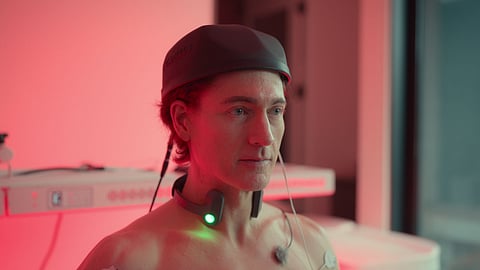
This is about an entire culture obsessed with optimisation. Cold plunges. Nootropics. Caloric restriction. Hormone stacks. Red light therapy. The quantified self — and the glorified illusion that if you just track enough variables, you can somehow outrun death.
You May Also Like: Mouth-Taping: The Bizarre Bedtime Trend Taking Over
In Silicon Valley, where billionaires treat mortality as a technical glitch, this kind of experimentation is treated like a virtue. Johnson isn’t alone. There’s Harvard’s David Sinclair, who microdoses metformin and resveratrol like vitamins. There are transhumanists prepping for cryogenic sleep.
But as these longevity experiments inch into the mainstream, they raise real questions. About risk, for one — the long-term effects of these protocols are often murky, with few large-scale human trials and plenty of anecdotal evangelism. And about accountability. What happens when millions take their cues from millionaires, only to find that the miracle molecule doesn’t quite deliver? Johnson had the data and the resources to course-correct. Most people won’t.
But at what point does self-optimisation become self-harm? Is it science — or just fear of death dressed in wearable tech? And crucially, who gets to play in this sandbox of immortality? Biohacking, for all its futuristic branding, is still a luxury sport.
Johnson, to his credit, isn’t pretending this was a win. But he’s also not treating it like failure. He’s reframed the whole thing as a “reset.” A necessary recalibration. And maybe that’s what makes this moment so compelling: the rare sight of a man who’s spent millions trying to become superhuman… being completely, unmistakably human.
You can biohack all you want, but biology has a wicked sense of humour. And sometimes, the smartest thing you can do is to admit that you’re still figuring it out.
Even billionaires trying to beat death are just guessing. So why are we so busy putting them on a pedestal?