
- Entertainment
- Style
- Lifestyle
- Food & Drinks
- Tech & Auto
- Culture
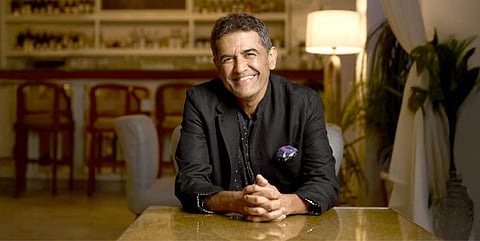
To say that AD Singh is a pioneer in India’s hospitality landscape, would be stating the obvious.
The restaurateur, who studied electronic engineering and began his professional journey in the corporate world of Cadbury, changed track to become one of the most respected names in the F&B business. His career in hospitality started with a boat party planning service called Party Lines in 1988 – a result of a highly successful cruise party he threw for his sister’s wedding. “There had been no entrepreneurs in my family but when I was looking for my own path for the future, I thought I’d give it a try. The success of my sister’s party also gave me the confidence to start this,” he says.
One thing led to another and he opened his first F&B venture, Just Desserts, in 1990, a jazz café that served only coffee and desserts, followed by Olive in Bandra in 2000. More than two decades later, Singh is regarded as a legend in the restaurant circles, with 14 restaurant brands in the country, including SodaBottleOpenerWala, Guppy, Fatty Bao and Monkey Bar, which has reopened in a brand-new avatar.
In a candid conversation with Esquire India, Singh tell us why there is no substitute for hard work and passion.
Why did you feel that Monkey Bar needed a revamp after 13 years?
Brands need to be kept fresh. In the restaurant business, 10 years is a big landmark to cross and to do more than that, even more. We have opened a new Monkey Bar in Bangalore with a new design and it is doing very well. We thought it was time to revamp the one in Mumbai and make it bigger and more exciting. We shut Fatty Bao next door and extended Monkey Bar. We felt that it required a larger space with a big bar inside as well as outside. We have done that in our Delhi outlet as well. We thought it’s time to not just revamp it, but to create a fresh avatar for the future.

What is the experience going to be like for the consumer?
Our roots are pretty much the same. It is a really cool neighbourhood bar with great food and good cocktails, lovely music and a nice vibe. We've tried to remain true to the core of what we are. In terms of the target audience, we've aimed it a little bit older than what it was when we started. It's more like 25 to 35 now. The vibe and the experience are as special now as it was when we opened it – of an innovative, interesting, delicious neighbourhood bar.
Olive ushered in a new era of eating out when you opened it in 2000.
With Olive, we broke down all the separate categories that existed for an evening out. For instance, people used to go out for dinner or for a drink or for dancing. Olive offered them a complete experience for whatever mood they were in. They could come here with friends and just sit for hours, chat, drink, get up and dance around their table, come back another time for brunch, etc. Olive was really, I'd say, the first lifestyle brand in India, which offered customers a complete experience of going out and did that very well. I'd say that Olive wrote the map for the future of the stand-alone restaurant.
How has it stayed relevant even after two decades?
Its success or relevance can be attributed to two or three reasons. For one, I'm a very hands-on restaurateur. Secondly, we've been able to retain our good people with us for a long time. So, the culture, the continuity, the consistency has remained for these 25 years. Thirdly, and even I didn't realize it earlier, but candlelight makes women look much more beautiful! (laughs) So women are always very happy to keep coming back and men are very happy to keep coming back to admire these gorgeous women at Olive.
Is there a success mantra you follow?
One of my favourite quotes is, ‘the harder I work, the luckier I get’. I feel the younger generation is ready to put in the hard work and the long hours. It's a must for success in any field. Secondly, it's a bit of a cliche, but from day one, the Olive Group has tried to be a family for its employees. Over the years, we have done many things and put policies in place to look after our people. I think our HR vision, philosophy and ideology has been a big part of the company's ongoing success.
What keeps you going after all these years?
I love what I do. I'm lucky I got into something I really enjoyed. It's been a hell of a journey. And so, I'm happy to keep going for years to come.
Do you ever wonder what your life would have been like if you had continued with your engineering path?
I know the answer to that. I would not have been the happy person that I am! (laughs)