- Entertainment
- Style
- Lifestyle
- Food & Drinks
- Tech & Auto
- Culture
Travel changes you. As you move through this life and this world you change things slightly, you leave marks behind, however small. And in return, life and travel leaves marks on you."
— Anthony Bourdain, The Nasty Bits
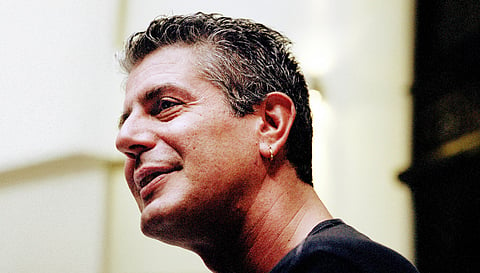
There are some voices that don’t leave you. They become the gravel in your gut, the compass in your travels, and the conscience in your profession. For me, that voice has always belonged to Anthony Bourdain.
Today, June 25, marks Bourdain’s birthday, he would have turned 69. It’s been seven years since he left us, and yet, in kitchens across the world, on dusty roads and smoky hawker stalls, in late-night re-runs and dog-eared books, he remains achingly present.
He’s there in the clink of cold beer bottles under dim lights in Ho Chi Minh City. In a badly translated menu in Tangier. In a side-eye shared across the pass of a busy line when the tickets just won’t stop printing. Maybe not in body, but in spirit, in honesty, in grit, in hunger.
I first met Bourdain not in person, but between the grease-stained pages of Kitchen Confidential. I was 22. It felt like being handed a cigarette and a truth bomb all at once.
Published in 2000, the book turned Bourdain, then a relatively unknown chef at Brasserie Les Halles in Manhattan, into a cult antihero. But for many, especially in India’s still-emerging food scene back then, Kitchen Confidential was a peek into an unapologetically honest world. The India of that time was just beginning to see the rise of chefs as a personality, and the brutal, beautiful world of F&B.
"You are sneaky, criminally irresponsible, insulting to the customers, monumentally incompetent, and no one trusts you. You haven't had a raise in years. But you're family." — Kitchen Confidential, 2000
The book wasn’t just a memoir, it was a manifesto. It didn’t glorify the kitchen; it cracked it wide open. And like many at 22, I was teetering between ambition and disillusionment. The underbelly of restaurant life wasn’t polished, it was feral, addictive, sacred. It introduced me to a tribe that I didn’t know I already belonged to: the bruised, blistered, brilliant misfits. A life where your tribe came from immigrants, addicts, geniuses, and sometimes, all at once.
Bourdain didn’t romanticize the kitchen; he demolished the myth. And yet, somehow, in doing so, made it feel even more sacred. I learnt that There was no poetry in peeling potatoes at 2 AM. But there was poetry in showing up anyway.
When Medium Raw came out in 2010, I devoured it in one sitting. This was Bourdain post-fatherhood, post-fame, and newly aware of the weight his voice carried. He still wielded his pen like a machete, but there was more mercy now. And reflection. In this book a more reflective and mature Bourdain returned, less cocky, more conscious. He had softened at the edges, but only slightly. He could still gut a phony with one sentence. But now he used that scalpel more selectively. His takedowns of celebrity chefs weren’t just about envy or rebellion; they were warnings against inauthenticity. He taught me that food is never just food. It’s culture, memory, violence, migration, longing. Sometimes, it’s all of those things on one plate.
"I like people who do things well. I admire a good butcher, a good cheesemaker, a good taqueria, a good old-school bar with a good bartender. I admire people who are good at what they do."
— Medium Raw, 2010
Bourdain became more introspective, willing to question his former bravado. He confessed his flaws, his judgments, even his privilege. He admitted he was softer now more of a father, less of a punk. But what remained was his obsession with realness. He critiqued the "cheffy" obsession with molecular gimmicks and the dilution of food culture by commercialism.
Here in India, where we’ve often battled between tradition and trend, Bourdain’s voice helped many of us hold our ground. That food isn’t just a thing to plate, it’s a cultural artifact. You can’t just throw microgreens on a dosa and call it progress.
But it was Parts Unknown that transformed him from kitchen insider to cultural oracle. In a world increasingly fenced by borders, Bourdain jumped them, literally and metaphorically. He didn’t travel to “Instagram worthy” places. He travelled to understand. To listen.
He once said, “If I'm an advocate for anything, it's to move. As far as you can, as much as you can.” And he did. From post-conflict Colombia to a ramen shop in Osaka, he moved not just geographically, but emotionally, diving into the scars of a place. Watching him made me realise that travel wasn’t a luxury or escape, it was a necessary act of breaking open your own biases. That to sit at someone’s table, eat their food, hear their stories, was the most humane way to learn about a place. Because of him, I stopped fearing the unfamiliar and started craving it. He didn’t just teach me how to travel, he taught me why.
The show wasn’t perfect. But what was revolutionary was his refusal to separate the plate from politics. He ate pho in Hanoi and reminded us about napalm. He feasted in Gaza and still acknowledged its grief. In a time when food media leaned into escapism, Bourdain leaned into reality. His table was always wide enough to seat the uncomfortable truths.
I’ve spent most of my adult life in the food and hospitality industry, working in restaurants, crafting culinary experiences, telling stories through chefs and menus. And Bourdain’s voice has never been far. Whenever I felt the pressure to gloss over something or simplify a narrative, I’d ask myself: What would Bourdain call bullshit on? And then I’d rewrite it. I follow the same principle while dealing with people too. If they are not authentic, they aren’t for me.
In a world full of polished influencers and scripted gastronomy, he reminded us that authenticity is messy. And beautiful. That the best meals often come from places with plastic chairs and no menus. That dignity exists in the smallest kitchens and that every dish tells a story worth listening to if only you shut up long enough to hear it. That the best meals are shared with strangers. And that curiosity is the purest form of respect.
One of his quotes that I carry like a tattoo in my mind is this: “You learn a lot about someone when you share a meal together.” Simple, yet so deeply true. It’s how I’ve chosen to work, with chefs, with travellers, with diner with strangers who become friends. I owe that to him.
"The world is not a particularly fair place, and it's not a particularly safe place. You don't have to look far to find horror, injustice, or tragedy. But I do believe that it's still a beautiful world," he said.
“Without experimentation, a willingness to ask questions and try new things, we shall surely become static, repetitive, and moribund."
- The Nasty Bits
He also gave permission to be broken, without shame. That success doesn’t mean silence. That you could be brave and vulnerable at the same time.
I never got to meet Anthony Bourdain. And maybe that’s for the best. But like many, I feel like I’ve been having a conversation with him for years. In every food story I write, every session I take for my students, every culinary trip I plan, I carry his lens with me. The one that says: be curious. Be kind. Call out the fake. Respect the underdog. Tip well.
He was also the reason I gathered the courage to travel solo, something I couldn’t bring myself to do until my early 30s. But once I did, it changed everything. It made the world feel personal, like I was living inside a Bourdain episode of my own, equal parts chaos(I am a terrible navigator!!), wonder, and connection.
On his birthday, I’ll have a Negroni, the drink he loved, to the man who taught me that food isn’t a trend, but a truth. That being lost in a new city is the fastest way to find yourself. That humility is sexier than swagger. That it's okay to sit with grief, as long as you never forget to taste the broth.
Cheers, Tony! I hope you’re enjoying a stiff one in the great beyond, somewhere in the heavens where the noodles are always perfect and the bar never closes.
The world is lonelier without you, but infinitely more open, thanks to you.
(Quoted from Kitchen Confidential: Adventures in the Culinary Underbelly; Medium Raw: A Bloody Valentine to the World of Food and the People Who Cook; The Nasty Bits: Collected Varietal Cuts; World Travel: An Irreverent Guide).
