- Entertainment
- Style
- Lifestyle
- Food & Drinks
- Tech & Auto
- Culture

How do you stop a tragedy before it begins? And worse—what if you never even saw it coming?
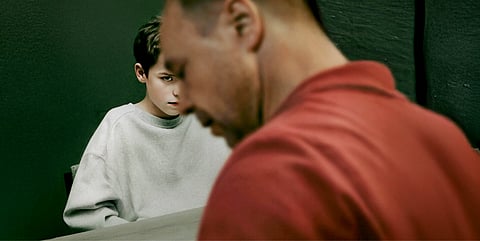
The opening scene in Adolescence is enough to cling to you like a fever dream. In a dawn raid at his family home, a 13-year-old boy, Jamie Miller, is arrested and hauled into the back of a police van on suspicion of murder, while his parents choke in horror. The camera never cuts away the entire time.
To call this show a crime drama doesn’t do it enough justice. Instead, it’s a brutal dissection of masculinity, gender violence, and the silent ways in which boys slip through the cracks—left to rot in a system that neither understands nor protects them. Co-created by Jack Thorne and actor Stephen Graham, the four-part British mini-series has already been hailed as one of the best shows of the year.
The premise is deceptively simple: when 13-year-old Jamie Miller is arrested for the murder of his classmate Katie, his ordinary working-class Yorkshire family is thrown into chaos. His father, Eddie (played by Stephen Graham), refuses to believe his son could be capable of such a crime. And yet, as the evidence piles up, denial gives way to something worse—doubt.
You May Also Like: True Crime Movies Worth Watching
Jamie’s guilt is never clear-cut, and his innocence is never assured, and as the story unfolds, the real question becomes less about what happened and more about why. Adolescence isn’t about solving a mystery, but about exposing the fractures in a system that breeds violence and neglects the vulnerable. Shot entirely in real-time with single takes, the show doesn’t allow for breathers and it definitely doesn’t let you look away.
I was never much for cinematography and neither did I care to read about the nuances of what it takes to make something more impactful on screen. But with Adolescence, the technical ambition to make every scene impactful is evident.
Each episode unfolds in a single, unbroken take—an audacious filmmaking choice that demands precision from both actors and crew. Philip Barantini, the director behind the critically acclaimed Boiling Point, brings his expertise here that makes every scene intimate. The camera masterfully maneuvers through cramped living rooms, school hallways, and police interrogation rooms, ensuring that every moment, every crucial dialogue is not missed. Unlike traditional editing, where we get perspective shifts and dramatic cuts, this ‘oner’ technique forces viewers to almost be in the room with the characters, like you can’t escape the scenes that are making you so uncomfortable. This method is not merely a stylistic flex—it amplifies the show’s emotional intensity, making Jamie Miller’s arrest, his parents’ devastation, and the detectives’ mounting frustration feel unbearably raw and immediate.
You May Also Like: 6 Shows To Watch While You Wait For The Next White Lotus Episode To Drop
My favourite export from Netflix UK used to be “Black Mirror”. It served as an unapologetic cautionary tale about society, the dark side of technology, and human nature. But then Adolescence came along.
This show is a searing indictment of society that shapes (and perhaps, misshapes) the young boys in our society. It’s not black or white. It’s not about guilt or innocence. Instead, it delves deeper into investigating the pressures that lead to such a horrifying act in the first place – toxic masculinity, online radicalization, and somewhere, a failing social infrastructure in which boys are growing up today.
Jamie isn’t a villain – and this inability to label him as one is what disturbed me. He is just a boy – both a perpetrator and a victim – of a digital ecosystem that breeds this resentment and rage. His character is truly a reflection of the constant epidemic of online misogyny. I can reference Andrew Tate, incel culture, and ‘manospheres’ here because they are chillingly relevant. Thorne and Graham didn’t conceive Adolescence in a vacuum. The inspiration came from real-life cases—children stabbing children, boys consuming violent rhetoric online, families blindsided by the darkness brewing in their own homes. The show underscores how the internet, often considered a safe haven by parents, can instead be a breeding ground for corrosive ideologies. Jamie’s descent is not dramatic; it is disturbingly mundane. His parents thought he was playing video games, doing homework. In reality, he was being shaped by a digital echo chamber that glorifies aggression and dehumanizes women.
You May Also Like: Why You Should Watch The Netflix Show Cassandra
Beyond its thematic weight, the series also critiques the institutions meant to safeguard young lives. Episode two’s depiction of Jamie’s school paints a bleak picture of a public education system that is overstretched and ineffective. Teachers shuffle through their responsibilities with exhausted detachment, and the detectives’ frustration at the lack of concrete information mirrors the audience’s own. The episode’s climactic final shot—where the camera leaves the characters and ascends into the sky, only to ‘land’ at the crime scene—serves as a sobering reminder that systemic failures, not just individual actions, are to blame for tragedies like Katie’s death.
It’s one thing for the show’s thematic content to be great. But only a stellar performance by a brilliant cast can really make you feel what you’re supposed to feel. Adolescence would crumble without its powerhouse performances. Graham, as Jamie’s devastated father, delivers a career-defining performance, balancing blind paternal love with denial, anger, and gut-wrenching grief. Meanwhile, Ashley Walters, as the lead detective, brings a gravitas to the procedural elements.
However, it was the 15-year-old Owen Cooper’s performance that really stood out. He delivers a performance that is raw and haunting, capturing the fragile, unspoken weight of adolescence with remarkable restraint. There’s a quiet turbulence to his portrayal—for instance, his silences often saying more than his words.
Adolescence is an experience that lingers long after the screen fades to black. The show’s refusal to provide easy answers is its greatest strength—it forces viewers to sit with discomfort, to interrogate their own biases, to reckon with the realities of a world that shapes children into both victims and perpetrators. The performances, especially those of Owen Cooper and Stephen Graham, are nothing short of perfection.
You May Also Like: Most Gripping Courtroom Dramas of All Time
Yet, for all its brilliance, Adolescence is not without flaws. While the single-take technique is unique and mostly effective, there are moments when you miss the occasional dramatic pause. The immersive style, although powerful, can sometimes get exhausting at times. Moreover, the series’ refusal to offer resolution—while thematically crucial—may frustrate some viewers. Jamie’s final fate is left ambiguous, and while this aligns with the show’s overall message about the unpredictability of justice (and maybe life), it risks feeling unsatisfying in a medium where people crave closure.
Despite these minor missteps, Adolescence remains one of the most compelling and urgent pieces of television to have come out this year. It is a show that needs to be watched, not just for its technical mastery or stunning performances, but for the conversations it ignites.
It’s no surprise that Anurag Kashyap—never one to hold back—has lavished praise on the show, calling it a feat of storytelling that simply wouldn’t be possible in India. His envy is well-founded. Adolescence is a testament to the type of ambitious storytelling that we should be aiming for.
In a world increasingly shaped by digital influence and ideological extremism, Adolescence is both a warning and a plea—to listen, to engage, and, most importantly, to intervene before it is too late.