
- Entertainment
- Style
- Lifestyle
- Food & Drinks
- Tech & Auto
- Culture

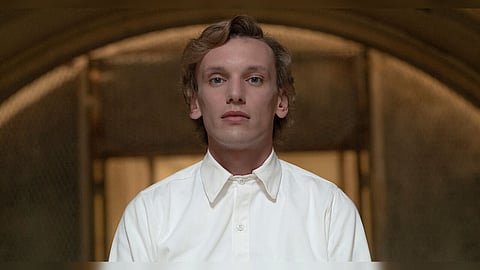
Jamie Campbell Bower has been famous in fragments for nearly two decades. He has one of those faces that makes us weak at the knees. All cheekbones and sharp angles. He doesn’t do soft. He does beautiful-with-a-dark-streak, romantic-but-unsettling.
His film debut came in Sweeney Todd: The Demon Barber of Fleet Street in 2007, directed by Tim Burton and anchored by Stephen Sondheim’s score. Within three years, Bower had orbited pop culture’s biggest franchises—Harry Potter, Twilight, fantasy epics, cult TV. He’s been the dangerous pretty boy, the doomed romantic, the quiet villain, the reluctant hero.
The current obsession with Bower—fuelled by Stranger Things Season 4 in 2022 and cemented by its conclusion in 2025—isn’t about novelty. It’s about accumulation. For years, he’s been cast at the edges of power: the vampire who enforces the rules, the wizard who radicalises love into ideology, the king who doesn’t yet know how to rule, the romantic who looks like he might snap. Even Vecna, the role that finally made him unavoidable, wasn’t a pivot so much as an escalation. Bower didn’t stumble into menace, he trained for it across genres and expectations.
Now that Vecna has turned him into a global fixation—and, let’s be honest, a fashion and internet obsession—it’s worth revisiting the roles that quietly built this moment.
Jamie Campbell Bower was 19 when Sweeney Todd released. As Anthony Hope, the young sailor trying to rescue Johanna from a city rotting with cruelty, he plays the rare thing in Sweeney Todd: sincerity. In a film obsessed with vengeance and decay, Bower’s Anthony is all yearning and optimism, and crucially, he can sing. Looking back, it’s striking how controlled he is for a debut, especially opposite Johnny Depp and Helena Bonham Carter at full Burton-volume. He also sang his own vocals—a detail often overlooked when talking about his early career.
Released just a year later, Winter in Wartime places Bower in a completely different register. The Dutch WWII film was a major local success and positioned him, briefly, as a serious European leading man. As Jack, a British airman shot down over Nazi-occupied Denmark, he avoids the hero template entirely. Jack lies. He hesitates. He falls in love when it’s inconvenient and survives when others don’t. Truly fantastic acting.
Yes, Twilight. Yes, he’s the one who says: “she knows too much. She’s a liability.” As Caius of the Volturi, Bower barely has screen time, but he doesn’t waste a second of it. While the franchise often leaned into operatic melodrama, Caius is cold, impatient, and terrifying.
Blink and you’ll miss him. As the young Gellert Grindelwald, Bower injects an unsettling intimacy into the Dumbledore-Grindelwald backstory. After that, Bower reprises the role in Fantastic Beasts: The Crimes of Grindelwald (2018).
When Camelot premiered on Starz, it arrived in the shadow of Game of Thrones. The comparison was unavoidable—and unfair. Where Merlin (2008) leaned youthful and Thrones leaned brutal, Camelot tried something more psychological. Bower’s Arthur is not myth-ready. He’s unsure, politically naïve, and visibly uncomfortable with authority.
The film may have stumbled, but Bower’s Jace Herondale remains a fan favourite for a reason. He brings sarcasm, physicality, and emotional restraint to a role that could have easily collapsed into fantasy cliché. Even now, when people talk about why the franchise deserved better luck on screen, his performance is usually Exhibit A. Also, I mean, he was the best example of a brooding teenage boy we all wanted to fall in love with. You know it’s true.
This modern reimagining of the cult sci-fi series is messy, ambitious, and uneven—but Bower is one of its anchors. As Number 11-12, he plays identity as something fluid and unresolved. Watching it now feels like spotting an early rehearsal for Stranger Things: the same curiosity about control, autonomy, and what happens when systems turn people into experiments.
Post-Vecna, this horror outing feels almost like a wink. Bower plays Alexander Babtiste, a man who knows far too much about the supernatural—and enjoys it a little too much. The film leans into retro horror vibes, but it’s Bower’s unsettling calm that carries the menace. He’s mastered the art of making darkness feel conversational, clearly.