- Entertainment
- Style
- Lifestyle
- Food & Drinks
- Tech & Auto
- Culture

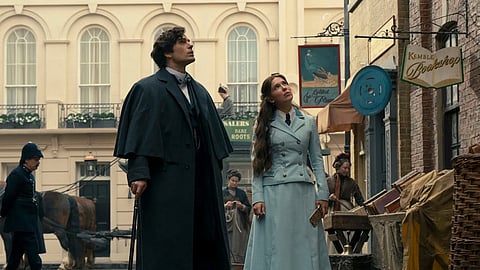
Millie Bobby Brown returns as the detective in Enola Holmes 3, and this time the case starts close to home: her own wedding day. The film opens with Enola set to marry Lord Tewkesbury (Louis Partridge) in Malta, only for the ceremony to be derailed when Dr. Watson (Himesh Patel) delivers the news that Sherlock Holmes (Henry Cavill) has vanished. What follows is a case involving a stolen war fortune, a returning villain in disguise, and a family secret that outlasts the empire that created it. Here's a full breakdown of the plot, the twist, and what that closing shot might be setting up.
At Sherlock's hotel room, Enola finds a scrap of lace and the word "Khost," a real city in Afghanistan, scratched onto a mirror in Morse code. Tracking down a soldier who saw Sherlock the night he disappeared gets her a dying clue: a word she first mishears as "Wrath," before realizing it's actually a name, "Rathe."
A day later, Tewkesbury's mother is also taken, and the hotel goes up in flames, seemingly to burn evidence along with it. Following the lace and a recovered war medal leads Enola back to a woman she's crossed before: Professor Adeline Rathe. Except that name is a cover. Rathe is Moriarty (Sharon Duncan-Brewster).
Moriarty, previously unmasked as Mira Troy in the second film, was the criminal mastermind Enola and Sherlock caught and handed to police, only for her to slip custody through a deal with a corrupt officer, the same soldier who dies early in this film feeding Enola the "Rathe" clue.
Once cornered, Moriarty frames her return as revenge against the Holmes family and disgust at what she sees as their hypocrisy. Both Enola and Sherlock clock that the explanation doesn't fully add up, and they're right. Revenge is only half the job.
The war medal ties back to Tewkesbury's godfather, and digging further uncovers the actual crime: British soldiers looted Afghan gold during the Battle of Khost, then sank a Maltese ship and pinned the loss on it to cover their tracks. Moriarty was never just chasing the Holmes name. She was hired to expose the Tewkesbury family's theft and, more practically, to locate gold that was never lost at sea in the first place.
Enola eventually clocks that she's been walked through the case rather than solving it independently. Moriarty needed a detective to do the finding for her.
Working from an offhand memory of Tewkesbury describing treasure hidden in the Maltese cliffs, Enola locates the gold and, with it, Moriarty holding Sherlock and Lady Tewkesbury in a dungeon nearby. A confrontation follows, and Moriarty is finally captured.
The fallout is where the film draws its actual ending. Tewkesbury chooses to return the gold to Afghanistan and turn in everyone involved in the cover-up, his own godfather included, a decision that costs him his title and his family's standing. It's the clearest statement the film makes: inherited reputation isn't worth protecting if it was built on theft.
Enola and Tewkesbury go on to marry where they left off, and because Tewkesbury has surrendered his title, Enola getws to keep her own surname. The wedding subplot was never really about the dress or the venue. It was about whether Enola could stay a detective and still choose a partner, and the film's answer is that the two aren't in conflict.
After the ceremony, Enola and Tewkesbury swim together, and the camera follows them underwater to a wreck: The Wrath of Adeline, 1863, the same ship Tewkesbury's father scuttled to hide his crime. Given that "Adeline Rathe" was Moriarty's alias, the ship's full name feels like a plant for whatever comes next.
Nothing is confirmed, but the sequel hook is unmistakable. Whether the franchise can keep running the "it's Moriarty again" card a fourth time is a separate question.