
- Entertainment
- Style
- Lifestyle
- Food & Drinks
- Tech & Auto
- Culture

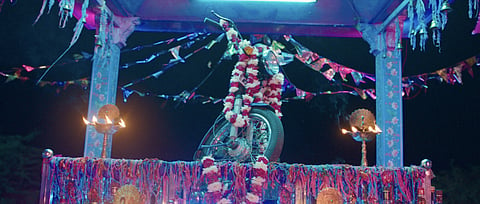
If we've learnt anything from delayed films and ‘problematic’ subject matter, one must make sure to watch Ritwik Pareek’s absurdist satire Dug Dug as soon as they get the chance. The protagonist of the film, streaming on Amazon Prime Video, is a rickety dark blue moped that insists on travelling the short distance back to the site where its owner died riding it. As it’s brought to police custody and seized—it repeatedly breaks all worldly entrapments, including metal chains and prison bars and escapes to the deserted roadside, overlooked by psychedelic-looking hoarding for a local magician.
What ensues is a hypnotic, Kafkaesque series of events that recreates a major psychosis of our times. At the suggestion of the local temple authorities, the moped is turned into a relic, a cult image around which a mystic, warren-like tradition comes up. The supernatural accessory gains followers from far and wide, as is often the case in the Indian hinterland, turning into a folk pilgrimage with a magnetism of the dusty steampunk kind.
What’s interesting, however, isn’t that it’s a satirical recreation of the manufacture of urban legends and superstitions in our culture. The question Pareek—who grew up in Rajasthan, very close to the making of countless such stories—seems to be asking is about the extent to which those involved in the manufacture, maintenance and expansion of these beliefs acknowledge the reality of their creation. To what extent do we remember the origin of our faith and at what point do we conveniently forget that they were a consequence of a circumstance?
Dug Dug is set in a dusty, unpeopled landscape—the arid foothills of the Aravallis streaked with thorny bushes wilting under the harsh desert sun. Cinematographer Aditya S Kumar, when he is not casting a spell on the viewer with his nighttime neons, populates his frames with silences and absences, both of which slowly come to be filled with the construction of a cult. Sanctioned by a presiding priest, approved by a crude active political system and funded by a body of people desperately in need of distraction and miracle, bit by bit, this totemic object associated with the other prevalent superstition—of death and spirits—is willed into existence as a beneficent force. A force you decorate with garlands and incense but also ply with lots of booze.
This is a film about symbols human civilisations come to foster. Pareek discovers a few of his own in the process, such as a balloon seller blowing air endlessly in a balloon, in a ridiculously long sequence that continues as the credits roll in the foreground. It is, of course, cut and montaged to convey a literal blowing up of the cult of Thakur-sa. It is masterful, as is the dual colour code of pink and blue that he chooses for the Order and devotees of his local deity. Not only are these colours reminiscent of the two bright colours you most associate with Rajasthan—pink for Jaipur and blue for Jodhpur—they also introduce an oddly absurd visual psychedelia in the daytime scenes.
That kind of thing is probably the best thing about Dug Dug. The film is courageous in its embracing of the ludicrous to convey bathetic satire. And it tickles most when the characters talk as if with a heightened consciousness of the silly enterprise, which is something that reminded me of the films of Yorgos Lanthimos and, again, Kubrick. Everyone is in on the joke, such as in the scene where Maharaj, the high priest, suggests that the memorial of a lover of libation must beget offerings of drink. Or when the police chief towers over the police station, standing in its courtyard day after day when the moped goes missing. The saturated consciousness possessed and performed by the characters works like an entrancing device.
What differentiates Dug Dug from another intelligent indie film is its rejection of complete tonal condescension. It instead chooses to implicate the viewer, in its final scene, in the making of the myth. At the end, the only voice of ‘reason’, the petulant constable Pyare Lal—petulant because he knows that the moped did not keep travelling to its site of consecration—realises the power the accidental god of his own making has come to gain. As the moped turns its lights on, as it is said to do on rare occasions to turn non-believers into believers, one only wonders whether keeping the flashback sequence of Pyare Lal and his fellow constables deciding to move the moped themselves, wordless, would have made for a much more powerful closer.
Such very minor quibbles aside, Dug Dug remains incessantly funny and impossible to stop watching, especially as it builds layer after layer of absurd realism. Produced by Ritwik and Prerna Pareek, the film, made in 2021, is executive-produced by Anurag Kashyap, Nikkhil Advani, Vikramaditya Motwane and Vasan Bala, and has earned rave reviews online as well as at film festivals worldwide.