
- Entertainment
- Style
- Lifestyle
- Food & Drinks
- Tech & Auto
- Culture

Few things are as they seem in Black Warrant, the splendid new prison drama series from the house of Vikramaditya Motwane.
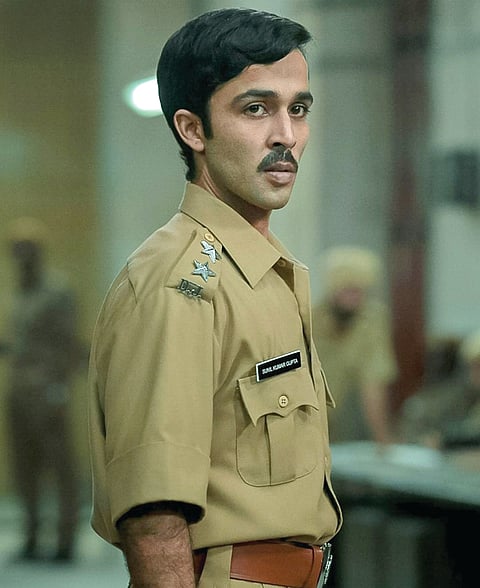
The first of all is the protagonist: the 20-something Sunil Kumar Gupta (nicknamed ‘Baby’), a frail and shy Delhi boy who applies to be an assistant superintendent at a notorious prison. You might predict either of two character development graphs for this diminutive young man: (a) his cowering everyman side will slip away once he faces the darkness of the prison, much like Vikrant Massey in the Haseen Dillruba world; (b) he will lose himself entirely and grow the kind of Machiavellian thick hide that we’ve seen classic screen softbois like Michael Corleone get used to wearing.
Neither of that happens for Sunil. Motwane and his team of writers and directors imbue him with the sort of languidity that allows one to fully bloom within the confines of the barracks of their own soul.
This is a significant juncture in the development of the small-guy protagonist. Even as lumberjack macho men in amusement-park franchise vehicles proliferate and the frustratingly ineffectual angry young man of the 70s refuses to register the rising modern-day disinterest in him, a few films have silently received the memo. The memo is: make the small guy big.
There’s immense potential in plumbing the depths of this character despite Vikrant Massey fast calling dibs on the seat elsewhere. The slick Lakadbaggha (2023) managed something similar with the martial-arts film. Black Warrant succeeds in quietly charting a distinct course for its small guy amid a content-led culture that believes firmly in the maxim that art is imitation. The writing assumes nothing for Sunil and, yet, it banks on the assumption of the viewer to bring all the hairpin bends to this small but steep hill.
Sunil is surrounded by big lugs in uniform, scowling prison inmates that even the compound snakes must shudder at the sight of, and one smooth-talking serial killer floating within the prison premises like an alpha spectre. References to his “softness”, vegetarian diet and unbecoming physical stature are made early on and then regularly through the episodes. He cannot be trusted in the brotherhood of his colleagues who throw behenchods around with the profuseness of Indian men spitting around in public. Narrative conditioning would have you expecting him to suddenly unfurl his wings as a surprisingly cerebral dark horse. If a guy can’t be hormonal, he must be patient. If he cannot freely dispense violence upon criminals, he must set about forging unscrupulous alliances.
The great thing about Black Warrant is that it doesn’t saddle Sunil with any of those things. He reaches for macho-ness, he embraces the art of manipulation, he hurts his girlfriend. But he is never made to overdo it, nor is his soft, city-boy core ever overwhelmed with overwhelming self-destructive tendencies or emotional consumption. As moving as these arcs may be, they are often clearly crutches and conveniences to bring drastic shifts to characters. In fact, the show almost never relies on sentimentalism except for the superbly shot final sequence where the peacock hiding within the prison emerges out of its chimeric, motif-like existence.
The balance and subtlety of the character graph of its protagonist never overpower the show’s unadulterated, flavourful drama. The prison is a workplace where allegiances between colleagues and collusions between unequal parties take root. Faustian pacts are established with the modern-day pragmatism that we are used to seeing across environments. The extramarital affair between Sunil’s colleague and their boss’s wife is wrapped up before it could all spill clumsily into where the true drama is—the prison.
Motwane and crew chapterise the dark individual cases, prison breaks and death sentences with the compartmentalised and unassuming precision of the serial format. It’s a returning reminder that the luxury of morality cannot be had in the “trashcan of society”. It must stink and adopt the troubles and trifles of the real world. The viewer must avoid pondering too much about things like crime and punishment. Even the horrific and haunting third episode, where rapist-murderer duo Ranga-Billa are hanged, slowly fades away as the viewer slowly internalises the inherent darkness of the prison and the physical and mental space it occupies in the world of the show. A lesser script could easily scatter the horrors of the prison and let them cast a dark cloud over the latter half of the show.
There could be another season, and we’re here for it. A lot remains in the book that it is adapted from. Liberties have been taken in the screen adaptation, including the fictionalisation of Prabha Dutt, the journalist who successfully appealed to the Supreme Court to interview Ranga and Billa. The show bricolages aspects of Sunil’s character, too—his Railways background prior to Tihar is omitted, two other siblings are done away with and colleagues are created based on the account Mr Gupta gives in the book, co-authored with journalist Sunetra Choudhury.
Zahan Kapoor embodies the sanguine uncertainty of his character, going from non-confrontational to self-assured and a host of other emotions on Sunil’s roster. The actor seems conscious of the weight of expectations he carries as the grandson of a globally renowned thespian, and he appears fully equipped to shoulder it. Sidhant Gupta appears, Hannibal Lecter-like, throughout the show, succeeding in charming as another character from history. Rahul Bhat, whose capability as an actor becomes more heightened with the fact that he isn’t in more films and shows (in an ideal world, we would want it to remain that way), is the deviant anchor of this show. In many ways, if the show successfully calibrates itself back to the everyday-evil setting, it is thanks to Bhat’s measured handling of all of this narrative emotional violence. He’s both Faust and Mephistopheles of this netherworld that he has accepted in return for normalcy.
I really hope Black Warrant doesn’t remain the best thing on Indian streaming this year. But I do have the intuition and experience to bet that it will. And I say this with less than a week to drop for the second season of the vastly capable Paatal Lok.