
- Entertainment
- Style
- Lifestyle
- Food & Drinks
- Tech & Auto
- Culture
As keyboard warriors—which is essentially the writer guild—we tend to romanticise the subjects of our penmanship. Read a zesty headline: “XYZ reveals it all.” “ABC is in her power.” Big Star One’s sunny disposition brightens the room, Big Star Two’s infectious laugh is charming the socks off everyone on set. We zoom into small details and find ambitiously grandiose gestures in them. If your subject is Vijay Varma, chances are the usual flourish-heavy word vomit, protein for starving abs in a story, doesn’t feel authentic. And that is perhaps the best challenge a writer can get.
At the risk of divulging trade secrets, these lavish appreciations are often whimsical interludes brought in to pad up a story when fodder is less. But Varma gives you no such crutch. He offers little room to romanticise and remains as real as they come.
“Accha, you’ve started freelancing now?” asks the 39-year-old actor, eyebrows raised, as I walk onto the Esquire India set. As if we’ve known each other for years. We have, technically—but I wasn’t expecting him to remember.
Our first meeting left a mark. I was a byline-hungry junior writer doing my first-ever print story for a fashion magazine and he was the breakout villain from Darlings (2022), keen to show a softer, more stylish side. We spoke about sneakers. The Nike Dunks that were lining a sneaker wall he had created at his new home. A pair of New Balances gifted to him by his friend and longtime collaborator, filmmaker Anurag Kashyap, had triggered his entry into fashion. Four years later, I would finally be seeing the sneaker wall in person. A symbolic full circle of sorts—for him, the accidental fashion boy; for me, a writer who never left the fashion room. But he’s still charmingly oblivious to the impact he’s made.

“I don't have many things to say about fashion. It doesn't consume me as much as my acting job does. Or my life does. It's something that I do to put my best foot forward,” he says without an ounce of pretence, sinking into the chair beside me. No false humility. No prepared lines. It’s refreshing, honestly. I’d much rather have his unaffected honesty than rehearsed talk about ‘expressing oneself through style.’
It’s a sobering Monday morning. I’ve folded myself into his couch, feet up, surrounded by the sound of ambulances and horns rising faintly from the streets below. Someone is arranging flowers in the hallway outside his apartment; apparently, Sri Sri Ravi Shankar was scheduled to visit his building. I am still shaking off the previous night: a dinner at home that spiralled into an afterparty with a celebrity guest I didn’t know, who offered me one last nugget of unsolicited wisdom: “There’s a beast inside you waiting to be let out. Take baby steps, and you’ll get there.” Thanks, babe.
Varma, in contrast, was a balm. Simple, fuss-free, with no pseudo-intellectualisms in sight.
“I don’t know how much a fashion interview could be exciting.
Is it exciting to read about people’s take on fashion?” he asks, genuinely confused. My heart did sink a little. Was the sky blue? Did I not go to war in my DMs over Jonathan West Anderson’s new Dior menswear collection?
I shrug. “I guess. It consumes my entire world. How you feel about cinema is how I feel about fashion. Sometimes clothing gives you identity. Buying it can be... cathartic.”
He nods with understanding. “I’ve had those moments,” he says,slowly. “At one point in my life, I was gripped with a certain life event which really threw me off, and I was struggling personally, and I just found retail therapy gave me some kind of respite in that moment. And strange as it may sound, it was a way for me to get past my obstacles at that point,” he says, acknowledging my world with his own experience. His fascinations over time have shifted—sneakers, watches—each phase like a new act in his personal story. Even his perfumes are inspired by the characters he has played.
“My sense of smell gives me the most authentic recollection of places and memories,” he explains, getting up to show me the bottles lined up on shelves in the room. He points to 212 by Carolina Herrera. “This one was for Darlings, because it feels flashy, which was how my character was,” he laughs.
For Mirzapur (2020), where he played twin brothers: “I used to change my perfumes according to which twin I was playing. One of them was a playful, wide-eyed innocent guy, so I wore the Gucci one, which smells minty and green,” he says, spritzing some on my wrist before picking up Tom Ford’s Black Orchid. “This was for the other brother, who was more structured, enterprising and in control.” In OK Computer (2021), his Saajan Kundu smelled like Intense by Issey Miyake. In Dahaad (2023), his psychotic serial killer, disguised as a teacher, wore Pleasure by Estée Lauder. “I felt like this is what a teacher would wear, and at the same time, it carries a little bit of mystery. Something that tells you that there’s more to this person.” I was out of wrists, but Varma was determined to give me a tour of his mini olfactory apothecary.
These small, sensory rituals are his method. A tactile way to shift between worlds. “Sometimes you have no time to get into character. I’d be flying back and forth between Mira Nair’s A Suitable Boy (2020) and Baaghi 3 (2020),” he says. “The spectrum of the work was very vast and different, and to get into that headspace in different cities and countries, there was no way I could just chant a mantra and come to a particular character. I found this to be one of the ways to get there.”
To get out of character, however, Varma took the help of fashion to show a softer side to him to the world. Playing a brutal character in Darlings was something that stuck with his audience, but being the anti-hero was never his only gamut.
“Yeah, I wanted to show a different side of me at that time,” he agrees, getting up to light a cigarette, looking out from the balcony. This different side of Varma would see him carrying off pussy-bow blouses and skirts that granted him a certain feminine appeal on red carpets and magazine editorials. “I was a bit troubled by the feeling that I might not get more opportunities. Because I’ve heard enough from others that, you know, typecasting is a thing.”
The comment hangs in the air, matter-of-fact but not defeatist. He was confident, perhaps even defiant, about breaking the system’s crusty habits, but understood that simply being talented wasn’t enough. “There are certain things which are part of the system. Prejudices that people carry. So I thought, maybe it’s good to just put myself out there, the way I am.” It was less about fashion and more about self-authorship. But it has worked in his favour so far, having played a heroic cop in Jaane Jaan (2023) and a serial killer in Dahaad. “I’d been more of a recluse. And that doesn’t work much for show business,” he smirks. “So whenever I do go out, it’s an opportunity for people to see me in a light outside of the work I do.”
Still, he gets the game. “Red carpet appearances? I don’t take them very seriously,” he says, and it’s something that has propelled him into the fashion scene as the new boy wonder. Just a few months back, I bumped into him at a Halloween-themed fashion party. Sensei Varma, with his douli hat, black kimono and a prop sword attached at his waist, had gotten the memo. “I have fun with it, but I try to keep my time on the carpet as short as I can. I’m more interested in what’s happening—the people, the event, the film. That’s the draw. The carpet is just the way to get there.”
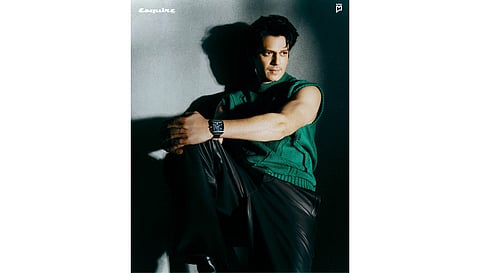
Working in fashion, you come to understand that although you can hire a stylist to create a new identity for yourself, carrying your clothing is just as much of an art as putting it together. Varma’s knack for wearing Amit Aggarwal on shoot day is the opposite energy compared to a delicate checkered green knit set, where his body language switched from rigid lines to a relaxed, languid softness. Understanding silhouettes and their integral relationship with movement is not something that most can master without understanding their backstory.
“When I shoot, or even when I walk into a room, I think I subconsciously consider how the clothes move,” he says. “My inspirations were never people. It was always characters. Like… Johnny Depp, playing everything from a delinquent to a pirate. Or films like Taxi Driver, or The Godfather… the way those suits were carried, the body language,” he finishes, animatedly.
There’s a particular glint in his eye now as he leans forward in his chair. “And then there’s Chaplin,” he adds. “I mean, just look at how he wore things. The hat, the cane, the baggy trousers, there’s an entire language in it. So many ways to wear the same hat.” He mimics a motion, a little shoulder roll, a shift of posture, and suddenly you see it. That quiet fashion theatre. A kind of wardrobe choreography that comes not from vanity, but character study. “I think about that. Even
Buster Keaton, or Daniel Day-Lewis in Gangs of New York… those audacious costumes, the centre-parted haircut. Outrageous. But it all worked. Because the energy was right.”
For Varma, each outfit he wears, especially the ones off-screen, carries the residue of these cinematic ghosts. “Sometimes a look reminds me of a guy who’s just come back from a long day at work and took a local train,” he says, dreamily. “Or a guy who’s been sitting in a jazz club, or someone who missed his bus and lit a cigarette instead.” None of these characters is real. But they help him inhabit himself. And maybe that’s the most stylish thing of all.
“I’m trying to find out more about me, yeah,” he says, his voice slowing just slightly, “and sometimes you find more about yourself through objects that you interact with. All your memories and experiences and everything you’ve assimilated together—that is you. But if you place this being in a completely different situation, something in it will change.”
It’s kind of a science experiment for him that feeds directly into his craft. Varma’s way of worshipping fashion is not entirely dissimilar to how I found escape within it. For many, fashion has been a way to find their own identity, and despite his hesitance to cop to consuming fashion as something deeper than a peripheral purview, Varma’s character studies give clothing that same weight.
He takes a personal interest in collaborating on the costumes of all his characters. “I always put myself with different objects, different kinds of outfits, colours, textures. I want to see how they interact with each other. You know, it’s like a chemical process.” He laughs. “I remember when we were doing look tests for Gully Boy (2019). We did everything. Mechanic, worker, the whole thing was dirty. Dirty nails, dirty teeth.”
There’s something almost innocent in how he approaches it. It’s not about a flawless final product, but the process of discovering the tiny eccentricities of details that shape a character. Inadvertently, it feels like I am getting an education in character study, which he somehow wraps in fashion lingo for me to understand. “Even with fashion, I’m interested to know… like I’m wearing an overcoat. How does it look? How does it make me feel? And how does it look from the outside? Because this mirror often lies. So you try to move around and see what is the best shape it can take?”
He gets up abruptly, pulls out his phone and scrolls through his photo gallery until he finds a picture of his next character from a project waiting to be released. He angles the screen towards me—long, tangled hair, prosthetic scars across his face, an unfamiliar presence entirely. “So now I am trying different chasma to see which one will go with this look,” he says. “And then we do all this prosthetic work to see which injury works better.” How do you know when you’ve landed on the right version? “You keep trying. The idea is that you have to be patient. None of this happens without patience,” he says simply. “It requires you to let go of all the trouble, all the discomfort you have to go through. And if I have to speak in today’s terms, it’s not a dopamine hit, it’s serotonin.” He smiles knowingly. “You take a long time to build something.
You delay gratification as long as you can… to get something, the results of which you’ll see perhaps the next year.”
As was his goal for when we first met, fresh off his success with Darlings, in his current era, he is hoping to lay low. “I’m really trying to hide most of myself right now,” he admits later, almost sheepishly. “Because I have some interesting work coming out this year. And I feel like it would be a disservice if people know too much about me. Those characters are far more fascinating than my life,” says Varma, who will be starring in director Nagraj Manjule’s upcoming web series
Matka King.
As we’re wrapping up our conversation, he quickly leaves the room to fix himself a plate of poha. I politely refuse a second breakfast. Being from Indore, I explain to him my particularity for the correct way to make poha. I approach it with the same snobbery as Italians do with making pasta al dente.
It needs to have the right amount of softness. He instantly brightens up at the mention of my hometown, Indore. It was a memorable stopover when he would travel from Hyderabad to see his grandmother in Kishangarh, Rajasthan. “It would take almost two days to reach, and we would get off the train to go eat poha across the road. It would have Ratlami sev on top, and if you felt extra edgy, you could ask for some chopped onions too,” he remembers.
I am duly impressed, but unsurprised, by Varma’s attention to detail when it comes to the correct art of poha-making. He moves through life with a kind of forensic attentiveness, clocking people, rooms, silences and applying the same slow-burn logic to his acting, peeling back characters layer by deliberate layer. Or adding that extra edge with some new toppings to enhance the flavours. That patience shows up in the roles he gravitates towards: complex, contradictory, never easy.
Just as I’m about to step out of his home, he pulls me back to show me a wall. The wall. The sneaker wall. Expanded now—new colourways, a few pairs he’s emotionally outgrown, and one gleaming silver Onitsuka Tiger he’s already mentally styling for a future red carpet. A canon moment, undeniably. But more importantly, a small window into Varma’s operating system. Like a cat with nine lives, the sneakers sketch out all the different lives he’s lived, but they aren’t about obsession or excess. What they really reveal is his appetite for information—a collector not of things, but of insight.
Credits
STYLING: KOMAL SHETTY
PHOTOGRAPHS: AMITAVA SAHA
MAKE-UP: SOMA RAJAN HAIR: PRASAD BHANDARY
DIGITAL ASSISTANT (PHOTOGRAPHY): GIRISH BALAKRISHNAN
FASHION INTERN: UNNATHI SHETTY
BOOKINGS & PRODUCTION: VARUN SHAH
CELEBRITY PR: SPICE OFFICIAL