- Entertainment
- Style
- Lifestyle
- Food & Drinks
- Tech & Auto
- Culture

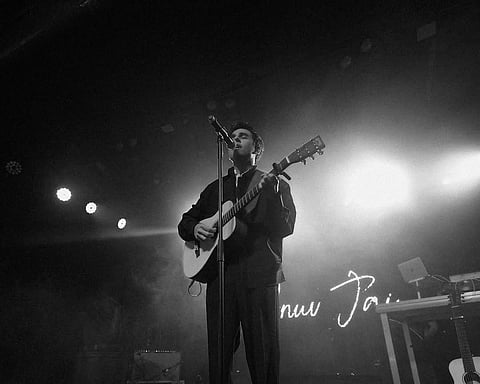
“If men don’t have words, maybe my songs give them those words." That’s Anuv Jain, in his soft-spoken, disarming way, explaining why his music has slipped so seamlessly into the emotional lives of a generation that loves indie pop.
Ever since Gul first turned him from an indie hopeful into the voice you couldn’t escape on late-night playlists, Jain has carried the reputation of a confessional songwriter. His verses both diaristic and relatable, the kind that feel like they were written for you alone include popular hits like Baarishein, Husn, and now Arz Kiya Hai in a way are words you text but can’t quite say out loud.
Perhaps because not everyone is ready to be vulnerable and confident professing their feelings.
With Arz Kiya Hai, his debut collaboration with Coke Studio Bharat and the electronic duo Lost Stories, Jain steps into new territory. It’s a track that marries his acoustic intimacy with classical flourish of harmonium and modern textures. It is a song that feels at once nostalgic and fresh, rooted in tradition yet unmistakably contemporary. For Jain, it also marks the realisation of a teenage dream: to see his music find a home in the Coke Studio canon.
In an exclusive conversation with Esquire India, Anuv Jain speaks about making that dream a reality, what it means to write from memory and heartbreak even after marriage, and why he still considers himself a student of the craft.
Congratulations on 'Arz Kiya Hai'. It’s your first Coke Studio Bharat collaboration, with Lost Stories. How has the response felt? and how did the collaboration come about?
Amazing. Honestly, there was such a long wait for this one, I was getting impatient. The day it finally came out, I was just relieved. The response has been overwhelming as people are making covers, dancing to it, even painting to it. That’s the best feeling, seeing a song take on its own life.
It actually came to me as a surprise almost like a wedding gift from my manager. On the night of my wedding, he told me we’d be working with Coke Studio Bharat. I was overjoyed, and my brain started buzzing right away. From there, it was all fresh ideation.
And Lost Stories—were they always part of it?
Not at first. I needed a producer, and I had a vague vision for the track but nothing concrete. Rishabh (Joshi) from Lost Stories is a close friend. I’d loved his Marigold Sound System album, and thought that vibe would suit perfectly. We sat down, bounced ideas, and the song grew out of those sessions.
There’s an intimacy to your music. How do you write your lyrics?
There’s a line in the song "jo bhi likha hai, jiyaa hai"—that sums it up. Everything I write is either something I’ve lived or something I’ve seen closely. Arz Kiya Hai was no different. Every line is literally my thoughts. That’s where music comes from for me—my own stories, or the stories that I see around me. My job is to take them and fit them into this economy of words.
So, is the process of creation entirely in isolation or you brainstorm with friends or family?
Always. My mom has been my sounding board for years. This time, my twin sister was in town, so she got deeply involved too. We’d go for walks in our garden in Ludhiana, tea in hand, while I typed lyrics into my phone. They’re like my in-house editors. Things that don’t make sense get filtered out immediately. I call them my “reducers”—they cut the excess and keep the essence.
Your songs often give men words they can’t say. Does that come from your own openness, or has writing made you vulnerable?
Not consciously. I think I’m just honest on the page. There are days I’m deeply emotional and days I’m very closed off. Music gets written on the days when I want to scream my feelings out loud. That’s when songs come. And yes, a large part of my audience is men. I think they find comfort in the vulnerability, even if it still feels taboo in some circles. If my songs can give someone the words they don’t have, or help them recognise their emotions, that’s enough.
You started independently recording, producing, putting your music out yourself. Now you’re on Coke Studio Bharat. How does that journey feel in hindsight?
Incredible. I’ve seen my songs grow from 50 listeners to millions. None of it was orchestrated, it just happened organically. I would put out music, people connected, and the community grew. Working with Coke Studio was literally a teenage dream. At 16, I would imagine being part of it. Fourteen years later, it happened. Half my life, basically. That feels surreal.
How about writing about heartbreak—given that you’re now married, how do you plan to write about it?
(Laughs) I still have plenty of stories left. I’m 30 years old and I’ve only written 14 songs. That’s not enough. I’ll draw from my own past, but also from people around me. If a friend goes through something intense, I love translating that into a song. So, heartbreak isn’t going anywhere.
Finally, what’s next for you?
This year is all about learning. Experimenting. Becoming a student again. Last year was about milestones, this one is about growth. I don’t want to reveal specifics; I’d rather people notice the evolution in the music itself. But I promise, it’ll be different, and hopefully something people can get behind.