
- Entertainment
- Style
- Lifestyle
- Food & Drinks
- Tech & Auto
- Culture
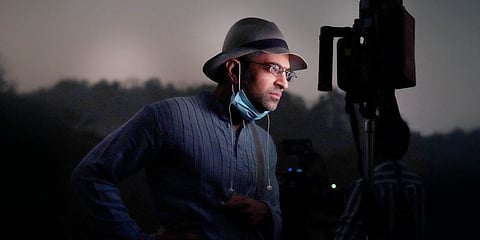
Richie Mehta is to real, hard hitting cinema what Imtiaz Ali is to the coming of age romance and travel genre. He envisions a cinema rooted in reality, and his inspirations stem from the society at large.
The Nirbhaya case moved him to capture it on screen and Delhi Crime went on to become an Emmy winner, a maiden win for India. When he heard about illegal ivory trade, he wanted to bring the story of its resistors onscreen and that is how Poacher materialised. He wants to create cinema based on nature and wildlife, and championed the same as the Goodwill Ambassador for the recently-concluded All Things Environmental Film Festival.

When we caught up with him, the Canadian filmmaker was at Ranthambore, researching the subject of his next. He talks to us about why wildlife crime interests him as a genre, what led to Delhi Crime and its big win and why he is no longer a part of the show.
Esquire: There are very few films in India that address wildlife or environmental issues – do you think there’s a gap in representation and that this needs to be addressed?
Richie Mehta: Not only in India but globally, we are not addressing the issues facing humanity and certainly, in places like India where the on-ground impact is huge because of extreme climates. I feel the film fraternity can easily address these issues – for instance, having an anti-environment villain in a masala film helps and it doesn’t change the makeup of the masala film in any way.
ESQ: Earlier this year you made Poacher. Why did you think it was an important story to tell?
RM: I happened to encounter wildlife crime fighters in Delhi and Kerala while working on my documentary India in a Day (2016), which was crowdsourced footage from all over the country in one day. When I received footage from Wildlife Trust of India on ivory trading, I found it very interesting and ended up calling the Trust. They connected me to the wildlife crime team and gave me their story. They were basically giving up their lives for environmental causes. I was inspired by their selflessness. We believe this generation is self-absorbed but they were not like that at all. In fact, they were more giving than anyone I have ever met. I wanted to take these stories and bring them into the mainstream so the public can help in it.
ESQ: How did Alia Bhatt become a part of the project as its executive producer?
RM: I got financing out of an LA-based company called QC Entertainment. They let me make the series I wanted to make and we collaborated independently. I showed it at the Sundance Film Festival in the US and sold it to Amazon Prime Video India. I was dealing with Alia Bhatt about something else when I told her about Poacher. She wanted to see the film and loved it. She asked, ‘how can I help you with this’. That is how she got onboard as the executive producer to help us promote it. She believes in all these causes.
ESQ: Your filmography is full of stories that are realistic, be it Amal (2007), Siddharth (2013), Delhi Crime (2019) or Poacher (2024).
RM: Real life has much more drama than we can conjure and the audiences believe in watching something real. They are moved when the story is real. It is a way to penetrate people’s hearts and minds. I am greatly fascinated by the world we live in. My upcoming projects are also real-life stories. I just can’t get enough of the reality of the world we live in we live in.
ESQ: Delhi Crime became the first Indian show to win Best Drama at International Emmy Awards. Tell us how you conceived the project?
RM: I happened to meet the former commissioner of Delhi Police, Neeraj Kumar, for some other reason and he suggested I do something on the case (Nirbhaya) and that he would help me get in touch with the right people. It was fresh at that time and piqued my interest. He gave me the files and the verdict that had come in and asked me to read it. I then met former-DCP South. Chhaya Sharma, (who led the special investigation team that cracked the case) and she and her team were incredible. I thought the best way to address this issue would be by looking at it through the prism of sexual violence against women.
ESQ: Tell us about the casting of Shefali Shah in the lead role?
RM: Our casting director Mukesh Chhabra believed in her and felt she was the right fit. Once I met her, she just felt right for the role of Vartika.
ESQ: Why aren’t you a part of Delhi Crime’s upcoming seasons?
RM: It is very straightforward – I have other projects that I’m interested in pursuing. To me Delhi Crime was about the first season and focusing on what the crime was, what unfolded and its relevance. That’s what I wanted to explore. I am no longer writing or directing it though I look forward to seeing its new season. Poacher exists because I had time to do it and it’s about evolving. I get very excited when I take on a project and I don’t know where it’s going. After Delhi Crime’s first season, I knew where it could go and it wasn’t exciting for me.
ESQ: How do you think Delhi Crime’s win at the Emmys has changed the way Indian content is viewed globally?
RM: I do feel there’s increased respect and acceptance of Indian content. No question about that. Indian content has also become very sophisticated and people appreciate that. Moreover, more than winning, getting nominated every year at the Emmy’s itself is a huge win. I feel it is more difficult to get nominated than to win.
ESQ: Tell us about your next project - Boy from Andaman
RM: It is one of the projects I am working on as executive producer. Parinaz Jal, the director’s assistant in both Poacher and Delhi Crime is directing it so I want to support her vision. She has an amazing voice and there’s an embedded environmental message in the film. I am also working on my own project which I am writing and will be directing. It is a story rooted in India but has a global appeal.