
- Entertainment
- Style
- Lifestyle
- Food & Drinks
- Tech & Auto
- Culture
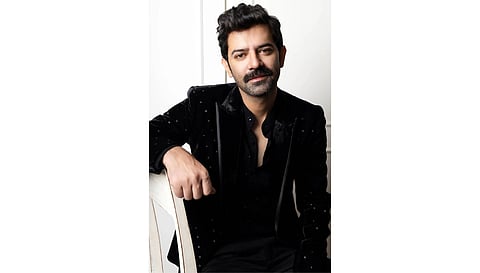
At the dawn of the 2010s, Indian television belonged to a man who spoke largely through clenched jaws, narrowed eyes and the occasional destruction of expensive office furniture. As Arnav Singh Raizada from Iss Pyaar Ko Kya Naam Du? (2011), Barun Sobti became the centre of a very specific, nationwide hysteria. He laid the foundation for a career built almost entirely on playing men who are fundamentally incapable of articulating what they feel.
From that toxic, irresistible romance to the suffocating trauma of Garundi in the staggering police procedural Kohrra, Sobti has cornered the market on the morally grey, internally fractured Indian male. And historically, we—the audience—have eaten it up. We love a red flag wrapped in a tailored suit. Somewhere deep down is the collective, delusional fantasy that someone—usually a woman—finally fix the emotionally lobotomised man.
Sobti, completely stripped of actorly delusion, knows exactly why this works. “You’ve hit the nail on the head,” he tells me, unbothered by the psychoanalysis of his own legacy. “Anything that is unavailable is more desirable. So no, I don’t see Arnav very differently now.” He mulls it over for a second. “I heard Denzel Washington say somewhere that there has to be some kind of mystery in an actor. All of your private life can’t be on the table.”
But here is my frank take on Barun Sobti: the great mystery is that there is no grand, tortured mystery at all.
As a journalist, you sit across from too many actors desperate to sell you their profound trauma. You brace for flourish-heavy word vomit about “absorbing the pain of the universe.” Instead, Sobti treats his craft with the pedestrian bluntness of a guy filing his taxes.
“Scriptwriting is like mathematics,” he states matter-of-factly. “It either adds up or it doesn’t. You know if you want to do it or you don’t.”
He doesn’t pull from a deep well of personal despair to build a character. He just looks around the room. “Sometimes the parts I play are very different from who I am. I have a very old friend who is a very funny guy. Sometimes I borrow things from him.” It’s a sobering admission. The devastatingly complex men on our screens are often just stitched together from the mundane reality of his daily life.

This absolute refusal to drink his own Kool-Aid explains the most subversive move of his career. At the absolute peak of his television fame, when he could have easily monetised that image until it bled dry, he walked away. He didn't chase the mainstream Bollywood machinery that routinely ruins good actors by demanding they become algorithmic stars.
Did he know what he was moving toward? “I’m not God,” he chuckles, a raspy, unguarded sound. “I desired a few things. They evaded me for a little while. But now I’m doing the kind of work I always wanted to do.” He credits this seamless transition to the anchoring force of his wife. “She told me, ‘Don’t do bad things, you’ll get harassed at home.’ And if you do bad things, you’ll also get called out.”
That brutal grounding translates to how he dissects his scripts. I float a sweeping, slightly pretentious theory to him about Kohrra: I suggest Garundi carries a destabilising sense of shame, and that shame is a far more lethal emotion for men than anger. Sobti listens patiently, then dismantles my thesis with precision.
“I don’t think shame is more destabilising. I think anger is,” he corrects me—not with arrogance, but with the weary wisdom of someone who actually understands male volatility. “You make the worst decisions when you’re angry. So shame, no. Anger, yes.”
A seismic television exit, a calculated digital resurrection, and a total refusal to play the PR game. Now, the man who practically invented the brooding anti-hero is tired of the intensity. In Raat Jawaan Hai (2024), he pivots into distinctly 'green flag' territory, playing a father navigating domestic trenches. The shift happened entirely by accident, triggered by the universal exhaustion of trying to find something light to watch on a Tuesday night.
“One night, my wife and I sat down trying to figure out what to watch. Everything felt so intense. That’s when I realised I needed to do something lighter,” he shrugs. “Secondly, I wanted to figure out my own range. I can complain about what’s being made, but what is my range?”
That range is about to stretch into entirely uncharted, chaotic territory. Next, he is headlining a comedy directed by Jaideep Sarkar, playing a bisexual character alongside Konkona Sen Sharma and Aditi Rao Hydari. It is a choice that permanently obliterates any remaining traces of the conventional Indian leading man playbook. “We often reduce people to how successful they are or what their sexuality is. We’re much more than that,” he says, his voice shifting into a register of genuine thrill.
Before we sign off, I try one last time to find the tortured artist trope. I ask if there are challenges to carrying the weight of characters like Garundi. He bursts out laughing.
“Oh, f***. Can I say f***?” he grins. “No, actually, I had a great time. We weren’t forced by our parents to become engineers or doctors. We raised our hands and said, ‘I want to do this.’ We’re solely responsible for it. If I start cribbing about this job too, then God help me.”
And perhaps that is the ultimate luxury of Barun Sobti. To survive the blinding hype machine, bypass the traps of stardom, and come out the other side as a spectacularly well-adjusted man who just happens to be brilliant at his job.