- Entertainment
- Style
- Lifestyle
- Food & Drinks
- Tech & Auto
- Culture
The first time I saw Alia Bhatt in front of a camera, she was barely eighteen. It was 2012, a Filmfare cover shoot alongside Sidharth Malhotra and Varun Dhawan, and there was something unmistakably raw about her presence. A flicker of nervous energy but also a startling ease, a natural understanding of light, frame and movement that most actors take years to acquire. Even then, she seemed instinctively aware of how to occupy space. She wasn’t performing. She was owning.
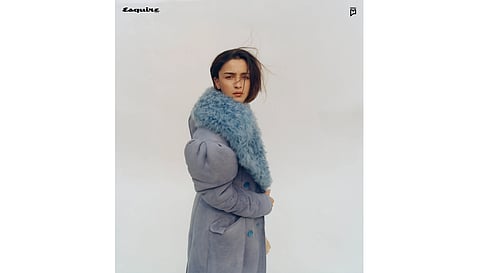
Thirteen years later, when Alia walks onto the Esquire India set for our first anniversary cover, that same spark still exists. Only now, it’s steadier and calmer. The nervous energy has softened into assurance. The instinct has evolved into command. What once felt like raw enthusiasm now carries the weight of lived experience, personal transformation and emotional depth. If 2012 Alia was kinetic possibility, 2025 Alia is quiet certainty. Less restless. More rooted.
She arrives on set right on time. No entourage theatrics. No starry fuss. She listens carefully, engages fully and offers more than what’s asked. A photographer’s muse, a videographer’s ally, a team player in every sense. Between outfit changes, lighting resets and video takes, she checks her phone often—maybe for social media, maybe for work updates or maybe for one reason alone: her daughter, Raha. And then, in one of those sweet, rare moments a workday occasionally presents, Raha arrives on set.
For a few minutes, the atmosphere changes. The superstar recedes. The mother steps forward. Alia scoops her into her arms, murmuring soft nonsense, stealing seconds between takes. It’s a glimpse into a reality that now defines her far more than box-office numbers, awards or global recognition.
Later, when we sit down for our conversation, it becomes clear: this is no longer a story about an actor at the peak of her career. This is the story of a woman who has discovered an entirely new axis around which her life now revolves. And it has changed everything.
I start by asking Alia about the last two years…the changes that have happened, the emotional density of motherhood, the professional whirlwind, the internal recalibration. She pauses, not theatrically but thoughtfully. As if searching for a memory that no longer quite exists in its original form. “Truly a lot has changed,” she says. “Every now and then, I feel I have a glimpse of who I used to be. But I don’t think I fully remember what my core was before becoming a mother.”

Motherhood has brought about a shift so fundamental that her earlier self now feels like a faint echo. “It’s such a massive change. It happens over the course of nine months. You feel your body, and your mindset, transforming. But when you see the child that you’ve made come to life, the scale of that change is so profound that it’s almost impossible to go back to who you were before.”
On the biggest internal change, her answer is disarmingly honest. “I don’t remember that,” she says simply. She describes it as a complete rewriting…emotional and physical, even spiritual. The change has become her new reference point. “It’s driven by far more purpose now,” she says. “It comes from a quieter place.”
Quiet, in Alia’s case, does not mean passive. It means deliberate. It means decisions are no longer impulsive and ambition is no longer frantic.
A few months earlier, she was honoured at the Red Sea Film Festival with an award recognising her impact, a milestone that might invite reflection for anyone. She admits, though, that she resists lingering on her own journey. “I’m naturally very self-aware, so I tend to overthink it,” she says. The award, aptly named the Horizon Award, resonated with her precisely because it didn’t suggest arrival, only continuation. “It gives me the feeling that it’s just the beginning.”
When she stepped onto the stage to accept the award, she chose not to prepare a speech. She wanted to stay inside the moment; unfiltered, unscripted. “I ended up just talking about how I feel as an actor,” she recalls. “I feel my calmest in front of the camera. It’s like I’m breathing with it. It feels completely natural.”
There is something profoundly revealing in that admission. For all the chaos, pressure, expectation and noise that surround her profession, the camera remains her sanctuary. “If I sit and reflect too much on my journey, I risk losing that primal joy…the simple peace of being in front of the camera. That’s the feeling I stay connected to.”
Across her career—Raazi, Gangubai Kathiawadi, Jigra and now Alpha, Alia has often been placed inside worlds traditionally governed by male energy. As Esquire, a magazine that examines masculinity in all its evolving forms, I ask her what these roles have taught her about it.
“I feel like we all have masculine and feminine sides. They surface at different moments in our lives.” She says her masculine energy was dominant for a long time, until motherhood reoriented her emotional centre. “But whenever I’ve tapped into that masculine energy in front of the camera, I’ve really enjoyed it.” She pauses. “It felt surprisingly familiar.” That familiarity, she explains, is grounding.
She speaks of the weight, restraint and stillness she found in Gangubai, her turn as a woman tricked and trafficked into prostitution in Mumbai’s red-light district, who rises to become an underworld madam through survivor’s ruthlessness and shrewd political alliances. “She has such a deep bass in her voice,” she says. “I found that it centred me. It brought a stillness to my performance, because you end up doing less. There’s more emotion in the eyes.”
It’s a philosophy that mirrors her life today: fewer gestures, deeper meaning. Less performance, more presence, more power.
On the topic of power, Alia dismantles its most familiar definitions almost immediately. “For me, power is extreme comfort with who I am, and extreme self-belief,” she says. It has nothing to do with arrogance. “It comes from clarity, belief and sensitivity.”
She sees herself as both leader and collaborator. “I feel I’m naturally a leader, but I’m also a team player. And even as a leader, you have to make people feel that you’re part of the team.” Power, she believes, lies in recognising your place within something larger. “You’re only bringing one part of what’s needed to the table. The rest has to come from others.”
The first time Alia stepped onto the other side of the table (as producer) was with Darlings. It wasn’t a dramatic declaration or a grand pivot. It was instinctive. Almost inevitable. When I bring it up, she doesn’t frame it as a power move or a milestone. She frames it as perspective. Asked what producing taught her, she answers without hesitation. “A lot. Just looking at the script as a whole, instead of only my part. Being able to envision the film from every character’s perspective…from a much larger lens…started with Darlings.” She’s careful not to overstate her role, admitting she wasn’t in the edit room or making technical decisions she doesn’t fully understand. What changed, instead, was how she began to see cinema itself.
“You realise how difficult it is to pull off even one day of shoot,” she says. “Your sensitivity towards producers becomes way more; how much they deal with behind the scenes just so we’re comfortable on set.” She credits her father, filmmaker Mahesh Bhatt, with early exposure to the invisible machinery of filmmaking, but admits that being inside that process is entirely different from watching it from the outside.
“As an actor, you’re looking at your part, your line, your situation. Did I do that take well?” Producing forced her to zoom out, to see how many moving parts must align for a film to work: timing, casting, logistics, emotion, rhythm. “That macro lens was my biggest learning,” she says. It’s the same lens she now applies to her career choices and to her life.
Her next release, Alpha, places her at the centre of a large-scale action universe, a genre still largely defined by male actors, male bodies, male mythology. When I ask whether it feels like responsibility or simply the next step, she doesn’t romanticise it. “It’s a very big challenge. It’s not a tiny challenge at all,” she says. She draws a parallel to Gangubai, a film that left no room for ambiguity. “We went in with a completely front-footed tone. There was no middle ground. It was either going to connect or not.” She remembers the scepticism clearly: her age, her physicality, and the doubts about whether she could carry a role of such weight. She reflects, “There was a lot of conversation…But we did what we did. The film released at 50 percent theatre capacity (COVID rules). And it worked. And that mattered.”
With Alpha, she finds herself at that junction again. But she’s quick to dismantle the gendered framing. “If the story is strong and the world is exciting and new, whether the character is male or female shouldn’t matter.” Action, she insists, is just a genre. “When you walk into the theatre, you need a story.” That belief extends beyond Alpha into her broader view of Hindi cinema today. She is cautiously optimistic, sensing a shift in how strength is defined, no longer tied to aggression or gender. “Strength doesn’t have to be loud. Even if strength is gentle, it’s still strength.” She speaks of male characters allowed softness and female characters permitted ferocity, without either being treated as anomalies. “The fact that it’s becoming normalised means it’s okay,” she adds. “It’s not surprising anymore.”
Fame has never been abstract for Alia Bhatt. It arrived early, and for most of her adult life, visibility has simply been part of the job. But motherhood, she admits, has quietly redrawn the boundaries of what she’s willing to share. “There are days when I wake up and think, okay, I just want to delete my social media and be an actor who acts. I don’t want to keep up with this conversation again and again,” she says. Then comes the hesitation. “I know that would really cut off contact with so many people who’ve supported me from the beginning, and I don’t want to do that.”
However, what has changed is where she draws the line. “When it comes to really putting out your personal life…now my personal life is so personal that I find it a little bit difficult.” She laughs and continues, “My photo album is full of Raha. I actually have to work hard to take pictures of myself.”
Public scrutiny has followed Alia into every chapter of her life, including her marriage. Commentary, memes, speculation… the internet has had a lot to say about her relationship with Ranbir Kapoor. But when she talks about it, there’s no defensiveness. Only distance. “The noise doesn’t reach us. Because it’s not real.” What people respond to, she explains, are fragments…moments stripped of context. “They’re responding to three-and-a-half seconds or seven seconds of what they’re seeing. We’ve been together for seven years. That’s way more seconds than what people are commenting on.”
Sometimes, they laugh at the memes. Often, they don’t even see them. “Even the B of bother doesn’t enter our life,” she says, smiling. Then she offers an analogy. “If you’re in a room of fifty people, maybe only four actually care about you. The rest might be thinking terrible things, but you can’t hear them.” Those inner thoughts, she points out, have always existed; there just wasn’t a platform that amplified them. “Is my reality changing? No. Is my family dynamic changing? Not at all. Am I living my dream? Yes. Do I go to sleep every day with a grateful heart? One hundred percent.”
When Alia speaks about home, the language she reaches for is stripped of romance. There is no metaphor, no flourish. Instead, she talks about something far more elemental. “Home is where you feel safest.” She adds, “As we come into the world our strongest instinct becomes survival and around family, that instinct softens. You just feel like everything is okay. Time passes smoothly. You feel protected.” It’s a sentiment that quietly answers years of public speculation about her relationship with Ranbir Kapoor, not because she feels the need to defend it, but because the truth, for her, is deeply uncomplicated. “The most important thing in life is to be safe. And there’s no safer place for me than being around them.”
If partnership brought Alia stability, parenthood revealed an entirely new register of love. Not just in herself, but in Ranbir. She says she always knew he would be a present, hands-on father; they had spoken about it, wanted it, felt aligned long before it happened. “He’s sensible that way,” she says.
What surprised her was something else. “He’s far more sensitive than he lets on. He’s shy, so he holds a lot back. But with her, he’s incredibly expressive. His eyes, his face, everything lights up. He almost becomes a child himself.”
The earliest days after Raha’s birth were marked by exhaustion and vulnerability. Ranbir took a month off work even before she arrived, staying back because Alia wasn’t keeping well and needed support. When he returned to set, only one thing changed: urgency. “He would go for a shoot and literally run home,” she recalls. “He’d run straight into the room to see her.” Even now, she adds, he keeps an eye on the baby camera; the moment Raha wakes up, he’s on his feet. If she’s arriving home, he’s in the lobby to pick her up. “His love is very obvious,” Alia says. “He can’t help himself.”
If motherhood softened anything in Alia, it wasn’t her drive, it was her pace. She is still ambitious, still deeply invested in her work. But ambition, she says, no longer means saying yes to everything that comes her way. It means discernment. “I’m still very driven. I’m still very ambitious. But my ambition has become more centred. I’m saying no more than I’m saying yes. There’s only this much bandwidth that I have at this time… Otherwise I won’t be able to be as present.”
Earlier in her career, things were different. “Whatever came my way, I just went for it,” she says. Now, she’s more deliberate. “I don’t want to be running helter-skelter from pillar to post. I want to wake up and be present.”
She’s clear-eyed about the privilege this shift requires. “I’m speaking from a position where I can afford to make these choices right now. But I also have to be in a sane, sound mind, because I’m responsible for another life.” It isn’t less work she wants; it’s work that allows her to remain intact.
When the conversation turns to the future, Alia doesn’t speak in terms of peaks or milestones. She speaks in terms of distance. She says, “You can’t be successful just once or twice. You have to be successful consistently.” She references Amitabh Bachchan, not as comparison, but as context. “He didn’t become who he is overnight. It was years and years of consistency. Showing up. Being there for the craft. It’s not about how high you fly but how far you go. And how long you keep going.”
The one thing she’s clear about the future: she needs to act. “I have to be on a film set. I can’t not be.” But alongside acting, there is another future she is quietly building. “I really want to build my production house. Ten years from now, I hope I’m making films that are loved.”
As the interview winds down, what becomes clear is that Alia Bhatt is no longer operating from urgency or insecurity. She is not chasing validation, nor resisting it. She has found something far more sustaining. A centre. The raw magic that once defined her is still there along with the instinct, the ease, the fire. But it is now anchored by something deeper: clarity. Choice. And a life that finally feels emotionally safe.
Credits
Chairperson: Avarna Jain
Editor: Rahul Gangwani
Creative Direction and Styling: Vijendra Bhardwaj
Photography: Rid Burman from The Artist Project
Editorial Mentor: Saira Menezes
Managing Editor: Sonal Nerurkar
Deputy Editor: Mayukh Majumdar
Hair: Amit Thakur from Sparkle Talents
Grooming: Puneet Saini
Assistant Stylist: Komal Shetty
Nails: Anisha Mulchandani from The Artist Project
Art & props: Reshma Rajiwdekar
Bookings Editor: Varun Shah
Production: P Productions
Artist Reputation Management: Hype PR
Esquire India Editorial: Saurav Bhanot, Prannay Pathak, Nitin Sreedhar, Abhya Adlakha, Rudra Mulmule, Riti Ghai, Kashish Mishra