
- Entertainment
- Style
- Lifestyle
- Food & Drinks
- Tech & Auto
- Culture
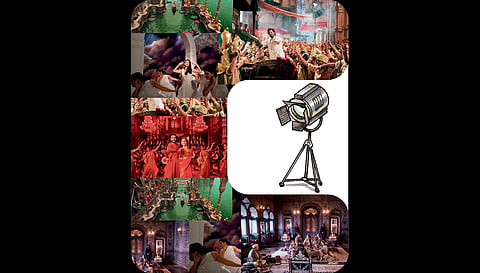
The profligacy of Bollywood productions used to be something of a stereotype. When I was growing up in the late 1990s and early 2000s, film magazines used to joke about Bollywood producers adding last-minute songs shot in European climes, just for the heck of it. In 2025, when you look at a big-budget Bollywood production these days, it’s quite visible where the money has been spent. One of the areas where serious creators seldom cut corners is production design. Dizzying mansions, medieval palaces or hundreds of dancers swaying in unison at futuristic-looking nightclubs—production designers today are leaving no stone unturned in the quest to bring these stories to life.
Take the 2023 Amazon Prime Video series Jubilee, for example. Co-created and directed by filmmaker Vikramaditya Motwane (Udaan, 2010; Bhavesh Joshi, 2018), Jubilee is a period drama involving the Bombay film industry of the late 1940s. Every visual in the show is meticulously prepared to give the audience a ringside view of 1940s Bollywood—dreamy, opulent studios, the coiffured heroines and Brylcreem’d heroes and the Art Deco-styled buildings of the era. In some of the violent scenes of the show, the overall visual palette resembles the slick aesthetics of a Frank Sinatra movie.
“Jubilee was easily one of my favourite projects,” said production designer Aparna Sud during an interview. “When I initially read the script and met the director, we had decided to refurbish some existing, very old places in Mumbai. But eventually, we realised that contemporary audiences probably would not connect with that world, so we decided to build everything on our own.” This dedication and meticulousness are on display in every frame of Jubilee, including one where the actor Aparshakti Khurana is signing autographs in front of Empire Cinema, a once-famous, now-defunct Mumbai cinema hall that used to be a bit of an institution. The original building was replaced with a then-in-vogue Art Deco styled building in the late ’40s, before the business shut down in 2014. I was quite thrilled to see Empire Cinema in the series and moments like that one make Jubilee a treat for history and architecture nerds.
Similarly impressive are the premises of the studio Roy Talkies, the setting for much of the drama and the intrigue in the story. This is where illusions are created for the masses, and so it had to look every bit the dream-factory. You feel like you have stepped out of a time machine, rubbing shoulders with 1940s movie stars. “Creating a world from scratch is always a team effort,” said Sud, who has also worked as production designer on films like Neerja (2016), Meenakshi Sundareshwar (2021) and Sandeep Aur Pinky Faraar (2021). “You have a production designer, you have an art director who is in charge of actually building everything the film needs, you have a set decorator and then you have assistant art directors supervising specific aspects of the construction and so on. If you have a very large or very elaborate painted backdrop, for example, it can take hundreds of workers to put that together.”
The large-scale projects Sud was talking about are films like Kalank (2019). For this period drama set in 1940s Lahore, a gigantic set was devised to depict ‘Husnapur’, a fictional town on the outskirts of Lahore. Production designer Amrita Mahal Nakai also led hundreds of workers in the creation of a grand set depicting Heeramandi, the famous Lahore market and red-light district. After Kalank, Sanjay Leela Bhansali’s Netflix show Heeramandi (2024) also depicted the grandeur, elegance and beauty associated with old-school Lahori courtesans’ quarters, the high ceilings, the chandeliers, the glitz and sparkle.
Bhansali productions have been universally praised not just for their elaborate sets but also era-appropriate costume and jewellery work. Think of Padmaavat (2018) or Bajirao Mastani (2015). In the latter, the song ‘Deewani Mastani’ stands out for the sheer opulence of its visuals, Mastani (Deepika Padukone) dressed in muted gold, medieval lute in hand, serenading Bajirao (Ranveer Singh) in front of a gold-bedecked royal court with impossibly high ceilings, even as Bajirao’s wife Kashibai (Priyanka Chopra) watches on from a tasteful, jharokha-style overhanging balcony, dressed in royal finery herself. The song’s elegance and old-world grandeur are reminiscent of films like Pakeezah (1972) and Mughal-e-Azam (1960).
“At the end of the day, we take our cues from the director,” said 32-year-old Vishal Gyanchandani, who has worked as art director on streaming shows like Matsya Kaand (2021), and as assistant director on Sacred Games (2018). “The director signs off on each and every element that you see in the frame. The world being presented before you has to be both believable and attractive to the viewer. If it’s a period film, the smallest detail, like a nose-ring or a certain hairstyle or a currency note being used by the character, can make or break the scene.”
If we think of opulence and high-end production design in contemporary settings, the Karan Johar film Rocky Aur Rani Kii Prem Kahaani (2023) scores highly. The romantic comedy involves two Delhi-dwelling families; the Randhawas, an ultra rich Punjabi family, and the Chatterjees, a well-off Bengali family. The palatial Randhawa mansion is a thing of over-the-top beauty as befits a Karan Johar movie. But I was even more impressed by the Chatterjees’ Durga Puja pandal—larger-than-life, in-your-face Delhi opulence and a warmer, distinctly Bengali touch, especially in terms of the colour palette. When Rocky Randhawa (Ranveer Singh) performs his ‘Dola Re’ dance alongside Chandan Chatterjee (Tota Roy Chowdhury), there’s a gorgeous golden Durga statue behind them, and everybody in the scene, men and women, are in various permutations of red and white, like the iconic red-and-white Bengali saris worn by Aishwarya Rai and Madhuri Dixit in the song’s original picturisation in Devdas (2002).
One might ask the question, why is projecting opulence so important to these projects? What does the audience get out of it other than a few fleeting moments of beauty? The answer is—all fiction, to some extent, depends upon a concept known as ‘the suspension of disbelief’. For a film to be commercially successful, audiences need to immerse themselves inside the world of the story, they need to forget that it’s Ranveer Singh and Deepika Padukone’s faces; they need to believe in that moment that they’re looking at the real Bajirao and Mastani. This is where art directors and set decorators come in. Well made, elaborate, detail-heavy production design facilitates the suspension of disbelief among audiences and helps them invest in the world of the story.
And long may it be that way.
To read more stories from Esquire India's October 2025 issue, pick up a copy of the magazine from your nearest newspaper stand or bookstore. Or click here to subscribe to the magazine.
