- Entertainment
- Style
- Lifestyle
- Food & Drinks
- Tech & Auto
- Culture

Fifty years ago, Ramesh Sippy’s Sholay thundered into Indian cinemas with horses galloping, dacoits charging, bullets ricocheting—and a friendship that would define a generation of Hindi cinema.
Now, half a century later, Sholay is finally showing up again as it was meant to be seen—restored, uncut, and projected under the stars in Bologna’s Piazza Maggiore. As part of the Il Cinema Ritrovato Festival, the 1975 Hindi-language epic will make its world premiere this Friday in a version that includes the original ending, long buried scenes, and, crucially, none of the edits that diluted its bite when it first released.
This version has never been screened publicly before. Not in India. Not anywhere. And certainly not in front of thousands of international cinephiles seated in one of Europe’s most atmospheric open-air venues.
For a film that’s become shorthand for a certain kind of maximalist Bollywood—big emotions, bigger action, and characters that launched a thousand punchlines—this is a rare full-circle moment. Sholay has long been canon in India. And now, it’s finally being shown to the world in all its glory.
For those not in the know—or born post-VHS era—Sholay was famously trimmed before its theatrical release. The original ending, in which Thakur (played by Sanjeev Kumar) kills the villainous Gabbar Singh (Amjad Khan), was changed at the behest of India’s Central Board of Film Certification. Instead, the police arrive just in time, in a more morally palatable conclusion. The restored version, set to premiere on June 27 in Bologna, brings back this lost moment. Along with other never-before-seen deleted scenes, it promises a more complete—and more uncompromising—vision of the film Sippy intended.
It’s also a small but satisfying reclamation of cinematic authorship. “Some things in life remain permanently etched in your mind. Sholay is one such film,” Amitabh Bachchan said in a statement. “I had no idea it would be a watershed for Indian cinema… I hope that even 50 years later, the film will capture the imagination of new audiences across the world.”
The new 4K restoration is the result of a three-year collaboration between the Film Heritage Foundation and Sippy Films. And while “restoration” can sometimes be PR shorthand for digital clean-up, this one required actual archaeological work. In 2022, Shehzad Sippy—grandson of producer G.P. Sippy—contacted the Foundation with a stash of unlabelled cans in a Mumbai warehouse. They turned out to contain the original 35mm camera and sound negatives. Additional material was tracked down in the UK, and everything was eventually shipped to L’Immagine Ritrovata in Bologna, one of the world’s leading labs for film restoration.
However, since the negatives were too far gone, the team had to piece together the best surviving interpositives and colour reversal intermediates and rebuilt the film entirely frame by frame. So now we have the missing endings, the deleted scenes, original audio, and even the Arri 2C camera used on set.
It’s the kind of deeply archival, quietly emotional project that often gets relegated to the footnotes of cinema history. But here, it’s front and centre.
What makes this premiere special—aside from the obvious nostalgia—is that Sholay is being presented not as a kitschy curio of Indian pop culture but as a serious work of international cinema—from Hitchcock to Kurosawa. At Il Cinema Ritrovato, a festival known for platforming lost classics and restored greats, the film will share space with giants of world cinema. For many in the crowd, it will be their first time watching the film. And yet, in that vast Italian square under the summer sky, Jai and Veeru’s bromance, Gabbar’s unblinking menace, Basanti’s chatter, and Thakur’s brooding vengeance will speak a language everyone understands.
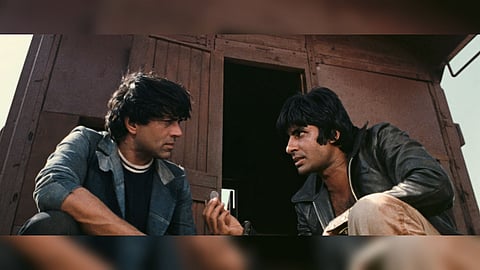
For anyone who’s somehow missed Sholay, it’s not an easy film to pin down. A spaghetti western reimagined in rural India. A buddy comedy, revenge saga, and musical all rolled into one. Jai and Veeru (Amitabh Bachchan and Dharmendra), two small-time crooks hired by a retired cop to take down a ruthless bandit. There’s romance. There’s loss. There’s a chatty tonga driver named Basanti. And there’s Gabbar Singh, the kind of villain that spawned merchandise and memes long before those were a thing.
Dharmendra, who famously chose to play Veeru over Thakur or Gabbar, said it best: “Sholay is the eighth wonder of the world.” Reflecting on the film’s legacy, he singled out the “tanki scene,” the temple sequence, and Jai’s death as his personal favourites. “So many scenes have gone down in the history of Indian cinema and every character became a star. But the real hero was the coin.”
True. Few props in cinema history have had such philosophical weight.
In India, Sholay isn’t just a film—it’s part of the cultural bloodstream. Lines like “Kitne aadmi the?” or “Basanti, in kutton ke saamne mat naachna” have outlived the era they came from. They’ve been spoofed, quoted, taught in film schools, and passed down like family lore. So to revisit Sholay isn’t just about the story—it’s about time-travel.
The version screening at Il Cinema Ritrovato is also a technical first. No 70mm prints survive. The 2.2:1 aspect ratio was reverse-engineered based on recollections from the crew. The magnetic sound was cleaned up using the original negatives and surviving audio reels. It’s as close as we’re ever going to get to Ramesh Sippy’s director’s cut.
Shehzad Sippy calls the restoration a “labour of love” and a tribute to his grandfather’s legacy. And in many ways, it is. Sholay is not just Sippy Films’ crown jewel—it’s also a mirror held up to an era of Indian filmmaking that was bold, brash, and totally unafraid of its own operatic ambitions.
Now, fifty years later, the same story will unfold on a new continent, for a new audience, in a square once filled with the ghosts of Italian neorealism. And yet, it fits. Because Sholay, at its core, was always cinematic in the grandest sense of the word—an epic made for large-format frames, high drama, and loud applause.
The coin has flipped again. And this time, both sides win.