
- Entertainment
- Style
- Lifestyle
- Food & Drinks
- Tech & Auto
- Culture
My parents hired Saraswati shortly before I was born. Sauro (I call her “Ma” or “Punti”) left behind her three young children to change my diapers and sing me lullabies. The children got her salary, but I got her time and attention. My mother was the working woman who put food on our table, but Sauro, who put that food on my plate, was, in my eyes, only generous and sacrificial. She cared for me not because she had to, but because she loved me, because she went above and beyond. She continues to work in her seventies, braving both arthritis and precarity.
At one point in Working Girls, Supreme Court advocate Shreya Munoth tells filmmaker Paromita Vohra, “Classifying acts done by women as divine acts, or acts of love, trivialises their very real contribution to society, to the economy, as well as to the lives and livelihoods of other people.” This hit me like a sucker punch. I’d trained myself to look at Sauro’s toil as kindness, as largesse, not labour. Blinkered by the hierarchies of gender, class and caste, I assumed the work she did was too menial for her to derive any joy from. The work, I said, was pain, while I was her pleasure.
Working Girls was, for me, an education, not because it was preachy, but because it was rapturous. For two hours and thirteen minutes, it put me in the presence of women I knew of but had never known. The folk dancers, sex workers, egg donors, ASHA workers, domestic workers and police aspirants I saw all belonged to different milieus, age groups and regions, but they shared one thing in common with Sauro: their invisibility. They worked jobs we discount either through social bias or unequal pay. Though many of these women perform what feminist scholars call reproductive labour—gendered, unpaid and undervalued work—the film exceeds this definition and forces us to look at them not as academic subjects or symbols of exploitation, but as people who have a very human capacity to feel and assert their desire, disappointment and delight.

Take, for instance, Alma, a domestic worker Vohra meets in Shillong. Tears flow down her cheeks as she describes how her previous employer would deposit only INR 500 in her bank account every month. “I didn’t know they were paying me so little. I thought they were paying me fairly,” she says. Alma’s grief is heavy. It hangs in the room like a millstone. For a few seconds, we—audience, crew, members of her self-help group—all carry her burden. Then, suddenly, an elderly woman asks whose turn is it to treat everyone to snacks today. Sandwiches are passed around in much the same way cash was distributed minutes earlier. Those belonging to this self-help group, an offshoot of the Meghalaya Domestic Workers’ Union, regularly pool together their savings. They meet to collect the interest from their hard-won investments. The circle in which they sit allows for relish, relief and, importantly, recognition.
In Working Girls, the binaries of pleasure and pain, love and loss, joy and sorrow, are never mutually exclusive. Rather than stick to a formulation of this or that, the film allows us to enter worlds where there is this and that. Growth and struggle don’t overwhelm each other. We spend enough time with every interviewee for her to be a sum of her varied emotional parts. Vohra seems to be driven by a curiosity to know how people survive the odds they are stacked against. Rather than simply ask her audiences to put themselves in the shoes of women they don’t know, she shows us how these women learn to tie their shoelaces, sometimes with great flair. She asks us to engage with working women who are far removed from us, to understand how labour and the wish for survival are common denominators that make equals of us all. Above all, she repeatedly challenges our received notions of solidarity, asking if we can feel it for those we do not see.
Vanita Mane is cooking when we see her first. We don’t know what she does. Arjun, her partner, is goading her to make fish. “No, not fish,” she says. “Who wants to do all that work?” When Vohra asks her how she learned to cook, she very casually says she picked up these skills from watching her friends in the brothel.
On the wall of her Pune home, alongside images of Kali, Shiva and Jesus, hangs the Preamble and a portrait of BR Ambedkar. “We owe our existence to Ambedkar,” she says. When Vohra teasingly points out that the Constitution doesn’t explicitly protect sex work, Vanita replies simply: “But it enshrines rights for humanity, for women, right?”
True to its documentary style, Working Girls follows the lives of individuals, but it also attempts something more difficult: documenting the life of collectives. Vanita also works as a community coordinator for Saheli Sangh, a sex workers’ collective. Because sex work is seen as “bad” and “dirty”, she says such organisations are needed to prove that women like her labour to support their families like anyone else. Saheli works tirelessly to better conditions for sex workers, institutionalising a minimum rate of INR 300 per client while giving workers something equally valuable: the ability to think of themselves not just as individuals, but as a people.
The same spirit of empathy animates the Durbar Mahila Samanwaya Committee, a sex workers’ collective in Kolkata. As its secretary, Bishakha Laskar, says, “The sorrow you carry is the pain I feel.” The affection with which Vanita puts her arm around a colleague’s shoulder in Pune is mirrored in the joy with which sex workers smear each other’s cheeks with sindoor during Durga Puja.
In much the same way that we diminish the labour of sex work by calling it immoral, we also discount the labour of care work by categorising it as divine. Vohra films in Thiruvanthapuram, where in 2025, KAHWA (Kerala ASHA Health Workers Association) staged a 266-day strike, demanding their honorarium be increased from a paltry INR 232 a day to a respectable INR 700. Seeing a group of ASHA workers trying to sleep on the pavement, Vohra breaks the ice by asking them the most ordinary and the most humane of questions: “Lots of mosquitoes?” They laugh, “Nalla biting (biting very much).” The workers’ slogans are both political and poetic: “How can you leave us in the pouring rain? How do you abandon us in the harsh sun? Hey government, make no mistake. We ASHAs will not budge.” The songs they sing in the intervals between their protests speak of weddings and ear-piercings, events that forge a sisterhood between women of different stripes. The film’s details give its subjects their due.
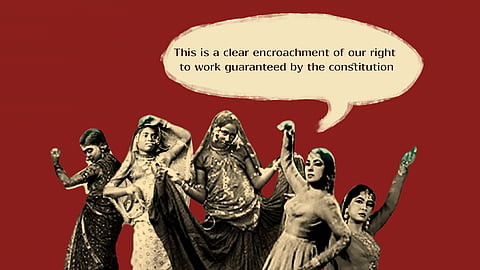
For the women in Working Girls, the State can be a bad paymaster, but also an unthinking censor. Vohra uses animation to show how laws in India have intersected with morality ever since the British tried to tame the “dirty natives” through legislation that criminalised several artistic and erotic practices. The cartoonish caricatures—a man in a veshti shouts “boys will be boys, but girls must be poise”—accentuate the ridiculousness of legal regulations that have all been designed to control women and their bodies. Performed at temple festivals in Tamil Nadu, Aadal Paadal—a dance form where women in short pavadais (skirts) gyrate to loud recorded music—has invited the derision of Tamil society and the scrutiny of a prickly State.
In 2010, there was widespread outrage when it came to light that there were over 10,000 Aadal Paadal dancers performing across the countryside. The police soon started denying permission for shows, while organisers responded with writ petitions. The judiciary’s rulings walked a rickety middle path: “Permission for Aadal Paadal is given, but if anyone does anything obscene, let the police arrest them.” The film shows how such injunctions are made manifest: pot-bellied policemen sit around and watch an Aadal Paadal show progress.
Kalpana, an Aadal Paadal performer, asks, “If they ban it, what other way do we have? This is how we look after our families.” Kalpana, however, clarifies it isn’t only compulsion that makes her dance: “We’re completely in love with our work. No one can make us leave it.” Many of the women Vohra
interviews work because they have to, but not once does the documentary dismiss their allegiance to labour. As Sumaiya, a police aspirant, says towards the end of the film, “The feeling of doing things on your terms is something else—high-level ki khushi (supreme joy).”
There is a lot that stays with you when the end credits roll, but the catchy, upbeat soundtrack clarifies a niggling doubt: Why call the film ‘Working Girls’ when all its subjects are women? “Office wali-madam,” the lyric goes, “zara khisak udhar, tere maafik mein bhi hu ek working girl! (Hey, office-going madam, give me some room. Like you, I, too, am a working girl!)” Tellingly, the song widens the ambit of both work and womanhood. The film’s music, like its humour, is as inclusive as it is unconventional.
With Agents of Ishq, Vohra gave Indians a website where they could share their stories about love, sex and desire. Working Girls, too, is a platform where women can speak about love, labour and ambition. Vohra, a beloved columnist, strangely isn’t interested in climbing a soapbox; she seems to want to amplify voices that say the unsayable. Her feminist oeuvre often circles back to the idea that ‘pleasure is politics’ but with Working Girls, she seems to be making a yet more radical point: politics can also be pleasure. Art, like feminism, frees us from our constraints, but here, Vohra takes that urgent need for liberation and makes it art. The pleasure we feel while watching her film never undermines the pain and toil of her interviewees; it underlines and dignifies both. The camera in Working Girls is neither voyeur nor seducer, it is witness. Documentaries the world over are often judged by what they say, but Vohra’s film is remarkable in how it listens.
Shreevatsa Nevatia is the author of How to Travel Light: My Memories of Madness and Melancholia