- Entertainment
- Style
- Lifestyle
- Food & Drinks
- Tech & Auto
- Culture

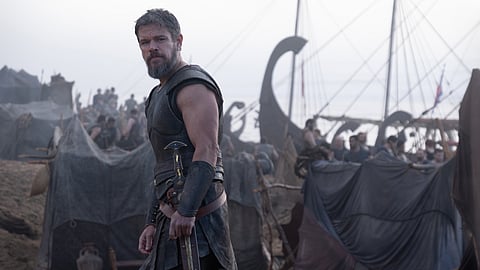
It's been three days since I watched Christopher Nolan's The Odyssey, and the thing that has stayed with me has nothing to do with the cast or the direction - both of which are, unsurprisingly, fantastic. It has to do with a phrase I encountered first as a kid, and then in college.
Anyone who has read Homer knows it: the sea, again and again, described as 'wine-dark'. It never once made sense to me. Why wine-dark? What does that mean?
Watching this film in IMAX, I finally saw what it meant. There are multiple moments during the scenes shot at sea where the water turns a blue so dark, so saturated, that it's nearly black - the exact colour of wine poured from a pitcher into a cup by firelight, in a world before electricity. I wasn't just understanding the metaphor anymore. I was looking at the ocean the way Homer must have pictured it, thousands of years ago. That image alone justified the trip to the theatre.
The film's emotional centre, though, is Matt Damon's Odysseus and Anne Hathaway's Penelope. The actors share minimal screen time but their chemistry is incredible and instant. Penelope's angst isn't born out of the fires of new romance but is the love of a woman who has spent years waiting, in a world where women, mortal and divine alike, are handed roles and duties and expected to just inhabit them. What Hathaway captures in Penelope's grief is the sorrow of someone who found a man who let her be all the woman she is and expected nothing more.
When Odysseus returns after two decades, unrecognised except by his faithful dog Argos, deliberately hiding who he is from Penelope, there wasn't a dry eye in the theatre - that’s how absolute the connection between Hathaway and Damon is.
My one hesitation, watching the film in the moment, was a nagging sense that something was missing. The Iliad and The Odyssey are enormous stories - there is war, politics, lust, magic, prophecy, grief, nearly every element of human experience ever expressed since the dawn of time. Nolan's film, on an IMAX screen, is visually as massive as anything there is. And yet it never feels massive. It took a while to understand why that isn't a flaw: the scale never overwhelms the human heart at its core.
Odysseus is one of mythology's most complicated figures - worshipped, imitated, and hated in equal measure. But his real journey has never been the one from Troy to Ithaca. It's an internal one: him discovering exactly what kind of man he is, what he's willing to do, how far he's willing to go - and maybe confronting the possibility that he isn't necessarily a good person. We tend to read his survival as a gift, a testament to Athena's grace while everyone around him gets punished. The film leaves you wondering if his survival is the blessing we imagine it to be.
More than anything, Nolan's The Odyssey feels like proof that ancient stories still work, and that our attention spans haven't gone anywhere. We're told constantly to look to the future - to embrace whatever comes next, AI included, or risk being left behind. This film argues (quite firmly) for the opposite: that the stories at the foundation of human civilisation still have the power to hold a full auditorium for three hours, and receive a standing ovation at the end.