
- Entertainment
- Style
- Lifestyle
- Food & Drinks
- Tech & Auto
- Culture

Anime has always been a universe of abundance. It is a fantastical world of giant robots, super humans, endless battles and improbable hairstyles. Then came Studio Ghibli. For the first time, the world stopped calling it “cartoons” and began to see it as art.
Ghibli did something almost unthinkable in the 1980s: it gave Japanese animation the weight of cinema. Miyazaki, Takahata and their collaborators built films where aesthetics was as important as plot. They elevated anime to the cinematic forefront, where visuals and narrative are equally potent. Ghibli shifted anime from subculture to culture. Suddenly, anime was an Oscar contender. And even in 2025, that relevance has not dulled. That is why Ghibli isn’t just nostalgia, or worse, a “phase” of filters. It is still a living studio.
Miyazaki’s The Boy and the Heron winning the Academy Award in 2024, proves that decades later, Ghibli films are not relics but contenders. That continuity of relevance is precisely why anime without Ghibli is arguably incomplete.
The proto-Ghibli film, directed by Miyazaki before the studio was formally founded. It’s a post-apocalyptic eco-saga with a heroine who embodies strength and empathy. For men raised on Mad Max and Star Wars, this is the Japanese counterpoint: stranger and just as visionary. It is also a film that predicted our anxieties about climate change long before they became headlines
A boy and girl search for a floating island while chased by pirates and soldiers. It is an adventure with heart and a meditation on technology.
On the surface, a gentle children’s film about two sisters and a giant forest spirit. Beneath that, it’s about fathers and the weight of holding a family together during illness. Men often overlook softness in cinema and this is a masterclass in it.
Isao Takahata’s war tragedy about two siblings trying to survive in WWII Japan. This is not comfort viewing. It is brutal and unflinching. Pain achingly devastating. This is a window to knowing how wars can tear souls.
Every man who thinks war films are only about soldiers and glory should watch this. It forces us to confront the forgotten victims of war : our children.
A coming-of-age story about a young witch running her own courier business. Kiki’s struggle to find her place in the world mirrors the quiet crises of adulthood. Beneath the whimsy is a sharp meditation on burnout and creative doubt. Issues every modern man quietly wrestles with.
A WWI fighter pilot cursed to live as a pig, freelancing as a bounty hunter in the Adriatic. It’s both a romantic adventure and a melancholic tale about masculinity and aging. If you want Ghibli with swagger, this is it.
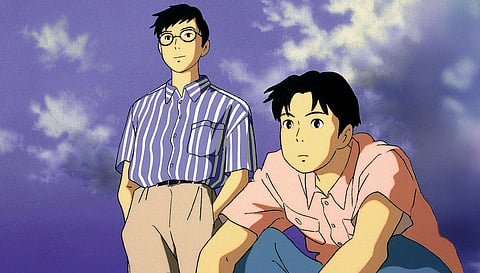
Ghibli’s rare foray into straight-up teen romance, directed by Tomomi Mochizuki. It’s less fantastical and incredibly honest about male friendship and the nostalgia of first love.
Talking raccoons wage war against urban developers in a tragicomedy that oscillates between slapstick and despair. It’s about resistance and the absurdity of fighting a battle you know you’ll lose. The movie explores the cost of losing one’s home or heritage to progress.
A love story about two teenagers: one chasing dreams, the other unsure of her own path. Men who think romance is fluff should watch how Ghibli handles yearning and the courage to create. It is about the quiet bravery it takes to admit vulnerability and to say “I don’t know who I want to be,” and still move forward anyway.
Miyazaki’s grandest epic, a bloody clash between humans and nature, gods and industry. This is the closest Ghibli comes to “dark fantasy.” For men raised on Game of Thrones or Lord of the Rings, this is essential viewing.
Takahata turns a manga into a minimalist watercolour comedy about everyday family life. It’s deceptively light and is sharp in its insights about marriage and generational conflict. It is a depiction that the epic battles of life are often fought in living rooms and quiet misunderstandings between loved ones.
The global breakthrough. An Oscar-winning odyssey into a spirit world that’s as surreal as it is allegorical. Every man should watch it not as a “kid’s film,” but as a critique of greed and identity in a hyper-capitalist world. Chihiro’s journey becomes a lesson in humility, a reminder that one’s value system is the only thing worth safeguarding.
A spin-off from Whisper of the Heart. A quirky, charming fantasy where a girl saves a cat and is whisked into a feline kingdom. It’s lighter and shows that not every hero’s journey needs to be grand and that sometimes courage lies in the small decisions.
A wizard with a magical, walking home. A young woman cursed into old age. A war raging in the background. On the surface, romance and spectacle; beneath, an anti-war meditation and a redefinition of what “masculinity” looks like. Howl’s vanity and eventual bravery form one of Ghibli’s most complex portraits of manhood.
Directed by Goro Miyazaki, based loosely on Ursula K. Le Guin’s novels. It’s messy yet fascinating. For men who like flawed cinema, this one is worth revisiting to understand the pressures of inheriting a legacy. It captures the important trope when a son is trying to step out of his father’s shadow while the world watches.
Ghibli’s riff on The Little Mermaid. A stormy, surreal tale of childhood friendship and the fragility of the world’s balance. A reminder that simplicity can be profound. In the movie, the sea is both nurturer and destroyer.
The Borrowers reimagined. A tiny girl lives beneath the floorboards, unseen by the human family above. A story about survival and learning to live with invisibility. A little too close to the uncomfortable truth about how modern men often feel.
Set in 1960s Yokohama, it’s a tender story about teenagers trying to preserve a clubhouse as Japan modernizes. A meditation on memory, history, and what men inherit from the past.
Miyazaki’s farewell (until it wasn’t): a fictionalized biopic of Jiro Horikoshi, the engineer behind Japan’s WWII fighter planes. The movie is controversial and unafraid to confront the duality of genius and destruction.
Miyazaki’s latest and possibly last masterpiece. A surreal coming-of-age film wrapped in grief and the desire for escape. The movie is almost reflective of an artist looking back on his life’s work. It neither feels like a pure farewell nor a simple continuation. Perhaps an ending that carries within it the possibility of a beginning.