
- Entertainment
- Style
- Lifestyle
- Food & Drinks
- Tech & Auto
- Culture

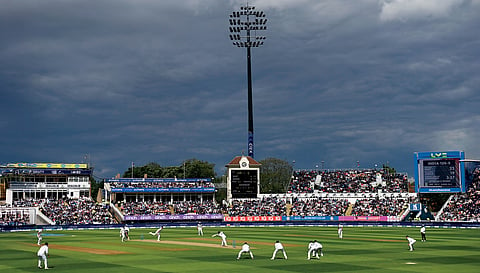
One of the promotional banners for the ongoing Anderson-Tendulkar Trophy depicts India’s newest captain, Shubman Gill, with a yelly little scowl. It’s not very becoming, if one may say so, of the soft-spoken 25-year-old whose altercation with an on-field umpire during the IPL became the subject of memes and jokes. That may have happened because of his soft voice or his boyish demeanour, his serene countenance or his nonconfrontational conduct on the field.
In the first test match at Headingley in India’s tour of England 2025, the Indian captain was seen celebrating the fall of Harry Brook particularly animatedly. Once again, memes and videos ran amok, commentators Sanjay Manjrekar and Navjot Singh Sidhu taking mock turns to guess which former Indian player it reminded them of. Who was it?
It was Virat Kohli, the world-beating mascot of Indian test cricket who took a side known for meek surrender and convention and hardened it into a surprisingly lethal unit. Under him as captain, they began racking up famous victories in the hostile arenas of Australia and England. The Indian cricket team’s fast bowling reserves expanded and flourished, because two spinners aren’t how you get 20 wickets in a test. This was unprecedented for a nation that started out playing with spin quartets in the decades after Independence. It was a veritable reign of terror that the boy from West Delhi unleashed over some of the most dominant and competent sides in business. Everyone, literally everyone, was afraid of Virat Kohli.
On May 12, after multiple reports swirling around on social media and an excruciating wait for return to form, Kohli retired from tests. A format that India’s 269th test cap arguably single-handedly reinvented with both theatrics and gumption, is suddenly left with a gap even bigger than the one between Babar Azam’s bat and pad.
Now, you wonder—who’s afraid of Gill? Who’s afraid of anyone anymore? His fortunes in the SENA nations—where Kohli once willed himself into thriving—have so far been nothing to write home about. With Kohli’s retirement, and erstwhile captain Rohit Sharma bowing out days earlier, the Indian outfit—so long defined by domination—is suddenly without its spiky thorns.
The test-watching audience is so used to this brand of spirited vengeance and hostility that anything feels hollow. Even in the battles that he lost or was forced to eat humble pie in (I think back to Birmingham 2021), the sheer drama and performance that he brought to the game was incomparable.
Three weeks after his retirement that left the internet all weepy-eyed, the Royal Challengers Bengaluru—the IPL side that Virat Kohli has laughed and cried with for the past 18 years—finally overcame the title jinx. As fireworks went off and the strings of sweet catharsis loosened in the backdrop, Kohli in his post-match speech raised a wistful toast to the game’s ultimate format.
“Test cricket has always been five levels above everything else,” Kohli said. “It’s a format I’ve loved deeply and respected the most. Even now, I urge the youngsters coming through to treat test cricket with that same respect. Performing well in tests earns you respect worldwide—it’s a badge of honour.”
For it is the game's ultimate format. No questions to be entertained about that fact. Its theatre and music are to be found nowhere else. Look into the past and you’ll find an anguished James Anderson after his long, unlikely vigil on the final day was cut short by Shaminda Eranga—off the penultimate ball of the match. Shane Warne crouching on the pitch in agony and submission after the famous Ashes loss at Edgbaston, and Andrew Flintoff consoling him, is an enduring image. Virat Kohli’s twin hundreds in a heartbreaking loss in Adelaide, circa 2014, in his first match as India captain. And these are just the losses—losses that helped accept that losing was how one did life.
But this dude rolled all of that up and chewed the hell out of that wad of gum. In the second game of India’s 2023-24 tour of South Africa, as the Indian pace attack worked to wrap up the Protea lower order and set up a series-levelling chase, Kohli was heard yelling to Jasprit Bumrah, “Ghaas ki patti par phenk bass chheh ball (Just keep pounding the grass strip).” It was not only a reminder of his unsated hunger to dominate, but his belief in grit and persistence.
Naysayers have constantly predicted the demise of the format, citing time constraints and the arrival of shorter transmogrifications of the game (including The Hundred and T10). And yet, in the past decade-and-a-half, viewership has only gone up. Star Sports saw a record 124 million viewers tuning in to watch the live broadcast of the International Cricket Council (ICC) World Test Championship Final 2023, exceeding the previous WTC Final’s viewership by 32%. The company also had an impressive 14.4 billion minutes of watch time for live broadcasts, making it the highest aggregate watch time for any test match in history.
In 2016-17, when India hosted England for a four-match series where they blanked the English 4-0, viewer impressions registered unprecedented numbers: 572 million impressions in the urban market and 956 million impressions in the all-India market. According to Broadcast Audience Research Council (BARC) India ratings, the fourth test alone brought 246 million impressions. This was also the highest rating for any test featuring India in the last three years. The following year, the India-Australia series delivered a total of 1.1 billion gross impressions with the third test match alone recording 383 million viewership. “The #TestofThe-Best campaign for the India-Australia test series delivered on its promise, becoming the highest rated test series in the history of BARC,” a statement from Star Sports said.
It couldn’t have been a coincidence—it was about a player peaking at the right moment. Between July 2016 and December 2017—nearly a year-and-a-half, Kohli scored six double centuries. Between 2016 and 2018, the then-captain averaged 54 in away tests. With 2018 considered the toughest year for test batting since 1959, it is almost unbelievable what he did that year. He was, after all, playing in England, South Africa and Australia, the toughest conditions to succeed in for subcontinent batsmen, in one of the most bowler-friendly years ever. ESPNCricinfo reports that hazard rates (the rate at which wickets fall at any score) in the years following the first 15 years of this century have been considerably higher.
But his greatest achievement wasn’t the numbers—it was doing it all without ever needing to be affable for optics. His brand of on-field hostility and competition drew fans of his own side as well as those of the opposition. Crowds could come in just to hate on him and eagerly await the mic-drop moment that he would fail. You could pay to watch him lose—which was part of why fans would think he was India’s own answer to Ricky Ponting, the Aussie captain who could bully you into submission.
“He became something rare for test cricket—a sensitive, drama-loving hero who looks good both laughing and crying,” screenwriter-filmmaker Varun Grover wrote in a heartfelt tribute to the former Indian captain on Instagram recently. Such has been Kohli’s sway over the zeitgeist that it has wrapped up not only sports fans, cricket pundits, legends from football and tennis and opposition players—cultural commentators have routinely expressed their awe at the brand of gamesmanship he pumped into the game.
“Every sport reflects some aspect of life, but test cricket is like a literary novel—combining many different genres into one. That’s why only those with a story to tell succeed in test cricket. A story so long and deep that it doesn’t care for the pitch conditions—grass, dry, home or away. Virat Kohli is the biggest character of this novel over the last decade. He not only lived the different emotions of the game but also enriched them,” Grover added.
Despite many games finishing inside three days now (the odd one going to the fifth day or the evening of the fourth), the longest format is built for the slow burn, and it needs its showmen to survive, not just its statesmen. Its injury-plagued rebels, like Shoaib Akhtar. Its aluminium bat-carrying crazies, like Dennis Lillee. Its diabolical charmers, like Imran Khan. Its career-enders, like Mitchell Johnson. Its controversy chasers, like the genius Shane Warne. Its brazen style icons, like the mohawked Kevin Pietersen. Its devils.
And Kohli was both—devil and romantic.
If the tests have survived, it is majorly because of the entertainment—the drama and the antics. And if the show must go on in the way that it has, it needs the fanaticism of its devils. Internationally, one might not be able to look too far into the distance, with cricket’s newest bad boys satisfying themselves with off-field misdemeanours (be it Ben Stokes or Kagiso Rabada). You get the odd tiff between a Travis Head and a Mohammed Siraj, but that’s about it. Willful prodigies like Yashasvi Jaiswal and Marco Jansen will need to know game comes first, attitude later. It’s about mastering the narrative, not the moment.
Rishabh Pant, who has staked his claim for the title for a few years now with both his antics and his counterattacking game, will certainly need to wrap that mantle tightly around his flexible back. Whether we’ll only see more backflips from India’s most avidly watched test cricketer alongside Jasprit Bumrah currently, remains to be seen. Those like Nitish Kumar Reddy, who smashed a rapturous hundred at the Melbourne Cricket Ground during the 2024-25 Border Gavaskar Trophy, will have to believe that T20 cricket isn’t the only place for rockstars.
That would be possible only if the leadership gives them room to wiggle—something that Kohli routinely did for his boys. The flavour of his aggression has percolated to the DNA of the baggy blue in such a way that a side known for timid capitulations has played like piranhas even when he hasn’t been present. Might I recall the storming of the Gabba for you, where a supposedly second-string Indian team—sans Kohli himself—chased 328 down on the final day of a test match at a ground considered an Australian fortress?
Just like Akhtar, Lillee, Warne, Pietersen and Botham, he has the stats to justify the tenure he received. Unlike the rest of the Fab Four of his generation—Steven Smith, Joe Root and Kane Williamson—the former Indian captain set greater stock by being feared and not by being revered. In the recent Border-Gavaskar Trophy held in Australia, he shoulder-barged 19-year-old Sam Konstas. That speaks less of Kohli’s sense of ethics or maturity and more of his pure passion for the format.
In a form of the game India have suffered humiliating whitewashes and series losses in, both before and after his captaincy—he’s always looked to win—at all costs.
And that showed that life could be done by winning, too.
To read more stories from Esquire India's July 2025 issue, pick up a copy of the magazine from your nearest newspaper stand or bookstore. Or click here to subscribe to the magazine.