
- Entertainment
- Style
- Lifestyle
- Food & Drinks
- Tech & Auto
- Culture
“EXCUSE ME, BUT WHAT ARE YOU DOING???”
In December 2013, my wife gave birth to a baby girl. My participation in this entire process was brief and not so memorable.
The moment the infant was extricated from her mother, a nurse cleaned her up and then asked me to hand over the onesie I had purchased for the baby. The nurse slipped the child into the item of clothing and handed her over to me.
“Excuse me,” one of the presiding nurses said in shock. An audible gasp passed around the room. “But what are you doing?”
I looked at my baby girl and then looked up in bewilderment.
“This will not do,” the nurse said, as she picked up my baby, who was dressed in the first piece of clothing she would wear in her life: a pristine Arsenal onesie. “We are all Tottenham fans here. We have no option but to return the baby back into the mother.”
And then everyone laughed. Except my wife. Who was completely anaesthetised.

I was born into a football crazy family. I have faint memories of watching the 1986 World Cup with my father, when I was just seven. Four years later, in 1990, I would watch every single match of the World Cup in Italy. Every single match. If more than one match took place at once, I would watch one live, my father would record the other one on our National VCR. We would sit and watch the recorded one later.
Then afterwards my father would huff at the TV. “This is horrible football,” he would say. “Where is Cruyff? Where is Pele? Where is Tostao? Even Victor Manjilla was better than this.”
T he 1990 World Cup was particularly special because the UAE, our home country, qualified for that World Cup. Also, exactly halfway through that World Cup, my mother passed away from a sudden heart attack. We did not watch the rest of that tournament. Except for the final. Which we all sat together and watched in sombre silence. It was, befittingly, a terrible match that was decided by a penalty.
Some years later his bank called up my father and told him that he could have his debit card personalised with a photo of some sort. Perhaps a family photo? A beautiful landscape of our ancestral village in central Kerala?
He chose a picture of Pele celebrating a goal.
I was a football fan before I was a fan of English football. Or any single English football club. In fact for much of my childhood in Abu Dhabi, I rarely watched a live match featuring the English clubs. Rummage around in my brain and you may find the faintest of memories of the 1989 FA Cup Final between Liverpool and Everton.
Sometime in 1991, we got cable TV in our flat in Abu Dhabi. The very first live English top division football match I saw featured Crystal Palace against Queens Park Rangers. I was engrossed. For the first time in my life I was watching the names I had only read in the newspaper’s sports pages come to life in front of me.
I decided, but without much conviction, that I would become a Crystal Palace fan. I even put up a poster of the Palace goalkeeper, Nigel Martyn, inside my cupboard. (But this was mostly because I was the goalkeeper of my class football team.)
Soon, however, I became more interested in an exciting young striker who played for Palace, named Ian Wright. In 1991, when Ian Wright moved to Arsenal, I went with him.
Over thirty years later I met Wright in person, at an event to launch his biography. I even got a signed copy. Ian Wright is one of the nicest people on the face of the planet. He was warm, and friendly, and let me take a photo with him. He also smelled amazing.
I really do love Ian Wright so much.
In November 2010 I moved to London with my partner. Her employer arranged for us to live in a flat for a month until we found a place. We were keen to live somewhere in North London, close to her brother, who, believe it or not, lived in a flat inside the old Highbury Stadium. It had been converted into residential properties when Arsenal moved to the Emirates Stadium in 2006.
I remember the first time I went to meet him in his flat. Oh my god, I thought. This is Highbury. This is where Dennis Bergkamp, T hierry Henry, Emmanuel Petit, Patrick Vieira, Charlie George, Liam Brady and, yes, Ian Wright, all kicked a ball around. This was from where, in 1937, the BBC televised the first ever live football match. And my brother-in-law was living in it! And he didn’t even like football. He was a cricket fan. A caveman. A barbarian.
Thankfully, a week or two later, I found my own flat on Drayton Park, on the other side of the railway tracks from the Emirates Stadium. I lived so close that I could hear the crowds inside the cauldron roar a millisecond before the crowds on the TV.
Arsenal was all around me. My local tube station was called Arsenal. The Pakistani guys who ran the local grocery shop would always talk to me about two things: life as a brown person abroad and Arsenal Football Club. Neighbours, postmen, delivery drivers, everybody assumed that I wanted to talk about Arsenal.
I loved the weekends when I lived near the Emirates. The fans, home and away, were always nice. The street food was amazing. T here was this one particular guy who made the most mediocre burgers. But he was so committed to the craft of making them, that I would eat one every week. There was the Anglo-Korean couple down the road who worked either in insurance or publishing, but rolled out a massive iron pan on the weekends and doled out steaming hot Korean beef bulgogi baguettes.
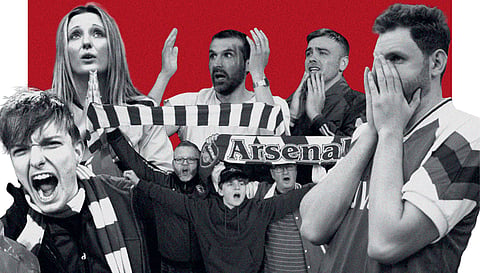
The point I am making is: football is more than football. Arsenal is more than a football club. It is a means of engaging with the world. It is a means for humans to turn into a community. Human beings do not become people until we mourn together, and moan together, and revel together.
With Arsenal Football Club, there has been so much of all those things, especially the mourning. Some years ago, long after I had moved from North London to South East London for “bigger house due to children” purposes, I was discussing football with a London cab driver.
“Arsenal is like one of your movies mate,” he said.
“What do you mean?”
“One moment everyone is singing and dancing. And then the next moment everyone is crying and dying. And then ten minutes later it is all singing and dancing again.”
It is the truest comparison I can think of. Arsenal Football Club is the entire filmography of Hrishikesh Mukherjee crammed into 45 minutes. Also 45 years.
Being an Arsenal fan, until a couple of months ago, was pure agony. When we lost it was agony. When we won it was agony, because we knew we would lose again.
But amidst all that agony? Oh my god the sheer ecstasy.
On 17 May 2014 Arsenal faced Hull City at Wembley in the FA Cup final. It had been close to a decade since Arsenal last won anything: the Premier League in 2004. (Almost to the day.)
An agonising wait. Deep inside, even the most glory-hungry fans knew that the FA Cup was but a brief palliative. We were all tired of not winning the Premier League. Of not winning anything.
After eight minutes, Hull City had scored twice. An eerie silence could be heard inside and all around the old Highbury Stadium. (I had decided to watch the final in my brother-in-law’s house for the atmosphere.)
Then nine minutes later, Santi Cazorla scored one of my favourite Arsenal goals of all time. He slammed in a free kick from 27 yards, kissed the inside of his wrist where he has his son’s name tattooed and then frantically gestured at the crowds to back the team.
It was a good free kick. And the goalkeeper did do us a favour. But I remember that goal, because it turned the tide. It flipped the mood. It switched the script from tears to song and dance. Arsenal went on to win 3-2 in extra time.
And yet the Premier League title eluded the club. Year after year, we would come close. We would peak early and then fade late. We would fade early and then peak too late. This particular sense of ennui had not only seeped into the fan base but also, I suspect, the club itself.
Some years ago, in Arsene Wenger’s penultimate season (2016-17) as manager, I was part of a press team that was invited to visit the club’s training grounds at London Colney and then bus it back to the Emirates for a match against Antonio Conte’s Chelsea.
It was a fascinating trip. Even the ornamental fish in the ponds, I was told, had been procured with Wenger’s approval. But there was an all-pervading sense of “but can we do it?”
Could we win again? Did Wenger have it in him? Ozil? Sanchez?
We were great. But were we good enough?
No one said it out loud. But there was a sense of: What if we never win it again? What if we have lost our mojo forever? What if we turn into a Spurs? My god, did I just type that.
You see, winning the Premier League is actually very hard. Very few teams have ever done it. Very few teams have done it more than once. And the thing with modern football is that once you stop winning, it is very hard to start again. Teams will just leave you in the wake.
That evening we went on to demolish Chelsea 3-0. “Could this be the start of things?” We wondered. Nope. Immediately after that match, Conte changed his system and Chelsea went on to win the league that year.
On May 20 this year, I was winding up a meeting in London, when I realised that there were ten minutes or so left in the Manchester City-Bournemouth match. I asked my companions to wait while I watched the last few minutes of the match on my phone.
“What are you watching?” they asked, none of them football fans.
“Hush,” I said. For weeks, by then, I had refused to say the words premier, league, champions altogether. I just could not bear it. I refused to look destiny in the eyes. I did not have the courage.
And then it happened. Manchester City could only manage a draw. We were champions. For a few minutes I felt nothing. Nothing at all. Complete silence. And then the honking of horns and pinging of bicycle bells and the whooping of voices. I was on my way back to Euston station, to take a train to Bromley, when I thought: “What the heck am I doing? I should take the tube to Arsenal station and see if anybody is celebrating outside the stadium”
By the time I got there, there were a few thousand fans. By the time I left, there were tens of thousands. And between the throngs I could catch a glimpse of my old flat, on Drayton Park, on the other side of the railway tracks.
I never saw him directly. But I was told later that Ian Wright was in the crowd as well.
Why do I love Arsenal Football Club? There is no reason really. I could just as easily love Crystal Palace or Aston Villa.
I think I love Arsenal Football Club because I get to love it with other people. In a world where people seem to increasingly bond and organise and collectivise around hate and needling and provoking and fulminating, this stupid football club gives me a fleeting sense of solidarity.
I love it because we must all love abundantly and hopelessly and without reason. Also: how can I love anything else?
A few days ago my seven-year-old son walked up to me and said he wanted to be a footballer. He wanted to play for Arsenal. He wanted to be good at tackling. Oh and he wanted to be Norwegian.
What a hopeless guy.
Welcome to Arsenal Football Club.
To read more stories from Esquire India's July 2026 issue, pick up a copy of the magazine from your nearest newspaper stand or bookstore. Or click here to subscribe to the magazine.