
- Entertainment
- Style
- Lifestyle
- Food & Drinks
- Tech & Auto
- Culture

AI generated summary, newsroom reviewed
Do you tune into the Japanese Grand Prix every year expecting Suzuka to be a shitshow? you think that Monaco, Baku and Singapore are tracks where it all goes down? Does a race without crashes and cars running into the gravel bore you? Well, good new for you this weekend: this year's new track for the Spanish Grand Prix, Madring, is so crazy that it's already been described as "Jeddah on steroids".
Here's all we know about it.
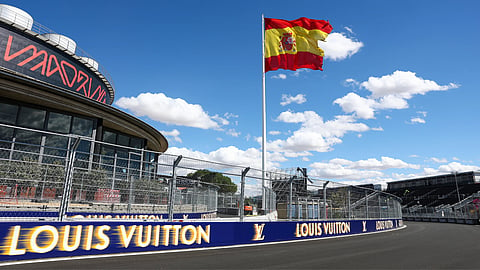
With 22 corners, high-speed sections, heavy braking zones and walls that leave little room for error, Madring is a 5.416-kilometre circuit built around Madrid's IFEMA exhibition centre. It's a hybrid circuit combining public roads and purpose-built sections around the IFEMA Madrid exhibition centre.
The Grand Prix will run for 57 laps, covering a total race distance of 308.524 kilometres. Cars are expected to reach around 340 kmph on its fastest sections. But it's the chicanes and corners that are getting Madring so much attention.
The track starts with a 589-metre main straight before the cars hit the heavy braking zone of Turn 1, one of the main overtaking spots on the circuit. From there, they head through Turns 1 and 2 (the lowest spot on the circuit) before accelerating through the fast Turns 3 and 4.
Then comes the first major headache: the Turns 5A and 5 chicane, a tight section where there is barely enough room for two cars to run side by side. Get this: squeezing through here will be so difficult that the average speed of a car is expected to drop from 340kmph to just 80kmph. After another fast stretch, drivers face the uphill braking zone of Turn 7, where a small mistake could send them into the outside barriers.
From there you wind through a series of fast left and right-handers before reaching Turn 12 aka, La Monumental. The huge 180-degree banked corner has a 24 per cent gradient.
Once they clear this, the drivers get another chance to stretch their legs through a fast section before heavy braking for Turn 17. The final sector brings another tricky sequence through Turns 18 and 19, followed by the sharp left-hander at Turn 20 and 20A chicane. Finally, Turn 22 brings the cars back onto the main straight.
Till now, the track has only been tested by Formula 3 drivers, and by Charles Leclerc, Lewis Hamilton and Carlos Sainz, who is also the ambassador of the track. To give you an idea of how bad it was, the F3 test produced 19 red flags across two days (though not all related to crashes), while 10 drivers hit the wall.
Sainz has already predicted that fans should expect safety cars, yellow flags and red flags, particularly during qualifying when drivers begin pushing the limits.
The difficult turns are not all the stands between the teams and a good race this weekend. Madring's novelty itself makes it a dangerous track. At established F1 circuits, teams can arrive with years of data covering tyre degradation, setup choices, braking references and race simulations. At Madring, much of that information has to be created from scratch during the weekend.
The newly laid asphalt adds another unknown. The surface is smooth and initially offers relatively low grip, meaning conditions should evolve considerably as rubber is laid down through practice and qualifying.
That said, the circuit's characteristics are expected to favour cars that perform well through corners, so expect a car like the McLaren that performed well in Zandvoort to do well. That is, of course, unless it runs into the gravel.
The 2026 Spanish Grand Prix takes place from September 11 to 13 at the Madring in Madrid. The race is scheduled for 57 laps around the 5.416-kilometre circuit.
It is also the first Formula 1 race in Madrid since 1981, when the Spanish Grand Prix was held at Jarama. Barcelona hosted the Spanish Grand Prix for decades before Madrid secured a long-term deal, while Barcelona continues to feature on the F1 calendar under the separate Barcelona-Catalunya Grand Prix arrangement.
As of now, everything seems to be in line for a rather dramatic race this weekend. If Madrid really is "Jeddah on steroids" as Formula 3 describes it, Formula 1 is about to find out exactly how much punishment that prescription carries.