
- Entertainment
- Style
- Lifestyle
- Food & Drinks
- Tech & Auto
- Culture

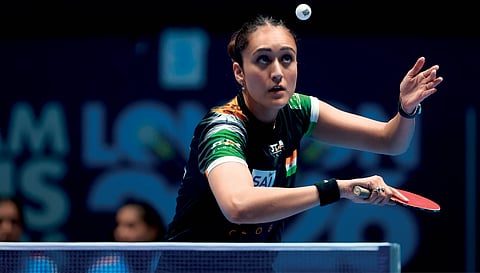
MANIKA BATRA IS THE UNDISPUTED FACE OF INDIAN TABLE tennis. But her path to sporting royalty was anything but easy.
The Commonwealth Games double-gold medallist has slowly built her career, battling injuries and slumps.
Batra is renowned for her distinct playing style: a surprisingly strong forehand, her height and reach and her ability to twiddle or rotate, the racquet in her hand during a rally to control the speed of the ball and bamboozle her opponents.
Her big breakthrough came in 2018 at the Gold Coast Commonwealth Games where she won India’s first-ever women’s team gold in table tennis and then became the first Indian woman to win the Commonwealth Games singles title.
Many other firsts followed in 2021at the Tokyo Olympics where she went on a historic run to become the first Indian table tennis player to reach the third round of an Olympic singles event. At Paris 2024, she became the first Indian table tennis player to reach the Round of 16 in Olympic singles competition. Suddenly, India had a credible table tennis superstar.
At 30, Batra now stands at a crucial stage in her life and career as she eyes more glory at the 2028 LA Olympics.
As she tells Esquire India, this Regal is determined to take Indian table tennis even further. It’s fair to say she’s staying true to the Latin phrase in her Instagram bio: “Per Aspera Ad Astra”: To the stars through difficulties.
Looking back, when was the first time you felt like you had earned authority in your field and what did it cost you to get there?
I think the first time I truly felt it was after the Commonwealth Games in 2018, where I beat World No 4 and World No 6 in the semi-final and final to win the singles gold medal. Until then, I was always trying to prove myself, but that moment made me feel like I belonged at the highest level. It came with a lot of quiet sacrifices—missing out on a normal life and staying away from my family, which is the hardest part for me. It also meant staying disciplined when nobody was watching and pushing through phases where the results didn’t reflect the hard work.
Your career is not built on lineage or privilege. What did you have to build from scratch to claim your place?
Everything, honestly. I do not come from privilege at all. In India, we still do not have the kind of table tennis structure that many other countries competing at the highest level have. There was no fixed roadmap for me, so I had to understand my own game, build the right team around me and learn through every loss. Today, I have my own coach, sparring partner, physio and trainer—but building that system took years. Even confidence is something I built slowly, match by match.
Talent gets attention; discipline sustains power. What does discipline look like in your daily life when no one is watching?
Discipline is the small things. Showing up on days when you do not feel like it. I never miss my early morning training sessions—that is one thing I am very strict about. It is also about recovery, eating right, sleeping on time and being honest with yourself. No shortcuts, even when nobody is there to check.
Every trailblazer has a moment where the risk outweighed the safety. What was the decision that changed the scale of your life and how close were you to walking away?
I think one of the biggest decisions was choosing to back myself and my game even when it was unconventional and people doubted whether it could succeed consistently at the highest level. There were phases when results didn’t come, injuries happened and confidence was low. It would have been easier to play safe or settle. But I kept pushing myself out of my comfort zone—changing training systems, building my own support team, travelling constantly and trusting the process even when nothing felt certain. That period changed me. It made me mentally stronger and helped me believe that I could compete with the best in the world. I would not say I was ever close to walking away from the sport because somewhere deep inside I always knew this was what I wanted to do. But there were definitely moments where I had to remind myself why I started playing in the first place.
In the face of doubt or rejection, what belief kept you moving forward?
I always believed that if I stayed consistent, results would come. Maybe not immediately, but eventually. I also remind myself that no single result defines me—good or bad.
Today, how do you decide when to push, when to pause and when to walk away?
Now, I listen to my body and mind much more. Earlier, it was always push, push, push. But over time, I have understood that pausing is also part of progress. Walking away is rare, but knowing when to step back for a while helps you come back stronger.
How do you keep things real?
By staying connected to where I started and the people who have been there from the beginning. I try not to overcomplicate things. At the end of the day, it is still about playing table tennis and enjoying the sport I love.
If regality is earned, not inherited, what responsibility comes with it? How do you want to be remembered?
For me, it is about setting the right example — through your work ethic, humility and the way you carry yourself. I would like to be remembered as someone who gave her best, stayed grounded, and helped take Indian table tennis forward.
To read more stories from Esquire India's July 2026 issue, pick up a copy of the magazine from your nearest newspaper stand or bookstore. Or click here to subscribe to the magazine.