- Entertainment
- Style
- Lifestyle
- Food & Drinks
- Tech & Auto
- Culture
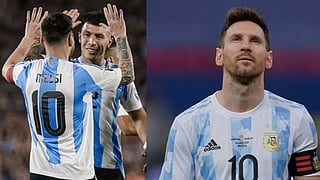
Lionel Messi has announced his retirement from international football this week, closing a 21-year chapter that began with a red card in Budapest and ended with tears on a New Jersey pitch. Between those two points lies one of the great sporting careers of any generation. The 39-year-old, who won his first cap in 2005, captained Argentina to their third World Cup title in 2022 and two Copa América triumphs.
His international career began with a red card in Budapest and ended with tears on a New Jersey pitch, bookending one of the greatest careers in sporting history.
Messi confirmed his decision on Monday by posting a photograph on Instagram of notes he had written on July 21, two days after Argentina’s defeat to Spain. In them, he said he was bringing his Argentina career to an end and wrote: “There’s not long left and chapters are coming to an end – and this is one that hurts me a lot.”
The death of his father, Jorge, in early August had only made him “more convinced than before”, Messi said. He had been visibly emotional during the World Cup and revealed during the knockout stages that his father was undergoing medical treatment.
Addressing Argentina supporters, Messi said the decision “hurts my soul” but that he knew it was time to step away. “I have emptied myself: now I have nothing more to give and, besides, there are great young players coming through who deserve to be [selected],” he wrote.
Messi’s decision marks the end of an international career that was once defined as much by disappointment as achievement. He briefly retired from international football in 2016 after Argentina lost to Chile on penalties in the Copa América final, his fourth defeat in a major final with the national team. At the time, the then-Barcelona forward faced criticism for failing to replicate his club form for Argentina, while comparisons with Diego Maradona were constant.
Messi led Argentina to their first major trophy in 28 years at the 2021 Copa América, scoring in the final against Brazil at the Maracanã. A year later, he was central to their World Cup triumph in Qatar, scoring in every knockout round and twice in the final against France.
“I take with me unforgettable memories and moments,” Messi wrote, bringing the curtain down on an international career that delivered Argentina its long-awaited third World Cup and established him among the defining sporting figures of his generation.
These are the eight moments that defined his legacy and people’s love for him:
Before any of it, there was a 17-year-old who hadn't even made his senior Barcelona debut, being courted by the Spanish federation to switch allegiances. Argentina's federation moved quickly, arranging a friendly against Paraguay purely to get Messi into the shirt before Spain could. He scored on debut in a 6-0 win, fittingly on the same ground where Diego Maradona once played his first game for Argentinos Juniors. It was a small, administrative decision that changed the course of football history.
Four years before he would carry Argentina to the World Cup final, Lionel Messi offered a glimpse of what was to come in Brazil. In the group stage of the 2014 World Cup, Messi scored twice against Nigeria in Porto Alegre, including a trademark curling finish and a low strike that restored Argentina’s lead after Nigeria had twice equalised.
The performance helped Argentina finish top of Group F with three wins from three, with Messi scoring four goals in the group stage. It was the kind of individual brilliance Argentina had come to depend on, as Messi took on greater responsibility for a side chasing its first World Cup title since 1986.
Before the trophies came the lowest point of his international career. Argentina lost a second straight Copa America final to Chile on penalties, with Messi skying his own kick in the shootout. He announced his retirement from the national team on the spot, exhausted by four finals and no title to show for any of them. He reversed the decision six weeks later.
Messi wasn't at his sharpest through the 2024 tournament, managing one goal and one assist while nursing injuries, and an ankle problem forced him off during the final itself. He watched the rest of the match in tears from the bench, and his teammates later said the sight of their captain hurting only sharpened their resolve to win it for him. Argentina lifted the trophy anyway, its third major title in four years, the golden era Scaloni had built now fully realised.
Argentina's qualification campaign under Jorge Sampaoli had turned into a genuine crisis, and the team needed a win away to Ecuador in its final qualifier just to make the tournament. Ecuador scored first. Messi answered with a hat-trick that many still consider his finest individual performance in an Argentina shirt, dragging a struggling squad over the line almost single-handedly. Commentators on the broadcast that night called him a genius.
The reception Argentina received when it played its first home match after winning the 2022 World Cup was unlike anything the Monumental had seen. Over a hundred thousand fans packed the stadium to greet the new champions, and Messi marked the occasion with a free-kick that also happened to be the 800th goal of his career. After years of being judged harshly by his own countrymen for a lack of international silverware, this was the night he was fully embraced as a national hero.
Argentina fell to Spain in his last match in national colours. He had already delivered the country its World Cup in 2022, so the defeat carried less of the sting Brazil 2014 had. He was 39, playing his second World Cup final in four years, in what turned out to be his final appearance for Argentina.
Messi added another landmark to his extraordinary career in 2023, winning the Ballon d’Or for a record-extending eighth time. The award recognised his decisive role in Argentina’s 2022 World Cup triumph, where he scored seven goals, including twice in the final against France, and became the first player to win the tournament’s Golden Ball twice.
The latest honour further cemented Messi’s place at the top of the individual game, extending his lead over Cristiano Ronaldo, who has won the award five times.
