- Entertainment
- Style
- Lifestyle
- Food & Drinks
- Tech & Auto
- Culture
Taha Ahmed’s immersive installation, ‘Drawn into two, which way home?’, forces one to reckon with a number of uncomfortable situations. To enter, one must separate the two halves of an arresting visage printed on a curtain. It is the compelling portrait of a beautiful woman, a Partition survivor, adorned in mid-century finery with her head covered demurely. Like her homeland, she has been cleaved in two.
Next, unknowingly, the viewer must wade through fine red dust lining the floor of the darkened installation containing photographs and other paraphernalia of survival, to create the proverbial bloodied footprints. Finally, one moves into a brightly lit room to see themselves repeatedly reflected – bloodied footprints and all – in strategically placed infinity mirrors. This discomfort is evocative of the intergenerational trauma brought on by the Partition of India and Pakistan in 1947.

“The point of this immersive experience is to reflect on the trauma of Partition and social divisions, as well as the collective memories of displacement and violence that have shaped today’s generation, our identity, and how these elements manifest in our daily lives amid political tensions, hatred and polarisation,” explains Ahmed, speaking of the installation currently on display at the Gallery at Penn College of Technology, USA. “The footprints and shoe prints on the floor represent the violence that took place in 1947 and how we are still metaphorically walking in the same shoes, not learning from history, and moving towards a society filled with fascism and religious hatred.”
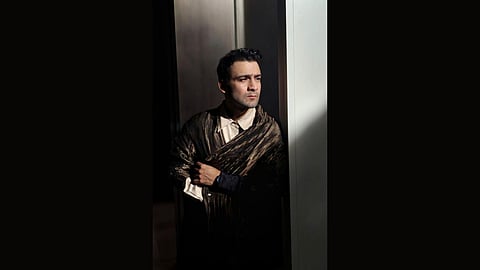
Delhi-based Ahmed, who originally hails from Lucknow, took to documentary photography at an early age precisely because it allowed him to show a mirror to society. For him, this visual art is a universal language with the power to facilitate a positive social revolution. As such, he uses it to showcase India’s unique pluralism, as well as its tenacity in grappling with its traumatic past and manifold socio-political issues. His work, however, does not restrict itself to a single medium. Apart from his thought-provoking docu-photo exhibits, he has worked as a still photographer on the sets of Netflix’s Khufiya directed by Vishal Bhardwaj, and the BBC miniseries A Suitable Boy, as well as with renowned brands like Rahul Mishra and Louis Vuitton. His most recent accolade was his inclusion in the Forbes 30 under 30 Asia list in 2024.
Tuning in from beautiful Thailand, where he is currently attending the Forbes summit, he thoughtfully responds to our query about wearing his roots on his sleeve. “Mira Nair once said if we won’t tell our own stories, no one else will. I feel a responsibility when I’m representing my community to honour their truth. Hence, this installation on the Partition of India and Pakistan in the US, is aimed at fostering conversation about reconciliation, identity and the dangers of forgetting the horrors of history. As an artist, I have the power to give voice to the South Asian narrative which needs to be heard in the western world.”
His project, ‘Drawn into two, which way home?’ does so aptly. The work was selected amongst 1,100 entries submitted by artists worldwide. It is spread across three rooms and uses audio, photographs, textile, thread, mirrors, scent and barbed wires to put across its message. Ahmed ardently believes that all the problems faced by the region of Punjab today – gun violence, drug abuse, or illegal trespassing – owe their origins to the Partition.
He explains with candour, “Through the project, I hope to promote empathy and cultural thought by challenging the colonial narratives around South Asian stories that the West has penned for the whole world. I aim to allow the region to reclaim its own voice.”
Ahmed’s personality and beliefs are certainly stamped across everything he does. “I only pick stories that resonate either with my childhood or with something I’m very close to or something that has affected me,” he shares, adding, “I’m very vocal in nature and very assertive of my ideology. I have strong opinions and believe that it’s important to express myself.”
In the past, this has resulted in projects where he photographed the Mukaish Badla artisans from Lucknow, a community driven to near extinction, with the aim of preserving their craft for posterity, and his childhood memories related to the art form. A playful iteration of it also emerged in the series ‘Displaced Hope’ where children were used as models around the ruins of Delhi’s Ferozeshah Kotla to depict the stories of djinns Ahmed was told as a child.
Despite his penchant for the past, however, Ahmed is unapologetically a product of his generation. He dons numerous hats and dabbles in multifaceted artistic practices with ease. He explains: “As an artist I never want to enter a comfort zone. I’m constantly asking myself – what’s next?” We look forward to finding out.