- Entertainment
- Style
- Lifestyle
- Food & Drinks
- Tech & Auto
- Culture
At the Shrine Empire gallery in New Delhi last December, Sajan Mani delivered a trance-inducing performance, scrawling the poetry of Poykayil Appachan—a Dalit activist and poet—onto every inch of white space, transforming writing into an act of reclamation and meditation.
“There was none on earth to write the story of my people,” Appachan lamented. Mani inscribed these words repeatedly, dancing with them, embedding them, quite literally, into fabric. “He [Appachan] was lamenting the ancestors who were killed as cows, as beasts,” he reflects.
Mani was a man possessed, channelling the spirit of his ancestors—their struggles and resilience through the visceral act of writing. Dalit histories are rarely found in recorded archives, either left undocumented or preserved only through the lens of colonial regimes. In the voice of the haunted, Mani wrote Appachan’s poems for hours, covering the stark white space with the curling script of Malayalam —desirous of communication.
Mani’s fascination with the body as a vessel of memory and resistance underscores his artistic practice, evident in this first solo show of his in India. “I am really interested in the question of body and space,” he explains. “Not only the human body, but also more-than-human bodies.”
The exhibition’s title, ‘Multiple Legs of a Historically Wing-Chopped Bird’, is drawn from a different poem by Appachan, in which abandoned children gaze skyward and find solace in the descent of a pariah kite. “Each room represents the limbs of a pariah kite,” he says, emphasising the interconnectedness of everything.

The video installation I Am the River (2023), presents the slow, silent flow of the Barapole river in Kannur, Kerala. It reflects on the river’s body—its banks, mangroves, crabs and birds, and draws inspiration from environmental activist Kallen Pokkudan, who dedicated his life to preserving mangrove forests. Accompanying autobiographical subtitles, such as “I was born out of Western Ghats or maybe from the star dusts” reflect Mani’s exploration of identity and ecology.
As a Dalit artist from India, now living and working between Kerala and Germany, Mani grapples with the politics of visibility. “In India, black is coded as something lower, something tied to Dalit, tribal and indigenous identity.
So, what I faced mostly is this kind of question: ‘How come you are here?’
“I’ve been nearly arrested at railway stations, faced interrogations in airports,” he recalls. These experiences shaped his critical inquiry into how bodies occupy and navigate space. “What is this friction?” Mani asks. “I realised I’ve been performing all along.
“After some such experiences your body will understand—it’s a bodily understanding, sensorial understanding,” he reflects. “I think I am the other in both cases (India and Germany).” Yet, Mani chooses to distance himself from identity politics, striving instead for nuanced dialogues that resist binary narratives.
This tension between movement, memory and imposed boundaries comes alive in Mani’s performances—both recent and past. “In some of my early performances, like the Caste-pital [2017], I was carrying this wooden plough which we used in the fields. I became the cow; I became the body of a cow.”
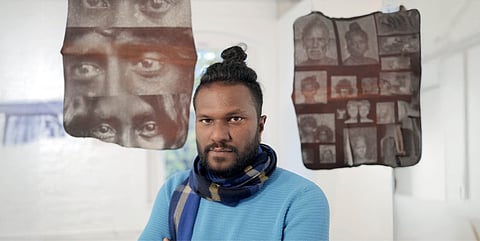
Mani’s art weaves the personal and the political, transcending continents, languages and histories. In this exhibit, spectral images—captured through the coloniser’s lens—are reclaimed as tools of resistance. In the series of six images titled Transmigratory Whispers, Dalit figures appear painted on archived pages of European missionary reports and dictionaries. Other works are displayed on thick rubber sheets—a material deeply tied to Mani’s own history and a potent metaphor for the enduring legacy of colonial exploitation. Inscribed on these sheets are words from early colonial linguistic records, a recurring motif in Mani’s exploration of language, power and history.
Born in Kannur, Kerala, to parents who worked on rubber plantations, Mani internalised the laborious process of latex extraction—a process that left a second skin of rubber on workers’ hands. At first, it was a nostalgic memory: “The smell, the elasticity, the skin—everything was part of my childhood memory,” he says. Later, after he had read and researched more, he connected the rubber industry to its colonial roots. “Rubber came into my life through British colonisation, but it originated as Indigenous knowledge from Mesoamerican cultures,” he notes. This realisation transformed his understanding of his own body as a vessel of layered histories.
Like the most interesting journeys, Mani's path to art wasn’t direct. He arrived at it via a circuitous route through literature, journalism, political cartooning, several odd jobs and, like many others from Kerala, a stint in the Gulf—experiences that lend his work texture and depth. A turning point came in 2012 with the inaugural Kochi Muziris Biennale—a politicised event in Kerala—where Mani defended the event against critics in a viral Malayalam article, carving his identity as a politically engaged artist. In the Biennale’s second edition, he put up an advertisement-style banner that read: “My Grandfather Is Not an Artist,” a jab at the elitism of the Indian art world. Today, Mani feels differently about that assertion, declaring that his grandfather was, in fact, an artist—a reflection of his ongoing exploration of the blurred lines between art and labour. As he explains, he is really interested in “the aesthetic of labour” and in finding “the blurry line that separates art from not art”.
Mani’s artistic journey eventually led him to Berlin, where he earned a master’s in Spatial Strategies at the Weissensee Academy of Art. There, he began connecting Kerala’s history with European colonial legacies—particularly scientific and missionary endeavours—revealing the entangled histories that shape contemporary realities. One such figure Mani frequently engages with is Hermann Gundert, a German missionary who compiled the first Malayalam-to-English dictionary and whose grandson was writer Hermann Hesse. Mani uses Gundert’s work to explore how colonial-era linguistic documentation has shaped contemporary understandings of Kerala's history. “Even though we’re looking into specific histories, it’s part of a larger history,” Mani asserts.
A globally acclaimed artist, Mani became the first Indian to receive the Berlin Art Prize in 2021. His work has been showcased at major biennales, festivals and exhibitions worldwide, including the Kochi Biennale, Dhaka Art Summit, Vancouver Biennale and Haus der Kunst in Munich. He has received prestigious fellowships and grants from institutions such as the Berlin Senate, Akademie Schloss Solitude and Max Planck Institute. In 2022, he was awarded the Prince Claus Mentorship Award and named Breakthrough Artist of the Year by Hello India Art Awards.
Yet, Mani’s work is not confined to galleries; it extends into public discourse, opening space for critical dialogues. For instance, in collaboration with Kottayam-based historian Vinil Paul, he is publishing colonial-era photographs from German archives in the Malayalam magazine Mathrubhumi Azhchappathippu. “These materials allow students and researchers to excavate, imagine and expand their understanding of history.” This initiative is also part of his research project, ‘Wake Up Calls for My Ancestors'.
Mani reflects on the challenges of engaging with such archives, particularly photographs that document subjugation. He cites an 1854 image of Dalit women denied the right to cover their breasts. “Is it about nudity, or the political questioning against that?” Without local archives, such images serve as historical evidence of subjugation—but how to approach them remains a question.
Then there are the racial profiling photographs, where scientific racism used images to assert racial superiority. “Which photograph do you choose? The eyes? Where do you focus?” For Mani, the act of selecting and interpreting these images is deeply political. By isolating faces from group photos, he reimagines erased histories.
European archives are extensive, but difficult to access. “It was a really difficult process, but some are now being digitised,” Mani says. “Others, especially in Berlin, remain inaccessible. Their understanding of what they have is limited and burdened by guilt and confusion, lacking frameworks to accommodate this knowledge.” He critiques the narrow lens through which Indian archives are often viewed. “For them, Indian archives mean the Mughal Empire, Hindu and Buddhist relics, or jewels like the Kohinoor. But we are more interested in the labour, its beauty and its aesthetics.”
Mani's work examines how colonial and caste-based histories shape the ways bodies are perceived and controlled. In September 2023, he was the target of a racist attack in Berlin—an act of violence that reflected the same dynamics of exclusion and marginalisation that his art engages with.
While sitting at a bus stop with a friend, Mila Panic´, a Bosnian-born artist and stand-up comedian, Mani was attacked from behind by a man wielding crutches. The assault left him with 33 stitches on his head and one ear had to be stitched back into place. “It’s a very difficult topic,” Mani shares. “I’m still in therapy, but support isn’t easy to find in Europe. Most therapists are white, and their understanding of our world is limited.”
He adds, “When I go back to Berlin, I always feel anxious in public spaces because the attack happened in daylight, in a public place. The memory is very physical”.
Mani’s experience with Germany’s judicial system was equally disheartening. “In court, I was my own lawyer,” he recalls. The case focused on the attacker’s psychological issues, side lining Mani’s trauma. “It became about his rehabilitation, not the attack or me,” he explains. He was classified as a witness, not a victim, and felt retraumatised by the process. “The police looked at my body as if I had just been
in a fight,” he says.
Despite his contributions as an artist and taxpayer in Germany, Mani feels let down. “I was attacked in front of my rented studio while waiting for a bus. Where is the responsibility of the State when I ask them to protect me?” In court, he cited the German constitution’s clause on bodily rights and justice. “But it felt meaningless,” he says. The lack of compensation or formal acknowledgment of his suffering only deepens his sense of alienation.
Yet, Mani finds resilience in his art. “I have my own ways of overcoming such experiences,” says the artist, who was awarded the prestigious Villa Romana Prize 2025—one of Germany’s oldest art award—and has recently begun his residency there. “Art is also a kind of therapy, a meditation for me."
To read more stories from Esquire India's March 2025 issue, pick up a copy of the magazine from your nearest newspaper stand or bookstore. Or click here to subscribe to the magazine.