
- Entertainment
- Style
- Lifestyle
- Food & Drinks
- Tech & Auto
- Culture

As a child, raised on a healthy diet of The Ramayana and The Mahabharata, I remember one story with distinct clarity, simply because it meant so much to me as a meek, objectively mediocre child who everyone worried would amount to nothing - it was the tale of a poor, old woman, looking out of her shabby hut the night Lord Rama returned to Ayodhya after his 14-year exile. His entire kingdom was lit up with diyas and lamps, dressed in rangolis and flower garlands. There were drums, flags, banners and conches. Seeing all this, the lady worried that her hut was the only spot of darkness in this otherwise brilliant display of love and adoration.
All she could afford was a small diya with just enough oil to last the night. And yet, because she gave all she had and because love encompasses all, her tiny hut shone the brightest. This story, in retrospect, was perhaps my grandmother’s way of telling me that God didn’t care if I didn’t have much - all that mattered was the size of my heart and that even the humblest diya could end up shining the brightest.
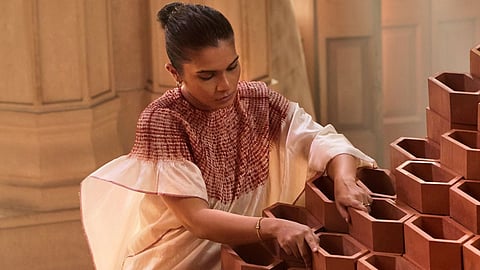
Standing in front of Doyel Joshi’s ‘Passing the Light’ - a monumental installation of 4,500 hand-sculpted terracotta elements at The Jaipur Centre for Art last month, it was this story that came to mind. Its name also reminded me of another recent retelling of The Ramayana called The Living Legend, where one woman’s attempt to light the way for Lord Rama’s entry into Ayodhya on a dark, moonless night, inspires the entire city to do so - hence, essentially ‘passing the light’ from one house to the next.
“We all know the diya. It carries so many personal associations, memories of home, celebrations, the smell, people we've celebrated with, the rituals we've inherited. But when you encounter 4,500 forms coming together as this enormous, undulating landscape, your relationship with that familiar object may change. From a distance, you're looking at something architectural, and as you come closer, one may begin to see and feel the familiarity of terracotta,” Joshi tells me later, when asked what she hoped would be people’s takeaway from the installation. “I think we wanted people to move between those two experiences. To feel the scale of something collective, but also the intimacy of a single gesture. In many ways, that's what celebration means to us too. Something deeply personal that only comes to its full expression with other people.”
‘Passing the Light’ is as much her success as it is the Roman High Jeweller, Bvlgari’s, which commissioned the piece in the first place. Joshi had earlier revealed that the creative freedom she enjoyed throughout the process showed her the brand was interested in a genuine relationship with India and its artists. The brand and the artist couldn’t have chosen a better venue to stage the reveal than the Jaipur Centre for Art, which, since its inception, has earned a reputation for successfully promoting dialogue between the old and the new.
“Jaipur has an extraordinary legacy of art, architecture and craftsmanship, and the City Palace sits at the heart of it. The Jaipur Centre for Art was created to bring contemporary practice into conversation with that heritage, so the past is seen through the lens of the present. ‘Passing the Light’ embodies that exchange, bringing traditional materials and craftsmanship together with a contemporary artistic vision. We've also worked with Doyel Joshi before, so the connection felt natural on many levels,” shares Noelle Kadar, co-founder, Jaipur Centre for Art.
Joshi, like most artists, will tell you that for her, art is a professional venture but that it is also deeply personal. While creating ‘Passing the Light’, she and her husband, fellow artist Neil Ghose Balser became parents to a baby boy, Baarish. “As the installation took shape over months, the question of what we choose to keep and pass on grew bigger for us,” the artist shared on Instagram, echoing what she had told me earlier: “The interest wasn't in 4,500 identical objects, but in bringing an idea to the table that would achieve its final form through the knowledge, empathy, technique and limitations of the material and people who master it. That individuality goes beyond the hand that shapes the clay . . . It was as much a conversation between minds and feelings as it was between hands.”
It is a conversation that Kadar herself is deeply invested in. On being asked what she would tell young people who stay away from art because they fear they won’t understand it (after all, the art world can be terribly elitist and exclusionary), she says that they should give themselves a little more credit. “Contemporary art mirrors where we are, in real time or in recent history. It may contextualise the past, but if anything, young people should understand and resonate with the work being made now better than anyone.”
What young people will experience when they stand next to ‘Passing the Light’ is beyond all of us. But for me, personally, the installation, mammoth though it may be, was a reminder that sometimes the only way to dispel the darkness, is to light a single diya.