
- Entertainment
- Style
- Lifestyle
- Food & Drinks
- Tech & Auto
- Culture
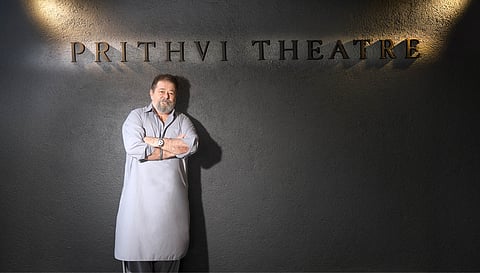
The lights dim. A hush falls over the audience. On this stage, for forty-seven years, generations have wept, laughed and been moved to silence. Behind the proverbial velvet curtains, a lineage continues... not of celebrity, but of stewardship. Kunal Kapoor, trustee of Mumbai's hallowed Prithvi Theatre (and son and grandson of cinema stalwarts, Shashi Kapoor and Prithviraj Kapoor respectively), doesn’t just protect the structure in which it lies; he preserves a way of being. Guarding its sanctity with unflinching devotion.
“It was never about us,” he says, frankly in his trademark gruff, unfiltered tone. “It’s not the Shashi Kapoor Theatre, or the Kunal Kapoor Theatre. It’s about the performing artists who walk through those doors.”
That ethos runs through everything about Prithvi. Founded in 1978 by his parents, Shashi Kapoor and Jennifer Kendal as a home for professional theatre, Prithvi’s story is one of quiet defiance against the noise, the vanity, the transactional. Kunal, then nineteen, had just left for drama school in England. “I wasn’t here,” he admits. “So my involvement of hanging around the theatre at the time was during a holiday period, if I came back.” What he didn’t realise then was that his life would eventually circle back to that stage forever.
When Jennifer passed away in 1984, Kunal took on a more active role at the theatre, working alongside his father for decades. “I grabbed Feroz Abbas Khan and used him as a prop because he’d also grown up at the theatre. He was around when the theatre was being constructed. And he understood the value system, the ethos behind what we are, how we are...”
In time, he got his sister, Sanjna, more actively involved. “She’s beautiful, bubbly, has this great personality—the press loved her,” he says, fondly, “Which was good, because she became the 'face' of it, so to speak. But I refused to do that. I said, I’ll stay in the background. I was the trustee—every decision was made by my father and I till the end of his life. And now, of course, with my son, Zahan.”

Even today, he resists the spotlight. Even while we set up for the shoot, there’s a hint of reluctance to stand in front of the camera.
“I’m absolutely thrilled to talk about what the theatre does and what we’re trying to support,” he says. “I’m not even active on social media. You’ll notice there are no paparazzi at Prithvi, never have been. Because that’s not who we are. The theatre isn’t a red carpet. It’s a refuge.”
And refuge is precisely what Prithvi has become—for artists, dreamers, audiences and generations of theatre lovers who come for connection. The theatre has just kicked off its annual festival, running from November 1 to 17, featuring an eclectic line-up of productions: Yuki Ellias’s A Fish Ate My Cat; Eden Creek, adapted by Kaizaad Kotwal and co-directed by him and Mahabanoo Mody-Kotwal; A Perfect Time to Panic, written and directed by Akarsh Khurana; and Ambaa (an adaptation of Lysistrata), directed by Atul Kumar. Complementing the theatrical showcases are a series of captivating performances, including a sitar recital by Ustad Shujaat Husain Khan, Leela: The Divine Play in Bharatnatyam, Timeless Expressions in jazz, and more—a celebration of art in all its resonant forms.
As a professional ad man and with a familial lineage such as his, Kapoor has also spent his life orbiting the world of scripts and spotlights, but was never one to crave them. As a boy, he was taken by his mother to watch a film of the Bolshoi Ballet’s Swan Lake at Regal Cinema—his first brush with the transformative power of performance. Later came plays by Satyadev Dubey and Mahendra Joshi in modest school auditoriums, watched from wooden benches. “It’s never been one lightning bolt moment,” he reflects. “It’s a progression. Theatre seeps into you.”
As for Prithvi, “The land was bought by my father,” Kapoor says, firmly. “Not given to us by some government or running grant. He bought the land from the Bajaj Trust—two plots [one where the theatre’s built and the other where we now sit for this interview, Prithvi Adda].”
Kapoor’s sense of integrity extends to every corner of the space. “We’ve always been clear,” he says. “No fashion shows, no sangeets, no corporate events. Only performing arts. If you’re not a theatre company or performing artist, you don’t get this stage.” His tone softens when he adds, “The only time I’ll go on stage is to introduce the opening act at the beginning of the Prithvi Festival; to thank everyone for coming, or at the annual Prithvi Memorial Concert where the late Zakir Hussain performed for nearly 40 years.”
The math of Prithvi’s legacy is staggering: 300 active days a year, averaging over 640 performances on a single stage with 83 to 84 per cent occupancy—all run by a staff of just fifteen. Kapoor notes, “Naseer [Naseeruddin Shah] once said our biggest contribution was making going to the theatre a habit again. People come to the box office and say, ‘Aaj kya hai?’ They don’t even ask what play, they just want to be here.”
What makes that habit endure in an era of infinite screens and shrinking attention spans? “Because it’s live,” he says, simply. “When you watch something on your phone, you’re alone. In a theatre, a Hindu, a Muslim, a Parsi, a foreigner—they’ll all laugh and cry together. That’s the real India. That’s what my grandfather Prithviraj Kapoor called the greatest temple. And the beauty of theatre performance is once it’s had its run, it’s gone—unlike on a TV or mobile screen, where you can watch things indefinitely.”
He smiles as he remembers how countless Padma Bhushan and Sangeet Natak awardees once walked here. “The list is amazing,” he says. “And there are stories for days! People who’ve slept backstage without my knowledge, who are today’s successful directors and producers. Anurag Kashyap used to sleep behind the theatre at one stage. Aamir Khan worked as a stagehand with Mahendra Joshi. That’s what the theatre is supposed to do.”
If the world has changed, so has Prithvi’s family, now entering its third generation of caretakers. “Zahan is a trustee, very involved in curation and PR. My daughter Shaira is a production designer—she does all the decor, and designed the set for The Queen (part of the festival, written by Aditya Rawal and directed by Daniel D’Souza). They’re both completely invested.” Then, with characteristic modesty, he adds: “The legacy isn’t a burden. It’s a value system. You don’t own culture; you nurture it.”
As for the conversation around privilege, he bristles slightly. “Please explain to me a profession in India where the children have not taken after their parents?” he says. “How dare they call that nepotism? In our family, we grew up surrounded by art, theatre, books, conversations. That’s not privilege—it’s culture. And even then, it’s not a guarantee. I wanted to be an actor. Did I make it? No. Did my brother or sister? No. But industrialists continue being directors of their companies forever. So don’t tell me it’s a given.” Kapoor pauses, his voice softening again. “We were a close family. We ate together, holidayed together. My father never worked Sundays; those were for the family. And my mother loved Indian history, particularly the Mughals and the Raj. So even in school, I was two steps ahead because I’d already read it.”
He pauses and says, “You go to some houses and there are no books. You come to mine and there aren’t enough shelves,” he laughs. “That tells you everything.”
Perhaps that’s what gives Prithvi its gravitas—a sense of lineage that transcends fame and fortune. For Kapoor, it’s not about ownership but about guardianship. “It’s not my vision,” he insists. “It’s my parents’ vision. I’m just keeping it alive.”
And nurture it he does, often till dawn. “Last night, I shut down the computer at five in the morning,” he says, with a laugh. “Then Amazon started sending OTPs at seven-thirty.” He shrugs. “But it’s worth it. What’s fulfilling is to see the audience react and to see young writers evolve. That’s the joy.”
There’s no mistaking the reverence with which he speaks—not the sentimental kind, but the grounded, practical reverence of a man who’s done his best. “It’s not glamourous work,” he says. “It’s hell sometimes. But it’s also romantic.”
And in that romance lies the truth of Kunal Kapoor. A man who could have chosen the lushness of insurmountable fame that his family has endured for generations, but instead, chose to uphold a legacy that honours them. Who reminds us that even in a city obsessed with spotlights and celebrity, the real stars are often behind the curtain... keeping the lights on.