
- Entertainment
- Style
- Lifestyle
- Food & Drinks
- Tech & Auto
- Culture

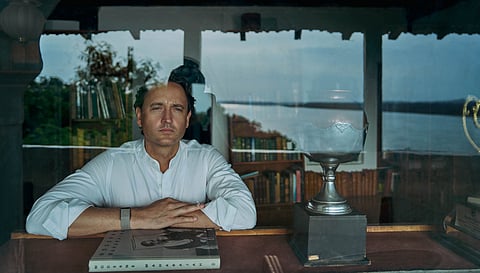
Yeshwantrao Holkar is looking luminous—quite literally. We’re at the private residence at Ahilya Fort in Maheshwar (or the ‘Captain’s Quarters’, as noted on the navy-inspired plaque at the door), prepping for our final shot, when the evening sun floods in through the jharokha-style windows, setting everything ablaze. The light grazes the floor-to-ceiling bookcases and glints off the globe pendant hanging from the rafters. Dressed in crisp white button-down and grey pleated trousers, the 42-year-old scion of the Indore Royal family stands like an Auguste Rodin sculpture, aquamarine eyes fixed on a pewter trophy inscribed Holkar Games—Ahilya Fort, Maheshwar 2014, with a tongue-in-cheek engraving: “Who remembers 2nd place? The odds were not in your favour!”
I’m standing opposite a tiger-upholstered armchair, its yellow faded to creamy white where generations of Holkars have rested their arms. A canvas chair to my right jostles for space with an elliptical bike, joining the television and AC in puncturing the otherwise heritage, library-like atmosphere. These modern intrusions seem at odds with the accoutrements that dot Holkar’s man cave: a 1920 edition of Jude the Obscure from Macmillan & Co., antique hand-painted knob pulls, an oval gilt mirror above the central bookshelf and cut-glass bottles tucked into wicker baskets.
“A lot of the furniture is turn-of-the-century, and we’re blessed to have Radheshyamji, who has been with our family for 50 years,” Holkar says, referring to Radheshyam Vishwakarma, Head of Carpentry Conservation at Ahilya Fort. Holkar has worked closely with him to repurpose and conserve furniture inherited from his great-grandparents, keeping the fort rooted in its history.
In my room, a finely carved wooden settee with turned legs sits against a wall with niches and an arched mirror. What intrigues me most is a brass hook shaped like a stylised human face, likely made using the traditional Dhokra (metal casting) technique. Outside the reception, a large wooden chest on small wheels echoes the deeply carved teak one at the private residence, complete with a hefty brass lock plate. “They’re from my great-grandfather and great-grandmother’s time, and he’s been able to repurpose them. No atelier in the world could recreate these pieces.”
Raised in Mumbai by his parents, Richard and Sally, Holkar attended the American School and later studied in Pennsylvania, spending years abroad working as a hedge fund analyst. Yet it is here that he seems most at ease, surrounded by the affection of family retainers who have known him since infancy. Kuntabai, enduring and regal as the fort itself, is Head of Housekeeping at the Ahilya Fort Heritage Hotel and has been integral to Holkar’s life. His earliest memories of the fort include a besan bath, administered by Kuntabai and her father, the INA runaway and “leading expert in the world at cutting onions,” head chef Raja Ram, aka Dabadoo. “I remember how awful it was,” Holkar shares, laughing. “So painful and uncomfortable, but it instantly transported me into a rural, traditional way of living compared to my life in South Bombay.”
The late Raja Ram was Holkar’s first introduction into the world of cuisine. “He knew 17 ways to cut onions and ran a very tight kitchen. I remember sitting next to him as a kid as he doled out instructions from his patla (low stool)—it was fascinating. Nobody was allowed to touch his masala dabba; only he knew what spices went where. The food had to be brought to him, sprinkled and sent back. If anybody from outside the kitchen came to see how the meal was made, he wouldn’t show them what masala he put in. There was always some secret thing,” Holkar recalls.
And it wasn’t just a love for food that Raja Ram imparted—it was heritage. He’d tug the young royal by the ear during visits to the fort, ensuring he understood the significance of his lineage and the legacy of Devi Ahilyabai, his great-great-great grandmother who ruled Indore from 1765 to 1796. “A wonderful man with a sharp tongue,” Holkar says of his cherished Dabadoo.
We discuss the fabled stories that still shape Maheshwar—how, instead of crushing dacoits who plagued her trade routes, Devi Ahilyabai brought them into her fold, turning criminals into model citizens. “Her whole approach was getting to the root of the problem and, out of difficulty, finding a better solution,” he says.
That philosophy—finding solutions that are both pragmatic and empathetic—guides Holkar today as he stewards the fort. “In a heritage setting, trying to apply modern solutions often leads to clashes,” he says, explaining: “Take the fort walls—they’re all made with lime mortar. It takes longer to set, is more difficult to make and costs more, but unlike cement, it strengthens with age and adjusts slightly. Cement does not. Fixing a wall here with cement would eventually cause cracks. It’s almost as if the fort is rejecting modernity.” In Maheshwar, where temperatures can soar close to 50°C, air-conditioning is a luxury. Yet Maratha structures were designed to breathe—to draw in cool air and expel heat. Holkar is bringing in experts to enhance cooling in eco-friendly, energy-efficient ways, aligned with traditional methods.
Later, over masala soda as the sounds of the Narmada aarti drift in from the ghats below, Holkar reflects on how prescient Devi Ahilyabai was when it came to water. “Many know her for the temples she built, but if you go to any small village in Maharashtra and ask who built the wells, they’ll take her name,” he says, admiring how she combined strategic thinking to provide basic needs with the custodianship of faith.
“Many of the temples would have a kund in front of them, and they were kept clean, vibrant and active. Not only because people had to use it for daily life but because there was a spiritual attachment to it,” he says, while offering me a moong dal pakoda.
It’s been around two hours since we wrapped the shoot. We’d spent the whole day with Holkar, from breakfast in his organic garden to shooting in the Lingarchan Courtyard, with its weathered stone basin and trickling fountain. Here, I notice an incongruous detail that underscores Holkar’s efforts to preserve the fort’s essence while adapting it to the 21st century: a widemouthed terracotta pot, pitted and blackened by age, now housing a modern LED bulb. This isn’t the only example. Outside the poshakwada, amidst the ancient, gnarled neem tree, a brass urli brims with fresh marigold petals, surrounded by a ring of cannonballs—once defenses against outsiders, now part of a ritual welcome.
We pause as he asks for more soda and stirs his drink. In the absence of contemporary lighting (the fort only uses diyas and oil lamps in the evening), a cool breeze drifts in from the Narmada, leaving us all languid. It’s peaceful. I notice the stars—over 50 of them, a rare sight for city folks. I mention this to Holkar, and he smiles. “When we were kids, the bijli would go out around 9pm for an hour or two. Ironically, those were the most beautiful moments—you looked up and saw the entire Milky Way! We had a telescope and could spot Saturn’s rings and often spent the entire night spotting constellations. Now, of course, there’s bijli 24/7, which is great. But sometimes, you wish people would turn a few lights off, you know?”
They say you can’t step into the same river twice, but for Holkar, the fort is both a responsibility and a return to simpler days—when he’d boat on the Narmada with his Labrador Bentley and play fetch in the river. He recalls his favourite spot beside the Baneshwar Temple—a rock downstream that was mostly submerged, with just three to six inches above water. “Sitting there, looking downstream at the Sahastradhaara and seeing this beautiful river flowing beyond you. You know when people talk about looking at the stars and feeling small in a good way? That’s how I felt. The divinity of this river is so pure and simple, and you are just one pebble in the middle of it. It’s grounding, humbling, and I’m very grateful for that experience,” he says.
And that is the essence of this space, and why he cherishes it. It has taught him that home isn’t just a place, but a way to reconnect with your values and purpose. “You cannot anchor yourself to one place or time,” says Holkar, who splits time between Maheshwar and Mumbai, where his wife Nyrika and their two children reside. “What you can do is ground yourself in a mindset and a purpose. That defines you, and it’s from there that you draw your sense of identity. Because all of this keeps changing, right? Our lovely sky with the Milky Way is now drowned out by floodlights. These walls that were built around 300 years ago will collapse one day, and the people you work with will retire.
“This place has taught me that home is a way of living because I have seen so much change here, yet every time I step through the gates, I feel a sense of purpose,” he says.
As we head to dinner, the scent of Holkar’s Vetiver by Guerlain and the fort’s citronella our silent companions, it strikes me that his sanctuary cannot be reduced to a single room or an assemblage of objects. For Holkar, it is the fort itself—ever changing, ever breathing, and still, incredibly grounding.
To read more stories from Esquire India's October 2025 issue, pick up a copy of the magazine from your nearest newspaper stand or bookstore. Or click here to subscribe to the magazine.