
- Entertainment
- Style
- Lifestyle
- Food & Drinks
- Tech & Auto
- Culture

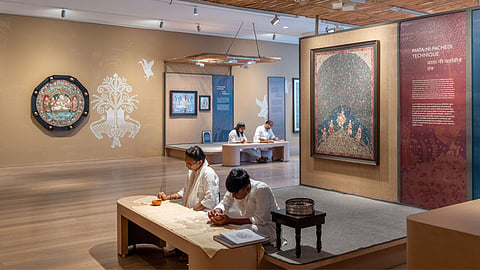
The boy couldn’t have been more than 13. When we meet him, he’s dipping his bamboo kalam into a bowl containing a mixture of iron rust, jaggery and water. We’re at the Art House in the Nita Mukesh Ambani Cultural Centre, watching him work on a Mata-ni-Pachedi artwork. He’s just finished filling in part of the goddess’s hairline and is starting on the eyes—it’ll take him another three months to finish the entire piece.
“I have been doing this since I was eight,” he says, smiling. This skill has been handed down over generations, and there’s such happiness in his voice - that unique sense of joy when your purpose aligns with your skillset.
He is one of the many artisans I interacted with at NMACC’s latest art exhibit, titled Bhakti: Krishna’s Grace. Curated by Ashvin E. Rajagopalan, the four-storey exposition celebrates artworks and crafts that express the Vaishnavite form of devotion to Krishna. But to me, Bhakti: Krishna’s Grace is a celebration of humanity’s deep-seated desire to understand itself. It is an ode to our devotion to meaning, cognitive ability, language, and the desire to leave behind a trace of ourselves long after our soul exits our earthly form.
Take the transition from wooden to stone temples, for instance, which is beautifully explained on the third storey of the Art House. “Wooden temples, though spiritually potent, were vulnerable to fire, decay, and the elements. In contrast, stone symbolised durability, stability, and legacy,” it reads.
The move to stone was not merely technical, however. It reflected our innate aspiration to defy the impermanence of our lives and to carve out a space where memory and meaning meet. Turning the ephemeral into the eternal—to embed divinity into the very landscape of the earth.
In that sense, Bhakti: Krishna’s Grace is not so much about God as it is about how mankind sees himself in the divine. Where do we fit in? How do we remain? Through devotion, yes—but also through sheer force of will. This is why we rejoice in carving out veenas from sandalwood. It is why we create marvels like the Vaikuntha Perumal Temple, which codifies the teachings of the Bhagavad Gita and the Bhagavata Purana in stone.
The exhibition seeks to honour human devotion across all four levels of NMACC’s Art House, from the top floor downwards. Tat Ekam - In the Beginning Was One reminds us that, at the end of the day, we are all one—expressions of the same cosmic entity. The Temple charts a timeline of mankind’s relationship with places of worship and the cosmological design of early Indian temples. The Crafts Village is a personal favourite—here, local artisans from across India demonstrate age-old crafting techniques inspired by Krishna devotion. These master craftsmen will reside in Mumbai for 51 days, bringing traditions to life in real time and offering visitors an intimate encounter with practices that have shaped India’s visual and material culture.
Finally, the exhibition concludes with The Art on Level 1, which showcases over 50 rare artworks and sculptures that offer an unprecedented opportunity to closely engage with India’s spiritual heritage.
Having visited the exhibition twice, however, I keep coming back to the story of Āṇḍāḷ, the devotee turned divine consort. Her story, written on the walls of the Art House, truly encapsulates what the exhibition stands for - not just the divine’s grace towards us, but our reciprocation of that love.
Āṇḍāḷ and Bhakti: Krishna’s Grace remind us that true devotion can only be achieved through love so total that even God responds.
The presentation is open to the public from June 20 through August 17, 2025.